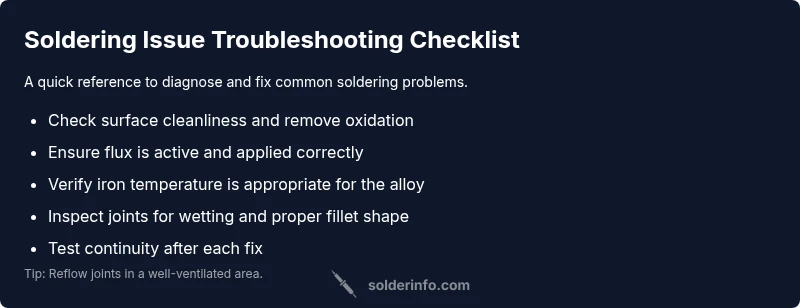
Soldering Issue Troubleshooting Guide
Urgent, practical guide to diagnose and fix common soldering issue problems across electronics, plumbing, and jewelry. Learn quick tests, root causes, step-by-step fixes, and safety tips for reliable joints.


Most soldering issues stem from poor wetting, dirty surfaces, incorrect heat, or contamination. The quick fix is to clean surfaces, re-tin the iron tip, apply fresh flux, and verify joints with a steady melt and a bright, smooth bead. If symptoms persist, follow the diagnostic flow in the body to identify root causes and fixes.
What is a soldering issue and why it matters
Soldering issue is a broad term that covers joints that won’t wet, heat-affected zones that crack, or seams that leak. A reliable joint must form a flawless bond between metal surfaces, with proper wetting, braze or solder flow, and a strong mechanical hold. According to SolderInfo, the most persistent problems arise from surface contamination, oxidation, or incorrect heat management. In electronics, a marginal joint can introduce intermittent faults; in plumbing, a weak seam may leak; in jewelry, a dull solder line can crack with movement. This guide focuses on diagnosing and fixing soldering issues quickly, safely, and in a way that reduces the chance of recurring problems. The aim is to restore reliable conductivity and mechanical strength while protecting component integrity and board traces. If you detect burnt flux residue or overheated copper, stop and reassess; damage may require component replacement.
Visual cues of a failing solder joint
Numerous telltale signs signal a soldering issue. Look for dull, gray, or matte surfaces instead of a bright bead. Cracked or fractured joints often indicate a cold joint, while excessive solder that creates bridges can short adjacent pads. A joint that looks glossy yet shows high resistance on a multimeter may suffer from poor wetting. Wetting is compromised by oxidation, residue, or contaminated flux. In plumbing, leaks at seams indicate insufficient solder or poor flow; in jewelry, a crack under movement suggests a brittle joint. Recognizing these cues quickly helps you prioritize the right fix and avoids unnecessary replacements. In all cases, confirm with a continuity test or pressure test as appropriate to the project.
Tools and safety basics you should never skip
Before you touch any joint, assemble a safe toolkit: a temperature-controlled soldering iron, rosin-core or water-soluble flux suitable for the alloy, a brass wire sponge for cleaning, flux brush, desoldering braid, and a good magnifier if you work on dense circuit boards or fine jewelry. Use eye protection and ensure good ventilation when flux fumes are generated. Wear anti-static equipment for electronics and avoid working near flammable materials when performing plumbing or jewelry tasks. Temperature control is non-negotiable: too hot causes oxidation and damage; too cool leads to cold joints. Keep your work area organized to avoid accidental burns or lost components.
Core diagnostic mindset: approach every symptom methodically
Start with the simplest explanation. If a joint looks dull, assume oxidation or dirty surfaces and rework with proper flux. If a joint conducts poorly, verify heat delivery and surface preparation first, then inspect for bridging or lifted pads. Use a stepwise approach: clean, flux, reflow, test, and iterate. Document each fix you try so you can identify what actually resolves the soldering issue and avoid repeating the same missteps. Always consider whether the problem is in the material (flux, solder alloy), the tool (tip condition, temperature), or the process (technique, hold time).
Root causes behind the most frequent soldering issues
Common culprits fall into four buckets: surface prep, heat management, flux and alloy compatibility, and physical damage to pads or components. Surface contaminants like oil, fingerprints, or oxidation reduce wettability. Heat mismanagement—overheating or insufficient heat—causes dull joints or cold joints. Flux choice and age, plus incompatible solder alloys, lead to poor wetting or brittle joints. Finally, physical damage such as lifted pads, broken leads, or corroded traces can mimic simple wetting problems. In jewelry and plumbing, corrosion and age-related wear can worsen joints without obvious signs of failure. Understanding these root causes helps you choose the right corrective action, often a combination of cleaning, flux reapplication, and reflowing with correct temperature.
Step-by-step fixes for the most common soldering issue: cold joints and poor wetting
A cold joint occurs when the solder fails to form a proper fillet due to insufficient heat or dirty surfaces. Start by cleaning the joint area with isopropyl alcohol and a brass sponge. Apply a small amount of flux and re-tin the tip. Reheat the joint with steady, even heat, ensuring the solder flows smoothly to cover the pad and lead without forming bridging. Inspect the joint for a shiny, smooth fillet; if still dull, reflow again after cleaning. For through-hole components, gently wiggle to check for reliability. Finally, test the circuit with a multimeter to confirm continuity and absence of short circuits. If the joint continues to fail, consider replacing the component or board area to rule out hidden damage.
Diagnosing flow: taking a systematic approach to symptom → diagnosis → solution
Use a flowchart mindset: pick a symptom, propose a diagnosis, apply a fix, verify, and iterate. Start with the simplest cause (surface cleanliness, flux condition) and progress to more involved problems (pad lift, damaged traces, or incompatible solder). After each fix, perform a wash test: a quick reflow to see if wetting improves, then a functional test using a continuity meter or functional load test. If a diagnosis remains elusive, isolate sections of the circuit and test individually to localize the issue. Document results for future reference.
Safety, common mistakes, and prevention for future soldering issues
Always unplug power and work in a ventilated area when soldering. Avoid breathing fumes from rosin flux or heated plastics. Do not apply excessive force on delicate boards; a gentle touch and proper support prevent pad lift. Cleanliness is the simplest safety and quality measure: clean workspace, clean tools, and clean joints. Store flux and solder properly to prevent contamination. A final preventive step is to rework joints periodically during maintenance and keep spare tips and solder alloys compatible with your project type. For jewelry, use heat shields and temperature control to prevent scorching gemstones or delicate settings.
When to seek professional help and what to expect
If you encounter persistent issues that resist standard techniques—unexpected component damage, repeated pad lifting, or boards that fail functional tests after multiple reworks—consider professional help. A seasoned technician can assess steam, flux residues, and moisture effects, rework with temperature-controlled equipment, and replace damaged traces or components. When you reach out, provide a concise report of symptoms, tests, fixes tried, and a photo of the affected area. This enables faster diagnosis and reduces the risk of additional damage.
Steps
Estimated time: 45-60 minutes
- 1
Inspect the joint and surface
Visually examine the joint for oxidation, contamination, or existing damage. Clean the surrounding area with isopropyl alcohol and inspect the pad and lead for lifted copper.
Tip: Use a magnifier to spot micro-damage that isn’t obvious. - 2
Prepare the tip and surface
Wipe and lightly tin the soldering iron tip; ensure the tip is clean and free of oxidation. Re-clean the target pad with flux and a brush if needed.
Tip: A well-tinned tip improves heat transfer and prevents oxidation. - 3
Apply flux and reflow
Apply a small amount of flux to the joint and gently reheat with a steady, even pressure until the solder wets the pad and lead, forming a shiny fillet.
Tip: Avoid overheating; too much heat can lift pads. - 4
Reflow with fresh solder
Touch the solder to the joint (not the iron) and allow it to flow across the pad and lead, creating a smooth, conical fillet.
Tip: If solder beads up, reflow after cleaning and reapplying flux. - 5
Inspect the fillet and test
Check for a clean, continuous fillet with no gaps or bridges. Test continuity with a multimeter and verify functionality in-circuit.
Tip: A shiny, uniform joint usually indicates a good weld. - 6
Address failures
If the joint fails, remove solder with braid, re-clean, and rework from step 2. Consider component replacement if leads are damaged.
Tip: Always test after each rework to pinpoint the exact fault.
Diagnosis: Solder joint shows dull finish, cracking, or intermittent conductivity
Possible Causes
- highPoor surface prep or oxidation
- highInadequate heat or cold joint
- mediumContaminated flux or flux residue
- lowIncompatible solder alloy or flux mismatch
Fixes
- easyClean the joint area with isopropyl alcohol; remove oxidation and old flux; re-tin the tip
- easyApply fresh flux and reflow the joint with controlled temperature; ensure proper wetting
- mediumIf the pad or lead is damaged, repair or replace the component/PCB section and reflow again
- easyTest continuity and resistance; verify no shorts; inspect under magnification for hidden bridges
Quick Answers
What is the most common cause of a soldering issue?
Dirty surfaces, improper heat, or contaminated flux are the usual culprits. Start by cleaning the area and verifying heat control before attempting a rework.
The most common cause is dirty surfaces, improper heat, or contaminated flux. Start by cleaning and checking heat control before reworking.
How do I fix a cold solder joint?
Reflux the joint with clean surfaces and fresh flux, ensuring proper heat and a smooth fillet. Re-test for continuity after each rework.
Reflow the joint with proper heat and fresh flux, then test for continuity after reworking.
Are lead-free solders harder to work with?
Lead-free solders require correct temperature control and proper flux; they can be trickier but are safer if used with the right technique.
Lead-free solders need accurate temperature control and good flux for reliable joints.
When should I replace components or pads?
If pads are lifted, traces damaged, or components show signs of heat damage, replacement is often necessary rather than reworking the same area.
If pads are damaged or traces show heat damage, replace the component or board area rather than reworking.
What safety steps are essential when soldering?
Work in a ventilated area, wear eye protection, and unplug power when adjusting the board. Keep flammable materials away from the work area.
Work safely with ventilation and eye protection; unplug power when handling the board and keep flammables away.
Watch Video
Top Takeaways
- Start with clean surfaces and fresh flux
- Control temperature to avoid cold joints or damage
- Reflow and re-test until the joint wets properly
- Know when to escalate to professional help