When to Solder and When to Weld: A Practical Comparison
A thorough, objective comparison of soldering vs welding, with clear guidelines on when to use each method, material considerations, safety, and best practices for electronics, jewelry, plumbing, and metal fabrication.


Soldering is best for small, delicate joints and electrical or jewelry work, using low heat and filler metal. Welding fuses thick metals for strong, load-bearing joints. In practice, use soldering for electronics, jewelry, and copper plumbing; reserve welding for structural fabrication, automotive frames, and thick metal parts. The key is matching joint requirements to heat, strength, and materials.
Key Differences at a Glance
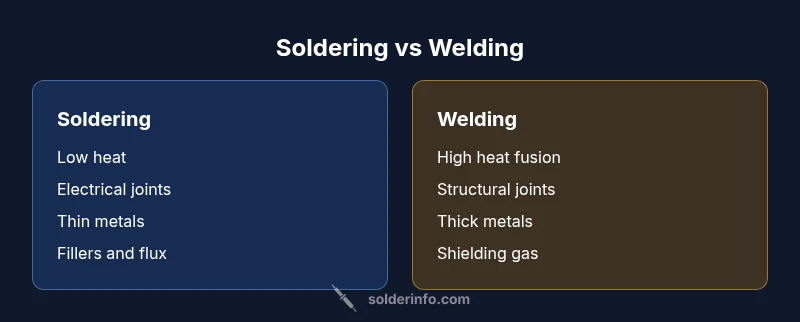
Understanding when to solder and when to weld starts with a simple distinction: soldering joins with a filler material at low heat, primarily for electrical conduction and precision, while welding fuses base materials with high heat for strength and permanence. Soldering preserves nearby components and textures, making it ideal for electronics, jewelry, and delicate copper piping. Welding creates robust, monolithic joints suitable for structural metalwork and thicker elements. The SolderInfo team emphasizes that the best choice hinges on load, conductivity, material thickness, and the environment in which the joint will operate. For hobbyists and professionals alike, starting with the project’s functional requirements will guide the method choice more reliably than chasing the latest tool trend. This contrast should be your first step when evaluating a project, from a tiny PCB repair to a steel frame assembly. The core idea is to align the method with the performance criteria you care about most: strength, conductivity, aesthetics, and safety.
When to Solder: Practical Guidelines
Soldering excels where joints are small, components are sensitive, or electrical connectivity matters. Electronics assemblies, jewelry fabrication, and copper plumbing joints are classic use cases. Soldering uses a filler metal (sold er) and flux to promote wetting, often at temperatures that minimize damage to nearby parts. The technique is forgiving for intricate shapes and fine details, provided you correctly prepare surfaces, clean oxidation, and apply heat evenly. Beginners should practice capillary action and wetting on test boards or scrap metal before tackling critical work. In jewelry, soldering enables precise seams without deforming the piece; in electronics, it creates reliable contacts and trace bridges when done with proper heat control and ESD precautions. For plumbing, copper tube joints can be made quickly with lead-free solder in appropriate systems, but always verify code-compliant materials and flux. Overall, when the goal is precision, conductivity, or delicate assembly, soldering is the preferred method.
When to Weld: Practical Guidelines
Welding is chosen when joints must withstand significant mechanical loads, bear weight, or join thick components. Structural steel, automotive frames, metal fabrication, and large metal art projects typically require welding. Welding fuses base metals, creating a strong, continuous bond that resists stress, temperature fluctuations, and fatigue better than most filler-only methods. Different welding processes (MIG, TIG, Stick) offer varying levels of control, speed, and cleanliness; TIG is favored for precision and thin sections, MIG for speed on thicker parts, and Stick for outdoor or dirty environments. Safety becomes paramount: welding involves bright arcs, intense heat, and fumes, so ventilation, eye protection, and PPE are essential. In plumbing, welding or brazing may be used for high-strength joints in copper or steel systems, depending on the job. Remember that improper welding can introduce warping or brittle zones, so beveling, fit-up, and shielding gas quality should be considered. The takeaway is straightforward: use welding where joint strength and permanence are paramount, especially with thicker materials and structural applications.
Materials Compatibility and Joint Types
Material compatibility dictates whether soldering or welding is feasible. Soldering is ideal for copper, tin, and some alloys used in electronics and jewelry; it relies on a filler filler, flux, and a clean, oxide-free surface for reliable wetting. Brazing sits between soldering and welding, using a higher-melting filler without melting the base metals and suits dissimilar materials in some cases. Welding suits base metals like steel, stainless steel, and aluminum when joints must carry load. Aluminum requires oxide layer management and often specialized techniques (TIG or MIG with appropriate shielding gas); steel and stainless steel welds provide excellent strength but may require post-weld treatment to control distortion. For electronics, avoid overheating to prevent component damage; for metal fabrication, choose welding when alignment and slotting permit strong, continuous joints. Overall, match the joint type to material properties and the performance target—conductivity and aesthetics in soldering, or strength and permanence in welding.
Tooling, Safety, and Best Practices
Both methods demand discipline around heat, cleanliness, and safety. Soldering requires a clean work surface, flux management, and careful heat application to avoid overheating components. For electronics or jewelry, practice ESD-safe handling and flux residue removal. Lead-free solders reduce health risks but still require good ventilation and careful disposal. Welding demands PPE: welding helmet with appropriate shade, gloves, and fire-resistant clothing; plus ventilation to manage fumes and gases. Shielding gas, proper electrode choice, and base material preparation can dramatically affect weld quality. Regardless of method, clamp workpieces securely, inspect joints for gaps and misalignment, and practice precision sequencing to avoid heat damage to adjacent parts. A thoughtful setup saves time and prevents rework, especially for mixed projects that combine soldered and welded joints.
Common Mistakes and How to Avoid Them
A frequent error is choosing the wrong method for the job’s load and geometry. Beginners often attempt to solder joints that are too thick or stressed, resulting in weak bonds; conversely, over-welding delicate components can cause heat damage. Surface preparation is critical: rust, oil, and oxides must be removed before either process. Flux exposure must be appropriate for the metal; excessive flux can cause corrosion or residue issues, while insufficient flux leads to poor wetting. Tool calibration matters: a properly tuned soldering iron tip or a correctly set welding process can mean the difference between a clean seam and a failed joint. Also, avoid overheating by maintaining a steady workflow and selecting the right filler metals and electrodes for the base material. Finally, always follow safety guidelines, use proper ventilation, and keep a clear workspace to reduce accidents.
Scenarios: Electronics vs Metal Fabrication
In electronics, think small-scale, high-precision joints with controlled heat, minimal material distortion, and attention to conductivity. In metal fabrication, prioritize joint strength, alignment, and the ability to handle stress and fatigue. A repair on a circuit board should favor soldering with flux and a heat sink to protect surrounding components; a frame weld should consider joint geometry, fit-up, and post-weld treatment to minimize distortion. Jewelry projects lean toward soldering for clean seams and minimal heat transfer, while structural doors and frames favor welding for reliability. When evaluating each scenario, start by listing required mechanical performance, electrical performance (if applicable), weight constraints, and safety considerations. This approach makes it easier to select the optimal method and avoid costly rework.
Practical Decision Tree and Quick Reference
Use this quick decision tree when you’re unsure which method to employ: 1) Is the joint load-bearing or electrical? If electrical and delicate, choose soldering; if load-bearing, choose welding. 2) Is the material thick or dissimilar? For thick or structural metals, welding is usually required; for thin metals or electronics, soldering is preferred. 3) Do you need a metal-free aesthetic or precision? Soldering offers fine control for visible seams. 4) Can nearby parts tolerate heat? If not, soldering with heat management or a brazing compromise may be necessary. 5) Are you working with plumbing or electronics? Solder for pipes and connectors within code constraints; welding for heavy piping or structural elements. Following these steps will help you arrive at a robust decision quickly and consistently.
Comparison
| Feature | Soldering | Welding |
|---|---|---|
| Best Use Case | Electrical/electronics and thin metals | Structural metalwork and thick materials |
| Typical Materials | Copper, tin alloys, PCB traces, jewelry wires | Steel, aluminum, thicker plates, heavy fabrications |
| Heat Input | Low heat, localized heating | High heat, fusion of base metals |
| Joint Type | Filler-based joints with flux | Fusion welds (could include filler) |
| Required Equipment | Soldering iron, flux, solder | Welding machine, safety gear, fume management |
| Common Safety Concerns | Flux fumes; potential lead in older solders | Arc radiation, burns, fumes; PPE essential |
| Electrical Conductivity | Excellent conductivity when joints are clean | Not primarily used for electrical conduction |
Advantages
- Low heat input protects sensitive components and reduces distortion
- Excellent precision for fine joints in electronics and jewelry
- Wide availability of consumables and approachable learning curve
- Relatively quick setup for small projects
Cons
- Not suited for high-load or structural joints
- Filler-based joints may fail under heavy mechanical stress
- Heat can damage surrounding parts or components if not controlled
- Brazing and welding may require more safety precautions and ventilation
Soldering excels in precision and electrical contexts; welding excels in strength and structural contexts.
For electronics and jewelry, soldering is the go-to due to low heat and fine control. For structural metalwork, welding provides the durability needed. In mixed projects, use the method that best matches joint requirements and safety considerations, as recommended by the SolderInfo team.
Quick Answers
What is the main difference between soldering and welding?
Soldering joins with a filler metal at low heat, primarily for electrical conduction and precision. Welding fuses base metals at high heat to create strong, permanent joints. The choice depends on strength needs, material thickness, and heat tolerance.
Soldering uses a filler to join at low heat, ideal for electronics. Welding fuses metals for strength, better for structural parts.
Can you solder aluminum or galvanized steel?
Soldering aluminum is challenging due to the oxide layer and typically isn’t the preferred method for structural parts. Galvanized steel can be soldered in some cases with specialized flux, but welding or brazing is usually more reliable. Always assess material compatibility and safety implications.
Aluminum soldering is tricky; galvanized steel can sometimes be soldered with care, but welding is often better.
Is brazing the same as soldering?
Brazing uses a higher-melting filler and does not melt the base metals, bridging a gap between soldering and welding. It’s a useful option for dissimilar metals or joints where heat-sensitive components are involved.
Brazing sits between soldering and welding and is used for certain dissimilar metals.
What tools do I need to get started with soldering and welding?
For soldering, you’ll need a soldering iron, flux, solder, a sponge, and safety glasses. For welding, you’ll need a welder (MIG/TIG/Stick), protective gear, and proper ventilation. Start with basics and upgrade as your projects demand.
You’ll need a basic iron and flux for soldering; a welder and PPE for welding.
Which method is better for plumbing projects?
Copper plumbing commonly uses soldering for joints in smaller or non-load-bearing sections, while welded joints are used for structural piping or thicker sections that require high strength. Always follow local codes and use lead-free solder where required.
Soldering is common for copper pipes, welding for thicker or structural piping, always follow codes.
Can soldered joints handle mechanical stress?
Soldered joints are generally not designed for high mechanical loads. They can be strong for light-duty electrical or jewelry joints but may fail under significant stress. Use welding for load-bearing applications or mechanical joints requiring durability.
Soldered joints aren’t typically for heavy loads; welding is preferred for strength.
Top Takeaways
- Assess joint strength vs conductivity before choosing a method
- Match material thickness and type to soldering or welding
- Prioritize safety: ventilation, PPE, and proper handling for both methods
- Prepare surfaces thoroughly for reliable joints (cleanliness is critical)
- When in doubt, consult guidelines or an experienced technician