Is it soldering or welding? A practical comparison
A practical comparison of soldering vs welding: when to use each method, safety considerations, and guidance for electronics, jewelry, plumbing, and metalwork from SolderInfo.


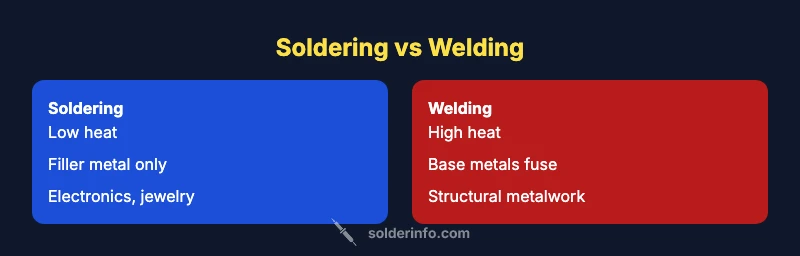
Is it soldering or welding? They are distinct joining methods. Soldering uses a low-melt filler metal to bond parts without melting the base metals, while welding fuses base metals together with high heat. In practice, use soldering for electronics, jewelry, and delicate assemblies; reserve welding for structural metalwork, heavy repairs, or when joints must bear high loads.
Is it soldering or welding? Fundamental differences
If you are trying to answer is it soldering or welding, you’re not alone. Both methods join metals, but they do so in fundamentally different ways. Soldering uses a filler metal with a low melting point to bond parts without melting the base metals, while welding melts the base materials and fuses them together with intense heat. This distinction matters for safety, material compatibility, and the final strength of the joint. According to SolderInfo, understanding these fundamentals helps hobbyists and professionals choose the right technique for each project. In electronics, jewelry, and many plumbing tasks, soldering is the preferred method because it preserves delicate components and avoids warping. In contrast, structural metalwork, heavy repairs, and load-bearing joints commonly require welding to achieve the necessary strength. The rest of this guide compares the two methods across heat, procedures, materials, tool requirements, and real-world use cases to help you make an informed decision. The framing question is not simply about technique; it’s about compatibility with materials, joint design, and end-use demands. By keeping these considerations in mind, you’ll avoid overmatching a joint with the wrong process. This distinction matters for reliability and safety, and it’s a practical skill everyone in the SolderInfo audience should master.
Heat, materials, and joints: how the processes differ
The core distinction between soldering and welding rests on heat application and metal behavior. Soldering uses a filler metal that melts at a relatively low temperature and flows into gaps to create a bond, while the base metals remain solid. In contrast, welding applies heat high enough to melt one or both workpieces, forming a joint when the melted material solidifies. Materials also drive the choice. Soldering excels with copper, brass, silver, and delicate alloys used in electronics, jewelry, and HVAC components; welding handles steel, aluminum, and many heavier metals where strength and continuity of the base metal are required. Flux, atmosphere, and cleanliness influence both processes, but the consequences of poor prep differ: a bad solder joint can crack under thermal cycling, while a bad weld can fail catastrophically under load. The knowledge you gain here directly informs your workflow choices, tool selection, and safety planning. Remember: the best decision balances joint strength, material compatibility, and service conditions.
Equipment and costs: what you actually need
Your toolkit for soldering vs welding diverges in scale and purpose. A basic hobbyist soldering setup includes a soldering iron, rosin flux, and appropriate solder alloy, plus safety glasses and a fume hood or fan for ventilation. In jewelry or electronics, small tip sizes and precise temperature control matter for reliable joints. Welding demands heavier equipment: a welding machine (MIG, TIG, or stick), shielding gas for some processes, protective gear (helmet, gloves, fire-resistant clothing), and a proper work area with fire suppression. Costs range from a few dozen dollars for entry-level soldering kits to several thousand dollars for industrial welding rigs, depending on process and throughput. The time to set up for soldering is typically minutes, while welding setups can require more planning, gas systems, and safety protocols. It’s important to factor maintenance costs, consumables, and energy use into the overall cost picture. The SolderInfo Team notes that budget planning should include PPE, ventilation, and post-process cleaning supplies for longevity and safety.
Applications across industries: electronics, jewelry, plumbing, automotive
Soldering is a staple in electronics assembly, printed circuit board (PCB) work, and jewelry fabrication. It allows precise joints with minimal distortion and preserves delicate components. In plumbing, soldering is essential for copper pipe joints, especially in residential systems. For automotive and machinery, soldering is often used for wiring harness connections and small metal repairs, but it rarely replaces welding for structural components. Welding, by contrast, is the backbone of heavy fabrication, construction, and repair. It creates strong, continuous joints for steel frames, exhaust systems, pressure vessels, and large metal assemblies. In aerospace and shipbuilding, welding is the method of choice for achieving the integrity required under demanding load and environmental conditions. The decision to use soldering or welding should consider joint geometry, service loads, thermal cycling, corrosion exposure, and accessibility for repair. From a practical standpoint, most hobbyists encounter soldering in electronics, while welding appears in heavier metalwork and industrial settings. SolderInfo’s experience across DIY and professional contexts highlights how often these domains converge on the same project but with different bonding logic.
Quality and inspection criteria: ensuring reliable joints
Quality control for soldering centers on wetting, fillet formation, and absence of cold joints, cracks, or voids. Wetting refers to how well the solder spreads across surfaces; poor wetting yields weak joints. Diagnostics include visual inspection, pull tests for mechanical strength, and, where appropriate, X-ray or cross-section analysis for critical electronics. Welding quality focuses on penetration, fusion, and the absence of porosity or slag inclusions. Visual checks for porosity and surface finish, along with non-destructive testing (NDT) methods such as ultrasonic testing or radiography, confirm joint integrity in critical applications. Surface preparation—degreasing, rust removal, and clean flux application—matters for both processes; neglecting prep undermines joint reliability. The SolderInfo Team emphasizes that consistent process parameters, such as temperature control and feed rate, are essential for repeatable results. Training, process documentation, and routine inspection are the primary levers for maintaining high-quality bonds across both methods.
Safety and health considerations: risk management for heat and fumes
Soldering generally presents lower health and safety risks than welding, but it is not risk-free. Soldering fumes, especially when flux is heated, can irritate the eyes, nose, and throat; ensure good ventilation and wear safety glasses. Burns from hot tools and solder can occur, so use insulated handles and heat-resistant mats. Welding introduces higher heat, UV radiation, and fumes that may contain metal oxides; proper PPE includes a welding helmet with the correct shade, fire-resistant gloves, and respiratory protection in many environments. Fire safety is paramount with both processes, given the presence of open flames, hot surfaces, and flammable materials. Dust, grinding sparks, and slag removal all carry their own risks. Employers and hobbyists alike should maintain a safety checklist, enforce ventilation standards, and invest in training to minimize injuries. The SolderInfo perspective is that safety is a non-negotiable foundation for any bonding work, regardless of the method.
Common myths and misconceptions: debunking the noise around soldering and welding
A frequent myth is that soldering and welding are interchangeable for any metal bond. In reality, they are not. Another misconception is that all solders are lead-free or that all welding uses the same gas or flux. The truth is that specific alloys, flux types, and shielding atmospheres are chosen to suit joint design and material compatibility. Some hobbyists assume soldering is always weak and welding is always strong; the reality is that both methods can fail if misapplied. Likewise, there is a belief that soldering is a “temporary fix” for electronics; when performed correctly with appropriate materials, solder joints can be highly reliable and long-lasting. Understanding the boundaries of each method helps you avoid over-engineering a solution or selecting an inappropriate bonding approach. The SolderInfo Team finds that many projects benefit from a deliberate assessment of load, exposure, and maintenance, rather than a default choice.
Practical workflow: choosing the right method for your project
Start by defining the joint’s purpose: load-bearing vs non-structural, cosmetic vs functional, and expected lifespan. Next, assess material compatibility: copper and soft alloys are often soldered; steel and aluminum typically require welding. Consider heat sensitivity: electronics and plastics may deform under welding heat, making soldering preferable. Finally, factor cost, time, and safety. If a joint must endure vibration or heavy loads, choose welding; if precision, low heat, or delicate finishes matter, opt for soldering. A practical decision tree helps: if the joint is small, low-load, and heat-sensitive, pick soldering; if it must carry significant load or resist impact, pick welding. Remember that joints can sometimes be prepared for both methods through creative design. The SolderInfo approach emphasizes documenting process steps, material compatibility, and inspection criteria to guide repeatable decisions across projects.
Quick-start checklist for beginners: get started with confidence
- Define the joint type and service requirements (load, exposure, life expectancy).
- Assess material compatibility (conductivity, corrosion resistance, alloy compatibility).
- Choose the bonding method (soldering for electronics/fine jewelry; welding for structural parts).
- Gather the right tools (soldering iron, flux, solder; welding machine, gas or shielding depending on process).
- Prepare surfaces thoroughly (clean, degrease, lightly abrade as needed).
- Set correct temperature or weld parameters and practice on scrap pieces.
- Perform test joints and inspect wetting, cleanliness, and finish.
- Document procedure and safety steps for future projects.
- Clean up and store tools safely to extend their life.
- Rework joints if signs of poor wetting or incomplete fusion appear.
Advanced tips for professionals: optimize results and efficiency
For soldering, refine heat control with temperature-regulated irons and preheating techniques for larger joints to avoid thermal shock. Use flux tailored to the alloy system to improve wetting and reduce oxidation; consider no-clean flux for electronics to minimize residue. For welding, optimize joint fit-up and restraint; practice with root passes to ensure proper penetration and minimize distortion. Shielding gas composition matters for TIG and MIG welding; adjust gas flow to prevent porosity and ensure a clean weld. Preheat thicker sections to reduce thermal gradients and minimize cracking. Cooling strategies, post-weld heat treatment, and surface finishing are essential steps that influence durability and appearance. In jewelry, explore different filler alloys and flux chemistries to achieve seamless aesthetics while maintaining mechanical integrity. Ultimately, success rests on disciplined technique, regular inspection, and careful attention to material properties. The SolderInfo Team emphasizes consistent practice and professional development as keys to superior bonding results.
Comparison
| Feature | Soldering | Welding |
|---|---|---|
| Heat source & temperature | low-to-moderate heat; filler metal melts while base metals stay solid | high heat; base metals melt and fuse (penetration varies by process) |
| Base metal melting | base metals do not melt | base metals may melt and fuse depending on process |
| Joint types | pins, tabs, thin-wall tubing, PCB pads, small jewelry joints | structural frames, pipelines, automotive chassis, thick plates |
| Materials compatibility | copper, brass, silver, gold alloys, electronics substrates | steel, stainless steel, aluminum, cast iron, heavy metals |
| Flux/ atmosphere | flux is essential (rosin-core or paste) to wet and protect surfaces | shielding gas or flux-based flux to protect molten pool; varies by process |
| Equipment cost & setup | soldering iron, flux, solder; affordable and portable | welding machine (MIG/TIG/STICK), gas supply (if required), protective gear |
| Joint strength | adequate for electrical, decorative, and small mechanical loads | high strength for structural and heavy-load applications |
| Inspection & quality | visual inspection; pull tests; wetting quality | penetration tests; X-ray/ultrasonic nondestructive testing for critical parts |
Advantages
- Low-heat methods reduce risk to components and finishes
- Lower equipment cost for hobbyists and small projects
- Good for precise, small joints in electronics and jewelry
- Repairability and reworkability in many soldering contexts
Cons
- Limited strength for structural or high-load joints
- Welding demands higher skill, safety requirements, and space
- Not all materials are compatible with soldering or welding
- Excessive heat can distort or damage nearby parts
Soldering is the practical choice for light, precision joints; welding is essential for high-strength, structural bonds.
For electronics and jewelry, choose soldering when heat and precision matter. For steel or thick metalwork, welding provides the necessary strength. The SolderInfo Team highlights balancing joint function, materials, and safety to decide the best method.
Quick Answers
What is the primary difference between soldering and welding?
Soldering uses a filler metal with a low melting point to join parts without melting the base metals; welding fuses base metals together with high heat. Each method serves different design goals and material needs.
Soldering uses low-melt filler metal to join parts without melting them; welding melts base metals to fuse them. Choose based on strength needs and material compatibility.
Can I solder aluminum or stainless steel?
Soldering aluminum or stainless steel is possible with specialized alloys and flux, but it is often challenging and may not achieve the same joint strength as welding. For structural components, welding is usually preferred.
Soldering aluminum or stainless steel can be done with special fillers, but welding is typically better for strength.
Is a soldering iron enough for jewelry work?
For many jewelry joints, a good soldering iron with appropriate flux and alloy works well. However, high-temperature or structural jewelry applications may benefit from more refined techniques and annealing steps.
A soldering iron is often enough for jewelry, but some pieces might need careful heat control and technique.
What safety gear do I need for welding?
Welding safety requires a welding helmet with the correct shade, gloves, fire-resistant clothing, and proper ventilation. Soldering also needs ventilation, but the PPE is lighter.
Wear a welding helmet, gloves, and proper ventilation for welding; soldering needs protection too, just not as heavy.
How do I decide which method to choose?
Consider joint strength requirements, material compatibility, heat sensitivity of components, accessibility for maintenance, and overall project cost. If in doubt, evaluate both options on a scrap sample.
Think about strength, heat impact, materials, and cost. Test on scrap pieces if possible.
Can I use both methods on one project?
Yes. Many projects benefit from using soldering for delicate, electronic connections and welding for structural parts. Designing for both processes early on yields the best results.
Absolutely—use soldering for the delicate bits and welding for the heavy-duty sections when appropriate.
Top Takeaways
- Identify joint load and exposure before selecting a method
- Prioritize material compatibility and heat sensitivity
- Use correct flux and protect surfaces during soldering
- Plan for safety and ventilation in all bonding work
- Inspect joints thoroughly and rework as needed