Can You Solder Instead of Weld? A Practical Guide
Explore when soldering can replace welding, key differences, materials, and best practices. Learn to choose the right method for electronics, jewelry, plumbing, and more with safety tips and real-world guidelines from SolderInfo.


Soldering and welding are two distinct metal-joining methods with different purposes. Soldering uses a filler metal with a lower melting point and capillary action to join surfaces, while welding fuses materials at high heat to create a single, continuous metal joint. You can substitute soldering for welding in non-structural, low-load contexts (electronics, jewelry, some plumbing), but not for critical, load-bearing joints where strength, corrosion resistance, or leak-tight integrity are paramount. Material compatibility, joint design, and service conditions drive the choice.
Understanding the core differences between soldering and welding
Soldering and welding are both metal-joining processes, but they operate on different principles. Soldering relies on capillary action and a filler metal with a lower melting point than the base metals. Welding fuses materials together at high temperatures, creating a bond that becomes part of the metal itself. This fundamental difference affects strength, ductility, heat-affected zones, and suitability for various applications. According to SolderInfo, the choice between soldering and welding should be driven by service conditions, load requirements, and the metallurgy of the pieces involved. In electronics or jewelry, soldering often yields fast, clean joints with minimal distortion. In structural steel or pressure piping, welding is usually the only viable option for long-term reliability. The two processes also differ in equipment, skill level, and inspection criteria. When you want to know can you solder instead of weld, you must consider what the joint needs to do in service: carry loads, withstand corrosion, or tolerate vibration. Material compatibility plays a role: some metals form brittle intermetallics if joined by solder; others form reliable bonds only when welded. By framing the decision around function rather than method, you can choose the method that delivers the needed performance with acceptable cost and risk.
When soldering is the right choice
Soldering shines where joints do not have to carry heavy loads or support critical safety functions. In electronics, solder provides fast, low-heat connections that minimize circuit distortion. For jewelry, soft solder enables clean seams and easy repair without melting precious settings. In plumbing with copper pipes, lead-free solders under proper flux create watertight joints when joints fit well and surface preparation is thorough. Soldering also allows disassembly and repair without damaging surrounding parts, which is a major advantage in hobby projects. However, the strength of soldered joints depends on the solder alloy, flux choice, surface cleanliness, and joint geometry. Solder joints are more vulnerable to vibration, temperature cycling, and corrosion if chosen inappropriately. As a result, SolderInfo recommends reserving soldering for assemblies where the service conditions align with these limitations and where the performance criteria can tolerate lower strengths and potential failure modes.
When welding is the better option
Structural, load-bearing, or high-temperature joints typically require welding. Steel frames, pressure vessels, and automotive components rely on fusion bonding that forms a metallurgical bond across the entire joint. Welded joints often require post-weld heat treatment, inspection (magnetic particle, radiography), and precise fixturing to avoid distortion. Welding can achieve greater strength and crack resistance when designed for it, but it also introduces heat-affected zones that can alter corrosion resistance and hardness. Welding remains the standard for many critical applications because it creates a single, continuous metal path without a separate filler metal that could act as a weak link. In non-structural contexts, welds may still be overkill and introduce unnecessary distortion or cost. The bottom line: if the joint must sustain significant loads, withstand repeated cycling, or form a pressure boundary, welding is usually the safer choice.
Solder types, flux, and how they affect joints
Choosing the right solder alloy and flux is essential to joint performance. Lead-free solders commonly use tin-silver-copper blends with 0-3% other metals, offering safe, reliable joints for electronics and plumbing. Rosin-core flux helps remove oxides during heating, but water-soluble flux residues require cleaning to prevent corrosion. For jewelry, high-temperature solders and flexible fluxes minimize metallurgical stress during fusion, while delicate settings demand low-temperature alloys. The flux type influences residue cleanliness, corrosion resistance, and ease of rework. Work with the recommended temperature range for your solder and distribution of heat to avoid damaging substrates. Always test a joint on scrap material before committing to a critical piece. Soldering with mismatched alloys can produce brittle joints or weak corrosion resistance, so material compatibility is essential.
Surface preparation and joint design for durable joints
Preparation is the unseen driver of solder and weld quality. Clean, oxide-free surfaces maximize wetting and capillary action for solder. For electronics and jewelry, file or scrub metal surfaces, degrease with isopropyl alcohol, and lightly sand to remove oxidation. For copper plumbing, ensure the pipe end is square and deburr plus apply flux evenly along the seam. Joint design matters: for soldering, a tight-fit butt or lap joint, with a small gap filled by solder, yields the strongest capillary path; for welding, proper bevels or fillets establish fusion across the joint. Heat management is crucial: excessive heat can burn flux, damage components, or warp delicate substrates. Use heat sinks or staggered heating to minimize thermal stress. After heating, apply filler metal consistently and inspect the joint while cooling to prevent cold joints.
A practical decision framework and workflow
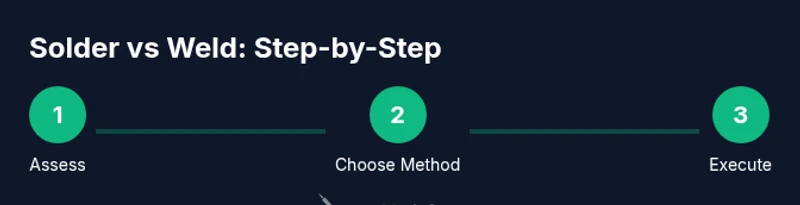
Start with a decision tree: identify function, required strength, temperature exposure, and service environment. If the joint is non-structural and the metals are compatible, drift toward soldering with appropriate flux and solder. If strength and leak-tight seals are essential, choose welding and, where feasible, design for weldability. Prepare the surface, validate fit with dry assembly, apply flux, and then apply heat with a controlled technique. The steps in practice: 1) Clean surfaces thoroughly; 2) Apply flux; 3) Position parts; 4) Heat evenly and apply solder or filler; 5) Inspect and test; 6) Clean residues. For disassembly and future maintenance, consider how you might reverse the bond or access the joint. SolderInfo emphasizes planning and test-fitting before committing to permanent heating.
Real-world scenarios and case studies
Scenario A: An electronics board where joints must conduct current while staying cool during operation. Solder is typically preferred due to low heat input and rapid wetting, provided the joint is not carrying heavy loads. Scenario B: Repairing a delicate jewelry ring that needs a discreet seam is a classic solder job; the ring band must be kept clean of flux residues and the metal must tolerate the heat without warping. Scenario C: A copper water supply pipe with a small crack can be effectively sealed with a lead-free solder joint, given proper pipe preparation and sealing. Scenario D: A welded steel bumper or frame will require fusion bonding, alignment, and post-weld inspection. Each scenario illustrates can you solder instead of weld only when service conditions align with the method’s strengths.
Safety, environmental, and quality considerations
Safety and quality are non-negotiables in metal joining. Proper ventilation, PPE, and fume extraction protect workers from toxic flux fumes and heated metals. Consistent cleaning, flux application, and temperature control reduce the risk of cold joints and brittle intermetallics. Quality checks include visual inspection, dye penetrant or X-ray methods for critical welds, and leak tests for plumbing joints. By understanding when to solder and when to weld, you can design safer, more reliable assemblies. The SolderInfo team recommends documenting material compatibility, heat settings, and inspection results for future reference.
Tools & Materials
- Soldering iron or micro-torch(For electronics, low-temperature irons are sufficient; for plumbing use a hotter torch with appropriate flame control)
- Lead-free solder (tin-silver-copper)(Choose alloy with a melting point compatible with your substrate)
- Flux (rosin-core or water-soluble)(Flux cleans oxides and improves wetting; store reagents properly)
- Flux remover / isopropyl alcohol(Used to clean flux residues after work)
- Soldering stand and helping hands(Keeps parts stable and protects surfaces)
- Safety goggles and heat-resistant gloves(Protect eyes and hands from hot splashes and flux fumes)
- Wire brushes / abrasive pads(Remove oxidation and prepare surfaces)
- Ventilation or fume extractor(Keep fumes away from breathing zone)
- Clamps or heat sinks(Mitigate heat distortion and protect delicate parts)
- Alcohol wipes or degreaser(Degrease surfaces before joining)
Steps
Estimated time: 60-120 minutes
- 1
Assess requirements
Identify whether the joint is structural, leak-tight, or cosmetic. Check service conditions, loads, temperatures, and corrosion exposure to decide between soldering and welding.
Tip: Ask: Will the joint bear weight or pressure? If yes, consider welding. - 2
Choose the method and prep surfaces
Select the solder alloy or weld process. Clean and degrease all surfaces, removing oxides and oils that hinder bonding.
Tip: Use a wire brush and solvent to ensure a clean, oxide-free surface. - 3
Provide proper joint geometry
For soldering: design a snug-fit joint with a capillary path. For welding: ensure bevels or fillets align with the weld procedure.
Tip: Dry-fit first to verify fit and alignment. - 4
Apply flux and heat appropriately
Apply flux evenly; heat gradually and control temperature to prevent overheating components. Introduce solder only after the flux coats the surface.
Tip: Keep heat sources moving to avoid scorching flux. - 5
Add filler and inspect
For soldering, feed solder along the joint to promote capillary flow; for welding, ensure full fusion and lack of porosity. Let the joint cool undisturbed and inspect for gaps or cracks.
Tip: Check for a clean, shiny wetting along the seam. - 6
Test and finalize
Test the joint for leaks, electrical continuity, or mechanical strength as appropriate. Clean residues and perform any post-process finishing required.
Tip: Document settings and outcomes for future reference.
Quick Answers
Can soldering replace welding for metal structures?
In most structural or load-bearing applications, welding remains the safer and more reliable option. Soldering is typically limited to non-structural joints, electronics, jewelry, and certain plumbing tasks where loads are low and the environment is controlled.
Welding is usually required for structural joints, while soldering works for non-structural tasks like electronics or jewelry repairs.
Is soldering suitable for copper pipes?
Yes, lead-free solder with proper flux is commonly used for copper piping joints to create watertight seals. Proper surface preparation and cleaning are essential for a durable joint.
Copper pipes can be soldered with the right flux and lead-free solder, given good surface prep.
What metals are difficult to solder?
Some metals form very stable oxides or have high melting points that hinder solder wetting. Aluminum, for instance, usually requires special surface treatment or alternative joining methods.
Aluminum and certain alloys can be tough to solder without special methods.
What risks come with improper soldering on structural joints?
Improper soldering can cause cracks, cold joints, leakage, and reduced corrosion resistance. In safety-critical parts, this can lead to failure under stress or pressure.
Poor solder joints can crack or leak, especially in safety-critical parts.
How does heat input differ between soldering and welding?
Soldering uses substantially lower heat than welding, reducing distortion and thermal stress but also limiting joint strength. Welding involves fusion and higher heat, creating stronger bonds but more risk of distortion.
Soldering uses less heat and creates less distortion, while welding fuses metals for strength but risks distortion.
Do I need special equipment to solder electronics vs plumbing?
Yes. Electronics soldering typically requires a fine-tipped iron and lead-free solder with vein flux; plumbing soldering uses a hotter torch and larger joints. Always match equipment to the work size and heat requirements.
Yes—electronics uses a fine iron and small joints; plumbing needs a hotter torch and larger joints.
Can jewelry be soldered for repairs?
Jewelry soldering is common for repairs and settings, but requires compatible alloys, controlled heat, and careful inspection to avoid damaging stones or sensitive metals.
Jewelry soldering is common for repairs if done with care and compatible materials.
What standards apply to soldering and welding in industry?
Industry standards vary by application and jurisdiction. Organizations like the AWS and OSHA provide guidance on best practices, safety, and inspection protocols relevant to metal joining.
Standards exist from AWS and OSHA guiding best practices and safety.
Watch Video
Top Takeaways
- Understand core differences between soldering and welding.
- Choose the method based on function, strength, and service conditions.
- Prepare surfaces and joints meticulously for reliable bonds.
- Use the right alloys and flux to prevent weak joints.
- Always prioritize safety and document results.