Difference solder and weld: A Practical Comparison
Explore the key differences between soldering and welding, covering processes, temperatures, strengths, and best-use cases for electronics, plumbing, and metalwork to help hobbyists and professionals choose correctly.


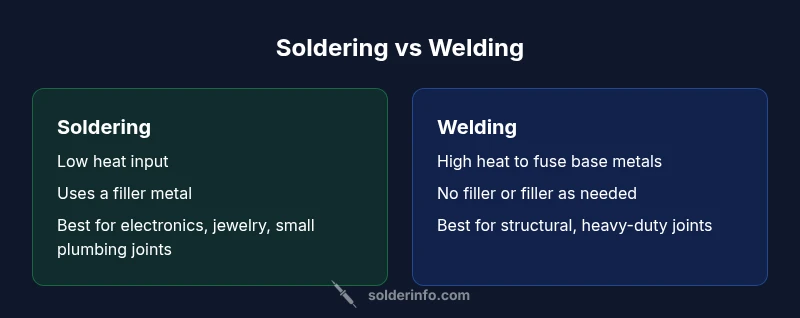
Difference solder and weld can be understood by heat, joint mechanism, and purpose. Soldering uses a separate filler metal melted at low temperatures to join parts without melting the base metals; welding fuses base metals by high heat, creating strong bonds. For electronics, jewelry, and plumbing fittings, soldering is typically preferred, while welding is chosen for structural metalwork.
Core Definitions and Scope
The terms soldering and welding describe two fundamental metal-joining processes that serve different purposes in fabrication, electronics, plumbing, and jewelry. The core difference solder and weld hinges on how heat is applied and how the joint is formed. Soldering relies on a filler material that melts at a temperature lower than the base metals, which remain solid. The joint is created as the molten filler wets surfaces and cools to form a bond. Welding, by contrast, fuses the base metals together by melting them (and sometimes adding filler), producing a metallurgical bond once the materials solidify. This distinction influences joint strength, thickness tolerances, and how the joint behaves under stress or vibration. Those differences should guide your choice across applications, from tiny PCB connections to steel structural work—the SolderInfo team notes that selecting the right method hinges on the intended load, environment, and long-term durability.
The phrase difference solder and weld captures a broad spectrum of techniques, from electronics soldering with rosin-core or lead-free alloys to structural welding methods such as MIG, TIG, and stick welding. While they share the goal of joining pieces, they diverge in heat input, joint geometry, and post-joining considerations. For hobbyists and professionals alike, grasping these fundamentals reduces trial-and-error time and improves outcomes across projects.
According to SolderInfo, understanding the scope of each process helps you choose safely and effectively. This article uses practical language and real-world examples to clarify where soldering shines and where welding is indispensable. It also covers safety, materials compatibility, and common pitfalls to avoid when applying the difference solder and weld to your work.
Key Differences at a Glance
- Heat input: Soldering uses low heat with a separate filler; welding uses high heat to fuse base metals.
- Joint formation: Soldering relies on capillary action and flux; welding forms a metallurgical bond between surfaces.
- Material scope: Soldering is common for electronics, jewelry, and small plumbing joints; welding is used for structural metalwork, automotive frames, and large fabrications.
- Strength and durability: Solder joints are adequate for light loads but not structural; welds provide high strength and stiffness for load-bearing applications.
- Equipment and training: Soldering requires a soldering iron, flux, and solder; welding needs a welder, protective gear, and specialized training.
- Repair and rework: Soldered joints are generally easier to rework; welded joints may require grinding and post-processing.
- Environmental and safety: Soldering can expose you to flux fumes and lead-containing solders; welding involves arc rays, fumes, and high heat.
The essential takeaway is that the difference solder and weld lies in heat control, joint bonding mechanics, and the resulting strength, which translates to distinct use cases across electronics, plumbing, and metal fabrication.
Temperature and Materials: Why Heat Dictates Choice
Heat is the main driver behind the difference solder and weld. Soldering uses temperatures sufficient to melt the filler metal (often in the range of a few hundred degrees Celsius) while leaving the base metals intact. This creates a bond through wetting and capillary action, which is ideal for delicate components where thermal expansion or warping must be controlled. Welding, however, applies heat high enough to melt the base metals themselves. The process may involve additional filler metal, shielding gas, or flux, depending on the welding method (MIG, TIG, stick, etc.). The metal’s melting point, thermal conductivity, and coefficient of expansion will influence process choice and joint geometry. For thin copper traces on a PCB, soldering is appropriate; for thick structural steel, welding is the practical option.
Materials compatibility matters too. Dissimilar metals may weld well only under specific conditions or require special filler alloys. Solder alloys are designed to wet and bond surfaces without dissolving the base metal, making them ideal for electronic assemblies, jewelry repair, or plumbing fittings where temperature sensitivity is critical. The SolderInfo team emphasizes evaluating the material pair, required joint strength, and service environment before deciding which route to take.
Process Parameters and Best Practices
Understanding the step-by-step considerations helps delineate the difference solder and weld more clearly. Soldering best practices include cleaning surfaces thoroughly, applying flux to promote wetting, selecting the appropriate solder alloy (e.g., tin-based for electronics, lead-containing solders are being phased out in many regions), and controlling the heat source to avoid overheating small components. Temperature control is essential to prevent damage to components and maintain electrical integrity. For plumbing, you may use solder that is appropriate for copper pipes, ensuring proper flux and joint cleanliness to achieve a leak-free seal. In jewelry work, flux selection, heat management, and temperature are critical for preserving the metal’s finish and avoiding burns.
Welding best practices involve adequate preparation of joints (cleanliness, bevels, fit-up), selecting the process (MIG, TIG, or stick) based on material type and thickness, and applying correct shielding gas if required. Heat input and travel speed influence bead shape and penetration. Welders must consider distortion control, post-weld heat treatment if required, and inspections for defects like cracks or porosity. Protective gear, ventilation, and fire safety plans are non-negotiable elements of welding practice. Each process has a set of thresholds and checks to minimize failure and maximize joint integrity.
Applications by Industry
The difference solder and weld becomes most visible when you translate it into real-world use cases. Electronics and hobby electronics rely almost exclusively on soldering for component attachment, wire connections, and PCB assembly. Jewelry artisans use soldering to join fine metal pieces and create secure, invisible seams, while plumbing often employs solder for copper joints and certain fittings, provided the system pressure and temperature are within the solder’s capabilities. In contrast, structural steel fabrication, automotive frames, shipbuilding, and metal sculpture rely on welding for the high-strength, immovable joints required in load-bearing scenarios. Understanding where each method excels informs your project planning, budget, and timetable.
As a general guideline, if the joint will experience bending, vibration, or significant loads over time, welding is usually the better choice. If the goal is electrical continuity, electronic assembly, or low-heat joining of delicate parts, soldering is often preferable. The line between these two processes can blur with brazing, which uses a filler metal at intermediate temperatures, bridging some applications; however, brazing is beyond the scope of this direct solder-weld comparison and will be addressed in related guides.
Common Misconceptions and Clarifications
Many projects stall due to myths about soldering and welding. A common misconception is that soldering creates a “no-strong” bond, when in fact the bond is perfectly adequate for low-load assemblies and is intentionally not a structural weld. Another myth is that all welding always requires welding gloves and heavy PPE; while welding safety is critical, some forms, like TIG welding with proper protective gear, offer more precise control and better aesthetics for fine metalwork. Equally important is recognizing that lead-based solders are increasingly restricted due to health and environmental concerns; modern lead-free solder formulations are widely used in electronics but require different dispensing temperatures and flux choices. Finally, the assumption that most metals can be welded without issue is false—some alloys require specialized techniques or may be impractical to weld due to thermal expansion or crystallography.
Material and Joint Strength Considerations
Strength and durability hinge on the chosen process and the joint design. Solder joints can provide reliable electrical connections and small mechanical bonds, but they typically cannot endure high mechanical loads or thermal cycling like welded joints. Conversely, welds deliver high strength and rigidity, but they can introduce distortions, heat-affected zones, and residual stresses that require post-processing or heat treatment. For designers and fabricators, it’s essential to match the joint type to the service conditions: mechanical load, environmental exposure, vibration, thermal cycles, and corrosion potential all shape the appropriate method. The strength hierarchy is not purely a matter of where the joint is used; it also reflects how the joint was prepared, the cleanliness of surfaces, and the exact materials involved.
Safety, Standards, and Inspection
Safety is a core concern in choosing between soldering and welding. Soldering flux fumes can pose inhalation risks, and some solders contain lead, which has regulatory and health implications. Ventilation, proper PPE, and safe handling practices mitigate these hazards. Welding introduces arc flash risks, intense heat, UV exposure, and heavy fumes; appropriate respirators, protective clothing, and welding screens are essential. Standards and inspection practices vary by industry: electronics follows IPC and related soldering guidelines; construction and fabrication rely on AWS (American Welding Society) and structural codes; plumbing may reference local plumbing codes and standards for pipe joints. For both processes, quality control includes visual inspection, non-destructive testing where applicable, and adherence to applicable codes. The key is to plan for safety and compliance from the outset rather than after the joint is completed.
Quick Reference Guide: When to Choose Solder vs Weld
- Use soldering when: working on electronics, jewelry, small fittings, or where heat must be limited to protect components.
- Use welding when: fabricating structural metal joints, large frames, or components subjected to high loads and stress.
- Consider brazing as an intermediate option when you need stronger joints than soldering but cannot or do not want to fuse base metals.
- Always assess material compatibility, joint design, service environment, and required strength before deciding. This quick guide should help you reduce guesswork and select the appropriate method for your project.
Authority Sources
- AWS (American Welding Society): https://www.aws.org/
- OSHA (Occupational Safety and Health Administration): https://www.osha.gov/
- NIST (National Institute of Standards and Technology): https://www.nist.gov/
Comparison
| Feature | Soldering | Welding |
|---|---|---|
| Typical Temperature Range | Low-temperature process; filler metal melts while base metals stay solid | High-temperature fusion of base metals (varies by process) |
| Joint Type and Filler | Uses filler metal with flux; joints formed by wetting surfaces | Fuses base metals with or without filler; metallurgical bond |
| Strength and Load-bearing | Adequate for electrical/soft joints; limited mechanical strength | High strength suitable for structural and load-bearing joints |
| Typical Applications | Electronics, jewelry, plumbing fittings (low pressure) | Structural fabrication, automotive frames, pipe supports |
| Equipment and Skill Level | Soldering iron, flux, solder; beginner-friendly | Welder, PPE, ventilation; requires training |
| Material Compatibility | Compatible with metals that wet well with solder; thickness matters | Broad metal compatibility but requires surface prep and process control |
| Environmental and Safety Considerations | Flux fumes; potential lead exposure in older solders | Fume exposure, arc safety, and PPE requirements |
| Repairability and Inspections | Easier to rework; inspections focus on electrical integrity | Repairs can be more complex; inspections emphasize joint penetration and absence of defects |
Advantages
- Low heat input minimizes distortion and damage to sensitive components
- Relatively low equipment costs and accessibility for hobbyists
- Easy rework and repairs for small-scale joints
- Soldering is ideal for precise, delicate assemblies
Cons
- Solder joints are not suitable for high-load or structural applications
- Lead-containing solders pose health and regulatory concerns in some regions (lead-free alternatives exist)
- Welding requires more expensive equipment and protective gear
- Welding can cause distortion and post-processing needs such as grinding or heat treatment
Soldering and welding serve different purposes; choose soldering for delicate, low-load work and welding for strong, structural joints.
In most applications, soldering is the go-to method for electronics, jewelry, and small plumbing joints, while welding is the preferred choice for structural metalwork. The SolderInfo guidance emphasizes matching the method to the load, material, and service conditions to ensure reliability and safety.
Quick Answers
What is the fundamental difference between soldering and welding?
Soldering uses a separate filler metal that melts at low temperatures to join parts, while welding fuses base metals by melting them at high temperatures. The result is a bond with different strength, heat tolerance, and applications. This is the core distinction implied by the phrase difference solder and weld.
Soldering uses a filler metal at low heat to join parts; welding melts the metals themselves for a strong bond.
Can I use soldering for plumbing joints in copper pipes?
Yes, soldering is commonly used for copper pipe joints, provided the system isn’t under high pressure and the solder and flux are appropriate for potable water. Use careful cleaning and flux to ensure a reliable seal.
Soldering works for copper pipes when you follow the right flux and solder choices.
Is brazing relevant when comparing solder and weld?
Brazing sits between soldering and welding: it uses a filler metal that melts above soldering temperatures but below many welding methods. It creates strong joints without melting the base metals, useful for certain dissimilar metals.
Brazing is a middle option between soldering and welding.
What safety considerations apply to soldering vs welding?
Soldering requires ventilation for flux fumes and care with lead-containing solders. Welding involves arc hazards, bright UV, and fumes, demanding PPE and proper ventilation. Both need safe handling of hot equipment and materials.
Ventilate, wear PPE, and follow safe handling for each process.
Which process is better for all metals?
Neither process is ideal for all metals or applications. Soldering works well for electronics and thin materials; welding suits thick or high-strength joints. Material properties dictate the best method.
No single method fits every metal—choose based on material and load.
Are there lead-free solders and why do they matter?
Lead-free solders are common due to health and environmental concerns. They require different fluxes and temperatures, but offer safer, compliant options for electronics and plumbing.
Lead-free solders are safer and often required by regulations.
Top Takeaways
- Choose soldering for electronics and delicate joints
- Opt for welding when joint strength and structural integrity matter
- Control heat to prevent damage and distortion
- Follow safety standards and use appropriate PPE
- Consider brazing as a middle ground when needed