What Temperature to Solder Lead Free: A Practical Guide
Learn safe, reliable temperatures for lead-free soldering across electronics, plumbing, and jewelry. Practical ranges, profiles, and troubleshooting tips for SAC alloys.


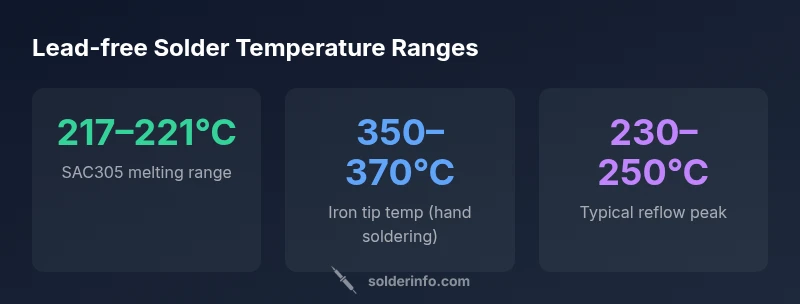
If you’re asking what temperature to solder lead free, use a practical rule: solder with SAC alloys around 217–221°C melting range and a conventional iron tip at about 350–370°C for hand work. Preheat, flux, and controlled cooling matter. For reflow, target peak 230–250°C with a gentle ramp. Always check the alloy datasheet and flux guidance for your specific materials.
What lead-free soldering is and why temperature matters
According to SolderInfo, mastering lead-free soldering temperatures starts with understanding alloy chemistry and heat transfer. In particular, the common SAC alloys (like SAC305) have a melting range around 217–221°C. This means your solder will begin to liquefy around this temperature, but the practical temperature you use in hand-soldering depends on the flux, pad geometry, component type, and your equipment. When you ask what temperature to solder lead free, you should think in terms of a process window rather than a single number: set your iron to an appropriate range, monitor the joint, and adjust quickly to avoid overheating. This baseline helps tailor process conditions to electronics, plumbing, or jewelry projects.
In all cases, temperature control minimizes defects and maximizes joint reliability. The SolderInfo team emphasizes using alloy data and flux guidance as your real north star, not a single temperature value.
Melting points and alloy behavior
Lead-free solders rely on tin-copper-silver alloys, commonly SAC alloys. The melting point is higher than traditional tin-lead solders, typically in the range of 217–221°C for SAC305, with slight variation by formulation and impurities. This higher melting point explains why lead-free soldering requires hotter irons and careful heat management. In practice, heat delivery matters as much as the metal temperature: a hot enough iron that briefly contacts a pad can sink heat too fast, causing cold joints or tombstoning on fine-pitch devices. Flux chemistry also affects apparent activity: rosin-based fluxes enable wets and spread at somewhat lower effective temperatures due to surface tension reduction. For precision boards, prefer a steady preheat ramp and gentle peak to ensure wetting without scorching the solder mask.
Hand-soldering guidelines: iron temperature, flux, and technique
Lead-free requires a balanced approach: use a clean, properly heated tip; preheat adequately but avoid thermal shock; flux is your friend. Typical guidance is to use iron tip temperatures in the 350–370°C range for hand-soldering SAC alloys. With small components and tight pads, start at the lower end (about 350°C) and increase in small increments if the joint fails to wet. For larger pads or heat-sensitive components, a brief preheat to 100–150°C reduces the time the joint spends above the critical temperature. Pro tip: clean as you go; excessive heat can oxidize copper pads and degrade tin-silver-copper joints.
Rework and reflow: profiles and guidelines
For reflow, the typical peak temperatures lie around 230–250°C for lead-free pastes, depending on the paste formulation and stencil design. A ramp of 1–2°C per second from preheat to peak is common, with a soak stage around 150–180°C lasting 60–120 seconds to reduce thermal stress. Always verify with your paste datasheet; a mismatch between paste and substrate can cause voiding or non-wetting. In wave soldering, mean peak temperatures around 240–260°C may be used, but this depends on the flux and board design. In all cases, do not exceed recommended temperatures for the components to avoid delamination or solder joint defects.
Practical tips for different substrates and components
On PCBs with sensitive components, consider longer preheat and lower peak within the allowed range. For through-hole vs. surface-mount, the thermal mass differs, so adjust accordingly. Use no-clean flux or water-soluble flux as appropriate for your process, and ensure you clean flux residues where required. For jewelry or plumbing applications, temperature bands for solder lead-free may differ slightly; always refer to the alloy and flux spec. In all cases, maintain ventilation and use proper PPE.
Troubleshooting common lead-free soldering defects
Common defects include cold joints, solder bridging, and tombstoning. Cold joints result from insufficient peak or slow wetting; bridging arises from excess solder or improper pad spacing. Tombstoning often occurs with large thermal gradients on small components. Solutions: verify flux quality, support a consistent ramp rate, and ensure joints are formed near instant as the solder wets. If you exceed the reflow window, joints can become dull or brittle. Use a temperature-controlled iron and calibrate your oven with test boards.
How to verify your results and safety considerations
Always inspect joints with magnification and run a quick test on test boards. Compare measured joint temperatures with the expected range; for manual work, aim for visible wetting at the tin-solder interface. Safety: lead-free solders can irritate skin; wear PPE and maintain ventilation. SolderInfo recommends following official datasheets for alloy composition and flux usage, and always test on scrap boards before production.
Temperature guidelines for lead-free soldering
| Aspect | Lead-free temp | Notes with context |
|---|---|---|
| Melting point | "217–221°C" | Typical SAC305 range for common lead-free alloys |
| Hand-solder iron temp | "350–370°C" | Use with flux and small pads; avoid overheating |
| Reflow peak temp | "230–250°C" | Tolerant range depending on paste and board |
| Preheat range | "100–150°C" | Preheat to reduce thermal shock |
Quick Answers
What temperature should I set my iron for lead-free soldering?
For manual soldering of SAC alloys, use an iron in the 350–370°C range. Start at the lower end for small pads and increase slightly if wetting is insufficient. Always verify with the component and flux data.
Set your iron around 350–370°C and adjust based on the joint size and flux.
What is the melting point of SAC lead-free solder?
SAC alloys commonly melt around 217–221°C, with slight variation by specific formulation. This higher melting point compared to leaded solders explains the need for hotter tools and careful heat management.
SAC alloys melt around 217 to 221 degrees Celsius.
Can I mix lead-free and leaded solders on the same board?
Mixing lead-free and leaded solders is discouraged because it can create intermetallics with unpredictable properties. If unavoidable, segregate thermal zones and verify joint quality thoroughly.
Avoid mixing lead-free and leaded solders on the same board.
How can I prevent tombstoning with lead-free soldering?
Tombstoning is caused by unequal heat distribution. Use proper pad design, controlled ramp rates, and even heat application to ensure uniform wetting.
Make sure heat is evenly distributed and check pad designs.
Is lead-free solder more brittle?
Some lead-free alloys can be more brittle, especially if cool rapidly. Use appropriate cooling rates, inspect joints, and choose paste formulations that improve ductility.
Lead-free solder can be more brittle; manage cooling and choose the right paste.
What role does flux play in temperature control?
Flux reduces surface tension and prevents oxidation, allowing wetting at higher temperatures more reliably. Use flux compatible with your paste and adjust temperature profiles accordingly.
Flux helps wetting; pick the right flux for your paste and profile.
“Temperature control is the linchpin of reliable lead-free soldering. By sticking to alloy-specific data and flux guidelines, you minimize defects and improve joint reliability.”
Top Takeaways
- Begin with SAC-compatible ranges and tailor to your materials
- Use a hand-solder iron at ~350–370°C for lead-free joints
- Preheat to 100–150°C to minimize thermal stress
- Always verify alloy data and flux instructions for your process
- Avoid overheating to prevent defects like tombstoning and delamination