Melting Point for Lead Free Solder: Profiles, Alloys, and Best Practices
Explore the melting point for lead free solder, common SAC alloys, reflow profiles, and practical tips for reliable joints in electronics, plumbing, and jewelry soldering.


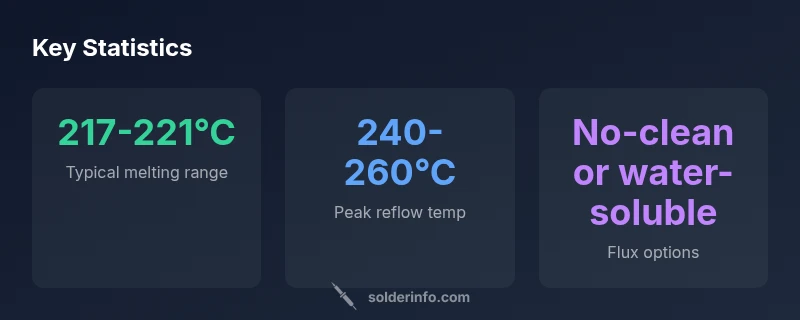
The melting point for lead free solder typically lies around 217–221°C for common SAC alloys (Sn-Ag-Cu), with practical reflow peaks commonly in the 240–260°C range. Processing windows expand or contract based on alloy composition, flux chemistry, and substrate mass. These higher temperatures compared with Sn-Pb require careful profile design to avoid component or board damage, while improving joint reliability. According to SolderInfo, understanding this melting behavior helps engineers select paste formulations, flux types, and heating profiles that minimize defects and maximize consistency across assemblies.
Why the melting point matters for lead-free solder
When you switch from Sn-Pb to lead-free alloys, the solder typically melts at a higher temperature. The melting point for lead free solder is a key design parameter because it governs reflow profiles, component stress, and board reliability. According to SolderInfo, selecting the correct temperature window minimizes defects such as cold joints, voids, and delamination, especially on dense boards and with heat-sensitive components. A well-chosen profile also reduces wear on solder paste and flux, extending manufacturing yield and consistency across batches. This section sets the stage for understanding how alloy choice, flux chemistry, and substrate mass all shape the practical soldering temperature you should target.
Common alloy systems and their melting ranges
The dominant lead-free family is Sn-Ag-Cu (SAC). SAC305, a common formulation (approximately Sn-96.5/Ag-3.0/Cu-0.5), typically exhibits a melting range near 217–221°C. Other SAC variants adjust silver content and can shift wetting speed and reliability, but most clusters fall within a similar window. Some alloys, like Sn-Cu or specialized SAC variants, may push the practical processing window a bit higher or lower depending on particle size, flux, and paste chemistry. When planning a process, always consult the exact datasheet for the paste and alloy you’re using, as practical reflow behavior depends on stencil thickness, board mass, copper density, and component heat tolerance.
How to select temperatures for reflow and hand soldering
Reflow profiles for lead-free soldering aim to bring the alloy into a molten state without overheating neighboring parts. Typical peak temperatures for SAC-based pastes sit around 240–260°C, with a soak window of roughly 150–180°C to promote uniform wetting and reduce thermal shock. For hand soldering, a controlled iron tip approach is used, but you must keep dwell times short to avoid scorching flux residues or delaminating PCB layers. Always tailor the profile to your specific alloy, paste, and substrate, and keep a record of test coupons to refine the heating curve over time.
Practical testing and verification
Validation goes beyond the reflow oven setting. Use thermocouples to monitor actual peak temperatures at representative joints, and inspect solder joints under a microscope for fillet uniformity and voids. Consider IPC-compliant wetting tests on coupon boards, followed by non-destructive tests like X-ray or cross-section analysis to verify quality. Document defect rates and correlate them with process steps (paste bake, stencil cleanliness, ambient humidity). This data-driven approach helps you tune the melting point for lead free solder in your facility, reducing scrap and rework while improving long-term reliability.
Common pitfalls and how to avoid them
Even with the correct melting points, issues arise if profiles are poorly tuned. Overheating can cause solder wick, component damage, and delamination; underheating can produce dull joints with micro-voids. Tombstoning frequently signals an imbalance in reflow slope or paste deposition. To avoid these problems, ensure consistent stencil alignment, adequate paste volume, and proper pre-cleaning. Store solder paste properly to preserve flux activity, and manage humidity exposure, which can alter viscosity and reflow behavior. A consistent, validated profile is your best defense against common defects.
Flux, substrate, and joint reliability
Flux chemistry and substrate compatibility are central to reliable joints at the melting point for lead free solder. No-clean fluxes simplify manufacturing but may leave residues that require later cleaning in dense assemblies. Water-soluble fluxes can improve wetting but demand thorough post-solder cleaning to avoid corrosion or residue staining. Pair the alloy with compatible substrates and consult the paste datasheet for the recommended profile. The goal is reliable, repeatable joints with minimal post-processing demands, achieved through coordinated alloy choice, flux strategy, and reflow settings.
Hand-soldering vs rework considerations
Hand-soldering lead-free alloys demands tight control of temperature and time. Use smaller tips and shorter contact times to limit heat soak, and verify temperatures with a calibrated thermometer. For rework, hot-air tools or a controlled heat gun with precise airflow help avoid board warping. Always observe safety practices and ensure the board can tolerate the thermal exposure. Given the higher melting point, plan rework steps to minimize repeated heating of the same joints and surrounding areas, which can degrade PCB laminates and solder wetting.
Industry practices and trend outlook
Industry practice continues to favor SAC-based lead-free solders with robust reflow profiles, guided by IPC standards and paste manufacturer recommendations. Ongoing research targets reducing the effective processing temperature without sacrificing joint reliability, including alternative alloys and flux chemistries. In practice, engineers must stay current with supplier data and update profiles as formulations evolve. For many manufacturing lines, the melting point for lead free solder remains a central constraint that shapes equipment calibration, paste storage, and quality assurance protocols.
Common lead-free solder alloy ranges and uses
| Alloy Type | Typical Melting Range (°C) | Common Applications |
|---|---|---|
| SAC305 | 217-221 | General electronics assembly |
| SAC387 | 217-221 | Industrial reliability tasks |
| SnCu (99.3Sn-0.7Cu) | 227-230 | Budget or low-cost lead-free soldering |
Quick Answers
What is the typical melting point for lead-free solders?
Lead-free solders, especially SAC alloys, melt around 217–221°C, with practical processing peaking near 240–260°C depending on alloy and flux. Always verify the datasheet for your specific paste.
Lead-free solders melt around 217–221°C; peak reflow is usually 240–260°C, but always check your paste datasheet.
Why is the melting point higher for lead-free solder than Sn-Pb?
Replacing lead with tin-based alloys raises the melting point, requiring higher processing temperatures to form reliable joints while maintaining material compatibility with components.
Lead-free alloys require higher temperatures than Sn-Pb to melt and wet joints properly.
Do I need to adjust reflow profiles for different lead-free alloys?
Yes. While many SAC alloys share similar ranges, small changes in silver content, particle size, and flux can shift the ideal peak temperature and dwell time. Always validate with test coupons.
Yes—adjust profiles for different lead-free alloys and validate with tests.
How does flux type affect soldering with lead-free alloys?
Flux enhances wetting and prevents oxidation; it does not dramatically lower the melting point but its chemistry can influence spread and void formation, so select flux to suit the alloy and substrate.
Flux helps wetting and cleanliness, affecting joint quality more than melting point.
Can lead-free solders be hand-soldered reliably?
Yes, with careful temperature control, shorter dwell times, and appropriate tool selection. Practice and proper flux choice are key to avoiding cold joints and tombstoning.
You can hand-solder lead-free solder, but you must control temperature and time carefully.
What are common signs of overheating lead-free joints?
Discoloration, burnt flux residues, delamination, and lifted pads indicate overheating. Adjust profile and inspect with magnification to prevent damage.
Watch for discoloration, residue, or pad lifting—adjust the heat profile if seen.
“Understanding the melting point for lead free solder is essential for reliable joints; proper profiles reduce defects and extend board life.”
Top Takeaways
- Know the typical melting range to plan reflow profiles.
- Choose alloy and flux based on substrate compatibility and joint goals.
- Test with thermocouples to verify actual joint temperatures.
- Avoid overheating to prevent damage and defects.