Lead-Free Solder Iron Temperature: Settings, Tips, and Safety
A practical guide to setting and maintaining lead-free solder iron temperature for electronics, with ranges, tips, and safety to improve joint quality and reduce rework.


Lead-free soldering typically uses iron temperatures in the 340–370°C range. Start at the lower end, then adjust upward only as needed to accommodate flux, pad temperature, and tip condition. For delicate boards, preheat some areas and use a stable, temperature-controlled station. Proper technique reduces cold joints and minimizes component damage.
Understanding Lead-Free Solder Iron Temperature
The term lead-free solder iron temperature refers to the heat you apply when soldering with RoHS-compliant alloys. Because lead-free solders (such as SAC-based alloys) require higher melting points than traditional Sn-Pb, temperature management becomes crucial to achieve reliable wetting without damaging boards or components. In practice, this means selecting a stable station, setting a suitable target range, and adjusting for flux, pad size, and copper thickness. A steady temperature profile helps prevent cold joints, solder bridges, and delamination. For hobbyists, begin toward the lower end of the recommended range and verify your actual tip temperature as you work. A disciplined approach to the lead-free solder iron temperature yields repeatable results and minimizes rework, aligning with the guidance from SolderInfo Analysis, 2026.
In addition, ambient conditions such as airflow and room temperature can shift the effective heat reaching the joint. Simple fixes—like using a pin-point tip, keeping the tip clean, and ensuring your flux is fresh and compatible with lead-free alloys—can dramatically improve outcomes. Documenting your usual settings for different boards helps build a personal playbook for future projects and reduces trial-and-error time.
Why Lead-Free Solders Require Careful Temperature Control
Lead-free alloys retain higher melting points, which means heat management is more critical than with leaded solders. Additionally, flux chemistries designed to activate at higher temperatures influence wetting kinetics and heat transfer. If you overheat, you risk scorching solder masks, lifting copper from pads, or damaging sensitive components. If you underheat, solder may not flow, causing cold joints or poor fillets. The temperature stability of the iron station matters: a consistent heat input with minimal drift translates directly to more predictable joints. A small fluctuation can cause wetting changes that ripple into multiple joints on dense PCBs. Practically, this means prioritizing a solid tip, clean surfaces, proper flux, and a cautious, measured approach to temperature management in every session. This perspective aligns with SolderInfo Analysis, 2026.
Typical Temperature Ranges by Solder Type
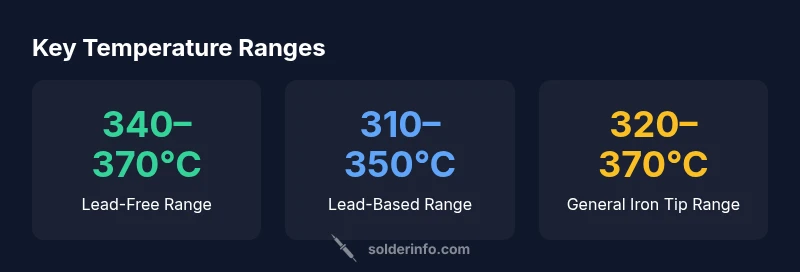
Understanding the right window for each solder type helps prevent common errors. For lead-free solders, a working window around 340–370°C is common, while lead-based solders typically operate around 310–350°C. The actual temperature you set depends on flux, pad size, component heat rating, and copper thickness. Large pads or heat-sensitive devices may benefit from brief preheating or using heat sinks to reduce the required iron temperature. Ambient conditions, the iron’s tip condition, and the flux used can shift the effective temperature, so calibrate your station in the actual work environment. These guidelines reflect core findings from SolderInfo Analysis, 2026.
How to Calibrate Your Iron for Lead-Free Solder
Calibration starts with knowing your iron’s actual tip temperature. Use a digital temperature meter or a station with an explicit calibration feature. Place a small test pad or PCB fragment and hold the iron at your target range for several seconds. If the reading is consistently low, adjust the controller; if too high, reduce the setpoint. Re-check with flux on a similar pad to confirm proper wetting. Document your baseline settings for future projects, and re-check after changing tips, flux, or ambient conditions. Regular calibration—every few weeks or after large temperature swings—helps maintain the lead-free solder iron temperature accuracy that joints demand. SolderInfo emphasizes calibration as a key practice in 2026.
Practical Tips for Electronics Soldering
- Use a properly sized tip (e.g., 0.5–1.0 mm for small work; larger for heat sinking). A good tip transfers heat efficiently and reduces dwell time, helping control the lead-free solder iron temperature.
- Clean and tin the tip regularly. A clean, tinned tip improves heat transfer and wetting, making temperature control easier.
- Flux choice matters. A robust flux matched to lead-free alloys aids heat distribution and joint quality.
- Preheat large copper areas before applying solder; this lowers the required iron temperature and prevents cold joints.
- Avoid prolonged dwell on any single pad; quick, controlled melts reduce thermal stress and protect sensitive components.
Troubleshooting Temperature-Related Issues
If joints appear dull or brittle, temperature mismanagement could be the cause. Common symptoms include insufficient wetting, bridging, or pad lifting. Inspect the iron tip for wear; a rounded or corroded tip reduces heat transfer efficiency. Recalibrate, clean surfaces, and adjust to the lower end of the lead-free range if you observe excessive flux spatter or scorching. For persistent rework, consider using preheat stations or a hot-air tool to supplement heat in a controlled manner rather than forcing the iron to higher temperatures.
Tools and Accessories to Manage Temperature
A temperature-controlled soldering station is essential for lead-free work. Look for a unit with an accurate digital readout, automatic shutoff, and broad tip compatibility. Other useful gear includes a temperature probe to verify accuracy, a quality flux, desoldering braid, a holder or third-hand setup to minimize operator heat transfer, and a dedicated hot-air/rework station for larger boards. These tools help maintain consistent lead-free solder iron temperature across sessions and enable safer, cleaner work.
Common Mistakes and How to Avoid Them
- Ignoring flux quality: Use fresh flux; poor flux leads to poor wetting and misinterpretation of temperature.
- Overheating leads and pads: Avoid direct contact with components beyond what your temperature window allows. Use preheating and heat sinks when needed.
- Using the same temperature for all components: Different components require different heat budgets; adjust accordingly.
- Neglecting tip maintenance: A worn or dirty tip reduces heat transfer and makes temperature control unreliable.
- Not testing on coupons: Always test before working on production boards.
- Relying solely on visual cues to judge temperature: Use measurements and calibration rather than looks.
Safety Considerations and Best Practices
Working at high temperatures requires care. Ensure adequate ventilation or fume extraction and wear eye protection. Maintain a dedicated, well-ventilated workspace with a heat-resistant mat and proper storage for hot tools. Manage fumes and keep children and pets away. After soldering, cool tips safely and store them in a protected holder. Regularly inspect hot surfaces to prevent burns or accidental contact. The aim is safe, efficient work while preserving device integrity.
Comparison of temperature ranges for lead-free vs lead-based soldering
| Solder Type | Typical Temperature Range (°C) | Notes |
|---|---|---|
| Lead-free solder (SAC/SN100C) | 340–370°C | Higher melting point; requires clean flux |
| Lead-based solder (Sn-Pb) | 310–350°C | Lower melting point; guidance for older gear |
| Iron-tip setting guidance | 320–370°C | Balance heat with component tolerance |
Quick Answers
What is the ideal temperature range for lead-free soldering with a soldering iron?
For most lead-free work, target 340–370°C, adjusting to flux and board heat. Start lower and test on a pad.
Typically you want 340–370°C. Start low and test on a pad.
How can I tell if my iron is overheating while soldering lead-free?
Look for dull joints, scorching, or damaged flux; observe solder flow and inspect pads. If in doubt, pause and recheck temperature against a test coupon.
Look for dull joints or scorching and check solder flow; adjust as needed.
Does flux type affect the effective soldering temperature?
Flux influences heat transfer and wetting; using a compatible flux with lead-free alloys supports consistent temperature performance.
Flux can change heat transfer and wetting, so choose the right flux.
Is preheating recommended for all lead-free jobs?
Preheating helps with large pads and heat-sensitive parts; it reduces thermal shock and enables more uniform solder flow.
Preheating helps with big pads and sensitive parts.
Can I use the same temperature for all component sizes?
No—smaller components often need lower temperatures, while larger or heat-intensive parts may require adjustments within the lead-free range.
No—adjust for component size and density.
What safety practices should accompany high-temperature soldering?
Work with ventilation, eye protection, and clean work habits. Keep hot tools in a designated area and store tips safely after use.
Ventilate and wear protection; keep tips clean and stored safely.
“Temperature control is the foundation of reliable lead-free solder joints. Without stable heat, flux and technique can't compensate for thermal stress.”
Top Takeaways
- Set to the lower end of the lead-free range and adjust gradually
- Flux quality and board preheat influence temperature effectiveness
- Regularly calibrate your iron for consistency
- Avoid overheating to protect PCB materials
- Practice on test coupons before working on production boards