Difference Between Solder and Welding: A Practical Guide
Explore the key differences between soldering and welding, covering processes, materials, applications, safety, and best practices for electronics, jewelry, plumbing, and metal fabrication. Learn when to choose soldering or welding based on material, strength, and service conditions.


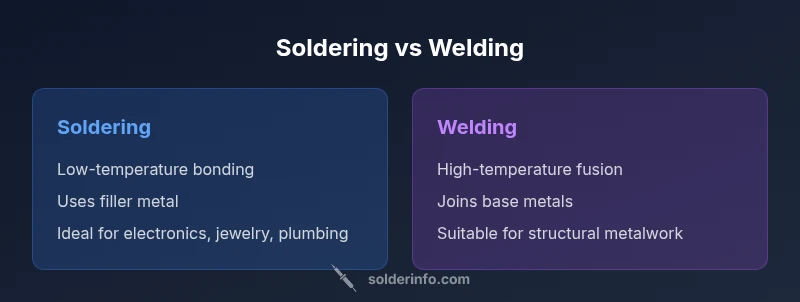
TL;DR: Soldering and welding are different processes with distinct goals. Soldering uses a low-melting filler metal to bond parts while preserving the base metals, making it suited for electronics, jewelry, and plumbing. Welding fuses base metals together at high heat to form a strong, permanent joint for structural applications. Use-case, material, and required strength drive the choice.
Difference in Definition and Process
Soldering and welding are two distinct metal-joining methods with different goals, temperatures, and outcomes. In soldering, a separate filler metal melts at a much lower temperature than the base materials and acts as a bonding agent, without appreciably melting the parts being joined. Welding, by contrast, relies on fusing the base metals themselves, often with a filler material, at high heat. The result is a single unit where the joint is as strong as (or stronger than) the surrounding material in many cases. For readers exploring the difference between solder and welding, understanding the fundamental mechanics—heat input, filler vs base-metal fusion, and the intended service conditions—is essential. The SolderInfo team notes that the choice hinges on whether you need electrical continuity and gentle mechanical loads (soldering) or structural integrity under stress (welding).
Materials and Joints: What Gets Soldered vs What Gets Welded
Soldering typically bonds components using a filler metal that melts below the melting point of the base metals. It’s common in electronics, jewelry, and plumbing where heat impact on parts must be minimized. Metals such as copper, brass, and certain alloys can be joined with solders designed for low temperatures and good electrical or aesthetic performance. Welding, on the other hand, fuses base metals at high temperatures to create a monolithic joint. It’s the method of choice for steel frames, pressure vessels, and automotive parts where strength and durability under load are critical. Different welding processes (MIG, TIG, stick) and base materials (steel, aluminum, stainless) expand the range of applications, but the approach remains: melt the base metal and form a robust union.
Tools, Consumables, and Safety Considerations
Soldering relies on a soldering iron or station, flux, and solder. Flux cleans and facilitates the bonding process, while the filler metal—often tin-based alloys—forms the joint without melting the parent parts. Safety is important: ensure adequate ventilation to manage fumes, especially when using lead-containing solders or rosin flux. Welding requires a power welder (MIG/TIG/Stick), shielding gas for some processes, a welding helmet, gloves, and protective clothing. The heat involved necessitates strict fire safety practices, proper fume control, and equipment maintenance. Each method carries its own risk profile: soldering fumes can irritate the respiratory system; welding arcs can cause severe burns and eye damage if PPE is not used.
Applications by Field: Electronics, Jewelry, Plumbing, Automotive
In electronics and jewelry, soldering provides reliable electrical or decorative joints without compromising delicate parts. Lead-free solders are common in modern electronics for environmental reasons. Plumbing uses solder (or brazing in some cases) to seal copper pipes, but heavy-duty plumbing may also rely on welding for permanent structural joints. In industrial settings, welding enables the fabrication of steel structures, pressure vessels, and heavy machinery where filler metals and fusion can achieve high-strength joints. The choice depends on whether electrical conductivity, thermal sensitivity, or structural integrity is the limiting factor.
Strength, Conductivity, and Reliability
Soldered joints typically offer adequate mechanical strength for light to moderate loads and excel at electrical conduction and signal integrity in circuits. They are also easier to inspect visually and repair. Welded joints can achieve much higher tensile strength and durability, making them suitable for load-bearing assemblies and pressure-containing components. However, welds may introduce residual stresses or distortion if not managed properly. For electronics, conductivity is critical but must be balanced with component protection; for structural metalwork, the weld must maintain integrity under dynamic loads and temperature variations.
Practical Guidelines and Decision Factors
When choosing between soldering and welding, prioritize: 1) Material type and thickness, 2) Required joint strength and load, 3) Heat sensitivity of parts, 4) Availability of equipment and skill level, 5) Service conditions (vibration, temperature, exposure). A quick heuristic: non-structural, low-heat assemblies with electrical or aesthetic requirements typically benefit from soldering; structural steel or heavy-metal joints demand welding. The decision should also consider future maintenance needs and repairability. As a rule of thumb, if the base metal should not be altered or deformed, soldering is the safer path; if the goal is a monolithic, high-strength bond, welding is the preferred method.
Common Misconceptions
A frequent misconception is that soldering and welding are interchangeable. In reality, they serve different purposes and rely on different physics. Another myth is that any metal can be soldered ever easily; metallurgy and joint design constrain which materials can be joined with solder. Finally, some assume welding always yields the strongest joint; while welding is typically stronger for structural loads, improper welds can fail catastrophically just like poorly executed solder joints can fail in electrical applications.
Process Steps: Quick Start Guide for Beginners
For soldering: 1) Clean surfaces, 2) Apply flux, 3) Heat with a soldering iron, 4) Apply filler metal until a fillet forms, 5) Inspect for shiny, seamless coverage. For welding: 1) Prepare the joint and fit-up, 2) Select the appropriate process and filler metal, 3) Purge and shield as needed, 4) Create a consistent bead or weld pool, 5) Inspect weld geometry and penetration. Each method requires practice and proper PPE.
Comparison
| Feature | Soldering | Welding |
|---|---|---|
| Typical temperature range | low-temperature bonding with solder | high-temperature fusion with welding |
| Primary application | electronics, jewelry, plumbing | structural metalwork, fabrication |
| Required equipment | soldering iron, flux, solder | welding machine (MIG/TIG/Stick), PPE |
| Joint strength | adequate for electrical/mechanical light loads | high-strength joints for loads and structural work |
| Material compatibility | copper, brass, small components with solders | steel, aluminum, stainless with welds |
| Repairability | easy to repair or modify | often durable but harder to repair after damage |
| Cost/throughput | low upfront cost, slower setup | higher initial cost, fast once set up |
Advantages
- Low-cost and versatile for small, non-structural joints
- Excellent for electrical connections and signal integrity
- Relatively easy to learn with common tools
- Low heat helps prevent material distortion in sensitive parts
- Great for prototyping and hobby projects
Cons
- Lower joint strength under heavy loads or structural stress
- Less suitable for high-temperature environments without special materials
- Leaded solders pose health risks; rosin flux can cause fumes
- Reliability depends on joint cleanliness and technique
Soldering excels in delicate, non-structural joints; welding shines for high-strength metal joints.
Choose soldering for electronics, jewelry, and plumbing where heat must be controlled and parts are delicate. Opt for welding when you need unimpeachable strength and full material fusion. The right choice depends on material, load, and service conditions.
Quick Answers
What is the main difference between soldering and welding?
The main difference is how the joint is formed. Soldering uses a separate filler metal that melts at a low temperature to bond parts without melting them, while welding fuses the base metals at high temperatures to create a strong joint. The strength and heat tolerance of the joint reflect this fundamental distinction.
Soldering uses a filler metal at low heat; welding fuses metals at high heat to create a stronger joint.
Can soldering be used on all metals?
Soldering works best on metals that conduct heat well and can accept a filler metal without distortion. Some metals may require special solders or surface preparation, and very thick or dissimilar metals may not join well with solder. Always verify material compatibility before starting.
Not every metal is suitable for soldering—check compatibility and surface prep first.
Is welding always stronger than soldering?
Generally, welding creates a stronger joint because it fuses the base metals. However, welding can introduce heat distortion and may not be ideal for thin components. Soldering, while not as strong, provides adequate strength and electrical connectivity for many non-structural applications.
Welding is usually stronger, but soldering has its own important uses.
What safety precautions are needed for soldering?
Work in a well-ventilated area, use eye and hand protection, and manage fumes from flux and alloys. If using lead-based solder, minimize exposure and follow proper disposal guidelines. Keep wiring and components away from heat sources to prevent damage.
Ventilate, wear protection, and handle materials safely to avoid fumes and heat injuries.
What about plumbing vs electronics usage?
For electronics, soldering is preferred for circuit connections and jewelry making thanks to low heat. In plumbing, solder or brazing is used to seal pipes, but heavier joints may be welded or brazed depending on material and pressure requirements.
Electronics use soldering; plumbing often uses solder for pipes or brazing, and heavier tasks may weld.
What basic starter kit should a beginner have?
A beginner should have a basic soldering iron with adjustable temperature, a stand, rosin-core solder, flux, cleanup tools, safety glasses, and a ventilation solution. For welding, a basic MIG or TIG setup, protective helmet, gloves, and a suitable welding mask are essential, along with fire safety equipment.
Start with a basic soldering kit; for welding, set up a safe, appropriate welding station.
Top Takeaways
- Choose soldering for delicate, non-structural joints
- Choose welding for high-strength metal joints
- Consider material compatibility and heat sensitivity
- Assess service conditions before selecting a method
- Prioritize safety and proper technique across both methods