Solder or Weld vs Brazing: A Practical Comparison
Objective, in-depth comparison of soldering, brazing, and welding for electronics, plumbing, and jewelry—covering strength, temperatures, materials, costs, and best-use scenarios.


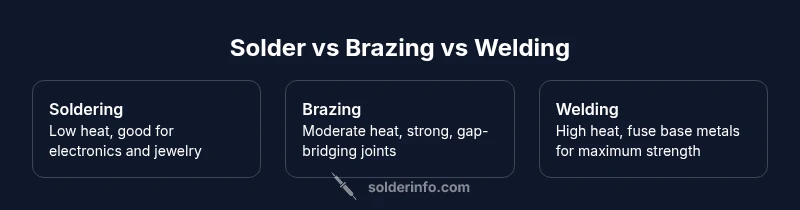
Soldering, brazing, and welding are distinct metal-joining methods chosen for different materials, temperatures, and loads. Soldering uses a low-melting filler to join parts without melting the base metals. Brazing uses a higher-temperature filler and capillary action to bond parts, while welding fuses the base metals themselves for maximum strength. The best choice depends on joint requirements, materials, and service conditions.
The Core Differences: Solder, Brazing, and Welding
In the solder or weld vs brazing decision, understanding the core mechanism is essential. Soldering, brazing, and welding are all metallurgical joining methods, but they operate at different temperatures and with different outcomes for the joint. Soldering uses a filler alloy with a melting point well below the base metals; the base parts remain unsoldered. Brazing also uses a filler metal, but at higher temperatures and with capillary action that wicks the filler into the joint. Welding, by contrast, fuses the base metals themselves, often creating a continuous metal bridge and requiring additional shielding and control.
According to SolderInfo, the choice is driven by three factors: joint strength requirements, material compatibility, and service conditions including temperature fluctuations and mechanical loads. For electronics, jewelry, and precision plumbing, soldering and brazing offer non-destructive options for joining small components; welding is typically chosen for structural integrity and long-term durability. When you compare solder or weld vs brazing for a given project, you are balancing heat input, joint geometry, and repairability. A well-chosen method reduces risk of damage to components, minimizes post-processing, and improves reliability across service life. The SolderInfo team emphasizes that there is no one-size-fits-all solution; the optimal choice emerges from matching process characteristics to the part’s material, environment, and expected stresses.
When Solder is Ideal
Soldering is ideal for joints that require low heat input, reversible or repairable connections, or when the base metals must not melt. This makes soldering a staple in electronics, jewelry making, and delicate plumbing with copper or brass components. The process uses a filler metal with a melting point well below the base metal, and relies on flux to promote wetting and capillary action. For electronics, this means joining wires, terminals, and circuit components without jeopardizing heat-sensitive parts. In jewelry, solder provides smooth seams and minimal distortion when done with compatible metals. In plumbing, lead-free solders are common for copper piping where joint integrity and water safety are paramount. For all these scenarios, cleanliness, proper flux chemistry, and precise heat control determine success. Soldering is typically faster, lower cost, and more forgiving for small or complex shapes, but its joints usually aren’t meant to bear high mechanical loads or extreme temperatures.
When Brazing is Preferred
Brazing sits between soldering and welding in terms of strength and heat requirements. It uses a filler metal with a higher melting point than solder but lower than many welding processes. Brazing can join dissimilar metals, fill larger gaps, and create strong, leak-resistant joints in copper, steel, and some brass alloys. The capillary action draws the molten filler into the joint, creating a strong bond without melting the base metals. This makes brazing attractive for HVAC components, valve assemblies, and jewelry pieces where gap bridging and material compatibility matters. Brazing offers attractive durability for moderately loaded joints while preserving heat-sensitive components in nearby regions. A key factor is selecting the right filler alloy and flux for the metals being joined to avoid brittle interfaces or corrosion.
When Welding Makes Sense
Welding fuses base metals, delivering the strongest possible joints when done correctly. It is the go-to method for structural applications, large fabrications, and where long service life under demanding loads is required. Welding can join steel, aluminum, stainless steel, and many other metals, but it demands compatible materials, adequate shielding, and skilled technique to avoid defects such as porosity, warping, or cracking. For electronics or jewelry, welding is rarely used for the final joints due to heat sensitivity and aesthetic considerations, but it remains indispensable for frames, housings, and mechanical assemblies in plumbing or industrial equipment. The choice to weld is often driven by load-bearing requirements, corrosion resistance, and the ability to bear thermal cycling over the product’s life.
Material Compatibility and Joint Strength
Each method has material limitations. Solder presents excellent compatibility with thin gauge metals and heat-sensitive components but offers moderate/low strength. Brazing accommodates a wider range of metals, including dissimilar alloys, and produces strong, leak-tight joints with relatively uniform fillet radii. Welding excels in strength, especially for structural joints, but materials must be compatible with the welding process (e.g., steel, aluminum alloys, stainless steel) and must withstand heat input. Joint geometry matters: solder and brazed joints benefit from clean, well-prepared joints with appropriate fillets and capillary gaps, while welded joints require clean bevels and adequate alignment to maximize fusion and minimize distortion.
Process Parameters and Equipment
Soldering requires a soldering iron or station, flux, and lead-free or traditional solders depending on the application. Brazing uses a torch or induction heating system, brass or silver-based fillers, and flux to promote capillary flow. Welding relies on a welding machine (MIG, TIG, or Stick), shielding gas for certain processes, and specific consumables matched to the base metals. Training, safety practices, and proper setup are essential for all three methods. Beginners should practice on scrap pieces to understand heat distribution, joint fit-up, and flux behavior before attempting real assemblies. Correct technique reduces defects and improves repeatability across projects.
Cost, Labor, and Longevity Considerations
Soldering typically incurs lower equipment and material costs and shorter setup times, making it attractive for low-volume or hobby work. Brazing can offer a balance between cost and strength, especially for dissimilar metals and larger gaps. Welding requires higher upfront investment, more space, and greater expertise, but yields superior strength and durability for structural joints. The longevity of each joint depends on proper material selection, heat control, and environmental exposure. For electronics, longevity is often tied to mechanical integrity and thermal cycling rather than raw strength; for plumbing, corrosion resistance and leak integrity matter most; for jewelry, appearance and biocompatibility may drive decisions.
Safety and Quality Assurance
All three processes require careful safety planning. Soldering fumes, flux residues, and hot metal surfaces pose risks to eyes, skin, and lungs; brazing and welding introduce higher heat and potential for burns, sparks, and UV exposure. Personal protective equipment, ventilation, and proper training are essential. Quality assurance includes cleaning joints, applying flux correctly, verifying bond integrity, and testing for leaks or mechanical strength. In production environments, standardized procedures and inspection criteria help ensure consistent results across batches.
Industry Applications: Electronics, Plumbing, Jewelry
Electronics rely heavily on soldering for interconnections and component attachment, with strict cleanliness standards and thermal budgets to protect components. Plumbing uses solder or brazing to create leak-tight copper pipe joints and to join fittings, where corrosion resistance and mechanical performance are key. Jewelry relies on soldering for discreet seams and repairs, where aesthetic appearance and metal compatibility matter most. Each sector has unique standards and testing methods that define acceptable joint quality, flux usage, and post-process finishing. Understanding these sector requirements helps select the most appropriate method for a given project.
Quick-start Guidelines for Beginners
If you’re new to metal joining, start with soldering for small, heat-sensitive assemblies and simple shapes. Practice joint fit and flux control on scrap pieces. When gaps exceed what soldering can bridge, or when dissimilar metals must be joined, consider brazing with a suitable filler and flux. For high-strength needs or structural components, welding may be the best option but requires formal training and proper equipment. Always prioritize safety, and validate joints with tests such as leak checks, torque tests, or visual inspection for uniform fillets and absence of defects.
Feature Comparison
| Feature | Soldering | Brazing | Welding |
|---|---|---|---|
| Typical Joint Type | Bond without melting base metals using a low-temp filler | Strong, gap-bridging joints with a higher-temp filler | Fusion of base metals for maximum strength |
| Required Equipment | Soldering iron, flux, and solder | Torch or heating method, brazing filler, flux | Welding machine (MIG/TIG/Stick), shielding gas where required |
| Typical Materials | Thin metals, electronics leads, jewelry pieces | Copper, steel, stainless steel, some alloys | Most structural metals (with process-specific compatibility) |
| Strength Range | Moderate to low; not for heavy loads | High to very high; suitable for gaps | Very high; best for structural joints |
| Appearance and Finish | Smooth seams; flux residues may be present | Clean joints with precise fillets; minimal artifacts | Fusion lines; potential distortion or warping if not controlled |
| Cost and Setup Time | Low cost and quick setup | Moderate cost; longer prep and cleanup | Higher cost and longer training; heavy equipment |
Advantages
- Low heat input protects heat-sensitive components
- Simple setup with minimal equipment for soldering
- Cost-effective for small, precise joints
- Repair-friendly for electronics and jewelry
Cons
- Generally lower structural strength than welding
- Not ideal for high-temperature service or heavy loads
- Material compatibility and flux residues can complicate processes
- Difficulty achieving perfect joints on large or complex assemblies
Solder is best for low-temperature, non-structural joints; brazing offers stronger results and gap-bridging; welding delivers maximum strength but requires skill and equipment.
Choose solder for delicate, low-load joints. Use brazing when dissimilar metals or larger gaps exist. Reserve welding for structural applications demanding maximum strength and durability.
Quick Answers
What is the fundamental difference between soldering, brazing, and welding?
Soldering, brazing, and welding all join metal, but differ in heat input and how the joint forms. Soldering uses a filler metal that melts below the base metals, brazing uses a higher-temperature filler that flows into the joint by capillary action, and welding fuses the base metals themselves to create a single, continuous piece. The choice depends on the required strength, material compatibility, and service conditions.
Soldering uses a low-temperature filler; brazing uses a higher temperature with capillary flow; welding fuses the base metals for strength. The right choice depends on strength, materials, and service conditions.
When would brazing be preferable to soldering?
Brazing is preferable when you need stronger joints, larger gaps, or when joining dissimilar metals. It handles higher service temperatures than soldering and provides better leak resistance in plumbing and HVAC components. The trade-off is higher equipment needs and slightly more complex technique.
Brazing is stronger than soldering and good for larger gaps or dissimilar metals. It needs more equipment and skill.
Is welding always stronger than brazing or soldering?
Typically, yes, welding produces stronger joints since it fuses base metals. However, strength depends on material type, alloy composition, joint design, and welding quality. In some electronics or jewelry contexts, soldering or brazing may be preferable despite lower ultimate strength due to heat sensitivity or aesthetics.
Welding is usually strongest, but it depends on the metals and joints. For some electronics or jewelry, soldering or brazing can be the better choice.
What safety precautions are essential for all three processes?
Always ensure proper ventilation and PPE. Avoid inhaling fumes, protect eyes from sparks, and prevent burns from hot metals. Use appropriate flux, shielding gas where required, and follow established procedures for heat management and disposal of residues. Training and supervision are crucial for beginners.
Ventilate, wear PPE, and follow proper procedures. Training is important for safe, effective results.
Can I mix processes in a single project?
Yes, in many assemblies you might use soldering for delicate joints and welding for structural parts. Brazing can bridge gaps between materials that soldering cannot. Plan joint design and sequence to minimize heat exposure and ensure compatibility of finishes and coatings.
Mixing methods is common: solder where heat must be gentle, weld where strength matters, and brazing for gaps or dissimilar metals.
Top Takeaways
- Assess joint strength requirements first
- Match metals to the joining method
- Prioritize heat control and material compatibility
- Plan for inspection and post-processing
- Invest in safety and proper training