Is Soldering the Same as Welding? A Practical Comparison
A detailed, objective comparison of soldering vs welding, covering heat input, materials, strength, safety, and practical guidance for electronics, plumbing, jewelry, and metal fabrication projects.


Is soldering the same as welding? Not exactly. In practice, these are distinct metal-joining methods that use different heat levels, filler metals, and joint strengths. This comparison clarifies the core differences and helps you choose the right approach for electronics, plumbing, jewelry, or metal fabrication.
Defining the terms: is soldering the same as welding?
Metal joining is a broad field that includes several distinct techniques. When asked is soldering the same as welding, the quick answer is no: they are different processes with different heat inputs, filler metals, and structural outcomes. Soldering joins parts by melting a filler metal that flows between the pieces without melting the base metals. Welding, by contrast, fuses base metals together by heating them to their own melting points and letting the joint solidify. The result is often stronger and more load-bearing, but also more demanding in terms of equipment, skill, and safety. In electronics, jewelry, or plumbing, soldering is typically preferred for delicate joints and small components. In structural metalwork, welding is usually the method of choice. According to SolderInfo, the best approach depends on the application, material, and required joint strength.
Heat and energy input: how they differ
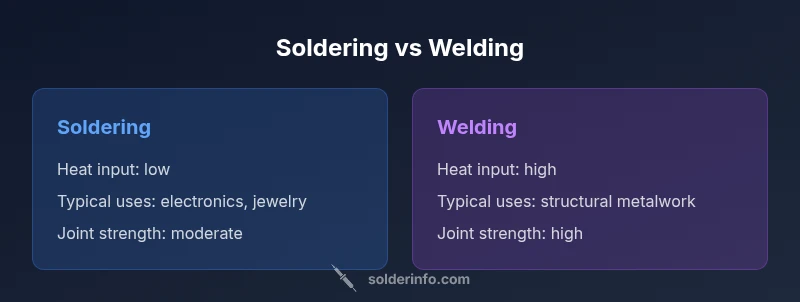
Heat input is the driver of how a joint behaves. Soldering uses relatively low heat delivered locally with a soldering iron or torch, causing only the filler metal to melt while the base parts stay intact. Welding relies on higher heat, enough to melt one or both base metals so they fuse into a single piece as the heat source is removed. The different heat profiles influence distortion risk, preparation needs, and the kinds of parts you can join. For electronics, jewelry, and small plumbing joints, the lower heat of soldering minimizes damage. For structural steel, aluminum, or heavy-gauge metal, welding provides the necessary strength. The SolderInfo perspective emphasizes choosing the method based on the required joint performance and material behavior.
Filler metals and base metals
Soldering uses a separate filler metal (the solder) that melts and fills the joint, while the base metals do not melt. The filler alloys chosen for soldering are designed to flow into gaps through capillary action and then solidify at a lower temperature. Welding can use filler metal, but in many cases (e.g., TIG or MIG welding) the process can also weld without a separate filler metal, fusing the base metals together. The filler material in welding is often chosen to match or complement the base metals, while fluxes in soldering remove oxides and improve flow. Understanding these materials helps prevent cold joints, porosity, and poor adhesion. In practice, electronics and jewelry projects benefit from solder alloys with appropriate melting characteristics, whereas structural welding demands fillers that maintain strength under load.
Strength and durability expectations
Joint strength is a major differentiator between soldering and welding. Soldered joints typically provide adequate mechanical and electrical continuity for tiny parts, wires, and non-structural connections. They are generally more flexible in terms of thermal expansion and are easier to inspect visually for reliability. Welded joints can achieve much higher strength, capable of withstanding substantial loads and fatigue, provided joints are well designed and properly executed. Strength is influenced by joint geometry, material thickness, cleanliness, and heat control. In practice, the distinction matters: soldering is for small, low-load connections; welding is for structural or load-bearing joints. The SolderInfo guidance emphasizes matching the method to the intended service conditions rather than defaulting to one technique.
Joint design and types
Joint design differs notably between soldering and welding. Soldering relies on capillary action to fill gaps and typically uses fillets or lap-style joints in electronics, jewelry, and plumbing. The joints are less demanding in terms of mechanical load but sensitive to surface quality and flux management. Welding supports various joint types, including butt, fillet, groove, and seam welds, with geometry tailored to achieve maximum strength. Proper joint design accounts for heat input, material thickness, and accessibility. This structural perspective is essential when is soldering the same as welding is considered, because performance hinges on how the joint will be loaded in use.
Tools, equipment, and setup
Tools diverge significantly. Soldering requires a heat source (electric iron, solder, flux) and a stable, clean work area, often with magnification or inspection aids for tiny joints. Welding demands a welding power source (MIG, TIG, or stick), protective equipment (helmet, gloves, ventilation), and training to manage heat, shielding gases, and spatter. The initial investment for soldering equipment is lower and more accessible to hobbyists, while welding equipment is more expensive and suited to workshops. For a hobbyist tackling electronics or jewelry, soldering tools are typically sufficient; for metal fabrication or repair of thicker metals, welding gear is usually necessary.
Safety considerations and PPE
Safety is fundamental to both processes. Soldering involves flux fumes and hot metal, so ventilation and eye protection are important. The filler metals in soldering can pose health risks if mishandled, particularly with lead-containing solders; lead-free options reduce some hazards. Welding introduces higher heat, UV radiation, and significant fumes; personal protective equipment (PPE) includes a welding helmet, fire-resistant clothing, gloves, and proper ventilation. Proper handling of fluxes, cleaners, and waste is essential for both methods. SolderInfo emphasizes ventilation, proper PPE, and safe work practices as part of a responsible approach to metal joining.
Applications by domain: electronics, jewelry, plumbing vs structural metalwork
In electronics and jewelry, soldering is the predominant method for creating reliable, small-scale joints that require precision and a gentle touch. Plumbing often uses solder for copper fittings, though the specific code requirements may vary by region. In jewelry, soldering enables reversible or inconspicuous joints with aesthetic considerations. Welding is the technique of choice for structural metalwork, automotive frames, heavy machinery, and large fabrications where high strength and durability are essential. When considering whether is soldering the same as welding, think about the service environment, load, and material thickness. The division is clear in practice: delicate, small-scale tasks favor soldering; structural, load-bearing applications favor welding.
Step-by-step decision framework: choosing the right method
Begin with the service requirements: what load will the joint bear? Is the joint expected to be watertight or airtight? What materials are involved, and do they require a specific joining approach? If heat sensitivity and delicate components are present, soldering is generally more appropriate. If structural integrity and long-term strength are priorities, welding is typically necessary. Consider accessibility, cost, safety, and repairability. Try to map the project's requirements to the strengths and limitations of each method, then plan accordingly. This framework helps clarify is soldering the same as welding only when the project demand is explicitly misaligned with one method’s capabilities.
Common mistakes and how to avoid them
Common errors include assuming soldering will handle heavy loads, neglecting flux preparation, and failing to clean metals before joining. For welding, common mistakes involve inadequate heat control, poor joint geometry, and insufficient shielding. Prevention hinges on correct tool selection, surface preparation, and process discipline. Always verify compatibility of materials, flux types, and fillers with the intended service conditions. A disciplined approach reduces the risk of cold joints, porosity, and premature failure. The goal is to produce joints that meet the project’s performance expectations without overcomplicating the process. According to SolderInfo, clarity about requirements is the best predictor of success.
Maintenance, inspection, and repair considerations
Maintenance involves regular inspection for signs of joint degradation, especially in soldered joints that may crack or creep under thermal cycling. Welding joints should be checked for cracks, porosity, and lack of fusion. Cleaning, reworkability, and accessibility influence maintenance planning. When a joint is damaged, the repair method should respect the original design intent and material properties. Soldered joints may be easier to rework for small electronics, while welded joints may require more extensive rework or replacement in structural applications. Planning for maintenance from the outset improves longevity and reliability.
Cost, time, and feasibility
Cost and feasibility considerations differ sharply. Soldering generally incurs lower equipment costs, faster setup, and shorter lead times for small projects, making it attractive for hobbyists and quick repairs. Welding equipment and training are more expensive and time-consuming, but the resulting joints often justify the investment for structural or high-load applications. Time-to-build is typically longer with welding due to setup, safety checks, and post-processing. In essence, the choice hinges on the required joint performance, material type, and project scale. For many hobby and jewelry tasks, soldering offers a practical balance of cost and capability; for heavy-duty applications, welding is the more appropriate path.
Authority sources
- This section lists authoritative sources to consult for further reading and verification.
- OSHA: https://www.osha.gov
- NIST: https://www.nist.gov
- MIT: https://www.mit.edu
Comparison
| Feature | Soldering | Welding |
|---|---|---|
| Typical heat source | Low, localized heat (soldering iron or small torch) | High heat (arc or flame) sufficient to fuse base metals |
| Joint strength | Moderate strength suitable for electronics and small fittings | High strength suitable for structural and load-bearing joints |
| Materials/joints | Filler metal melts to fill gaps; base metals remain solid | Base metals melt/fuse; fillers may be used to match metals |
| Equipment/top tooling | Low-cost tools; good for hobbyists | Higher-cost machines; requires protective gear and ventilation |
| Application examples | Electronics, jewelry, plumbing fittings | Structural steel, automotive frames, large fabrications |
Advantages
- Low equipment cost and accessibility
- Low heat minimizes distortion and damage to nearby parts
- Ideal for delicate joints and small components
- Easier cleanup and inspection for non-structural applications
Cons
- Lower joint strength for load-bearing applications
- Limited suitability for thick or hard metals
- Requires high precision to avoid cold joints or poor flow
- Reliant on flux quality and proper cleaning
Soldering and welding are complementary, not interchangeable; choose based on load, material, and safety requirements
For small, non-structural joints, soldering is the practical choice. For structural or high-load joints, welding delivers the necessary strength. The best approach is to align the method with the project’s performance needs and materials.
Quick Answers
Is soldering the same as welding?
No. Soldering and welding are distinct joining methods with different heat inputs, materials, and joint performance. Soldering uses a filler metal that melts below the base metal’s melting point, while welding fuses base metals together. Each method serves different applications and should be chosen based on the required strength and material compatibility.
They’re not the same. Soldering uses low heat and a filler metal, while welding fuses metals together with higher heat. Choose based on strength needs and materials.
When should I use soldering versus welding?
Use soldering for delicate, small-scale joints in electronics, jewelry, and plumbing; use welding for structural joints and thick metals that must bear loads. The decision hinges on required strength, material thickness, and heat sensitivity.
Choose soldering for light, delicate joints; welding for strong, load-bearing joints.
Can soldering repair metal joints?
Soldering can repair loose connections in electronics or small metal parts, but it is not typically suitable for structural repairs or heavy loads. If the repair demands strength, a welded solution or alternative method may be necessary.
Soldering can fix light-duty joints but isn’t usually used for structural repairs.
What safety precautions are essential for soldering and welding?
Ensure adequate ventilation, use PPE (gloves, eye protection, and appropriate clothing), and follow tool-specific safety guidelines. Keep flammable materials away, manage flux fumes, and use fume extraction when possible. Regularly inspect equipment for damage.
Ventilate well and wear PPE; keep flammables away and check gear regularly.
What’s the difference between flux for soldering and flux for welding?
Flux used in soldering helps remove oxides and aids solder flow at low temperatures. In welding, flux (or shielding gas) protects the molten metal from oxidation and supports proper fusion. Each flux type is tailored to its process and metal system.
Solder flux helps flow at low heat; welding flux or shielding gas protects the weld pool.
Is soldering suitable for all metals?
Not all metals are ideal for soldering. Metals with strong oxide layers or high melting points can hinder solder flow. Some metals require specialized solders or primers. Always verify material compatibility and surface preparation before starting.
Not every metal takes solder easily; check compatibility and prep surfaces.
Top Takeaways
- Assess load and material before choosing a method
- Soldering suits electronics, jewelry, and plumbing; welding suits metal fabrication
- Control heat input to minimize distortion
- Invest in proper safety gear and ventilation for both methods
- Understand filler metals and joint design to ensure reliability