Soldering SMD Components: A Practical How-To Guide
Master the art of soldering SMD components with a practical, safety-focused approach. This guide covers tools, materials, step-by-step techniques, troubleshooting, and best practices for electronics hobbyists and professionals.


You will learn to solder SMD components reliably using a fine-tipped iron, flux, and precise alignment. Gather a microscope or loupe, rosin-core solder or lead-free flux-core, and a clean, well-lit workspace. The key steps are prep, alignment, tin pads, apply solder with minimal heat, and inspect for bridging or tombstoning.
Why SMD Soldering Demands Precision
According to SolderInfo, surface-mount device (SMD) soldering is all about precision heat control, clean pads, and meticulous alignment. Unlike through-hole work, SMD joints are tiny, with pads that are often only a fraction of a millimeter wide. A minor amount of heat mismanagement or contamination can cause bridging, cold joints, or tombstoning. The success of SMD soldering hinges on clean surfaces, correct flux usage, and an understanding of how heat travels through a PCB. When done correctly, even very small components can form reliable, lasting joints that stand up to vibration and temperature cycling. This section lays the groundwork by explaining how pad geometry, thermal mass, and solder flow interact during hand-soldering and rework scenarios.
Key takeaways:
- Pad cleanliness and orientation matter as much as the component shape.
- Flux quality and amount greatly influence wetting and joint reliability.
- Heat must be applied locally and evenly to avoid damage to adjacent pads and traces.
Essential Tools and Materials for SMD Soldering
SMD soldering demands a precise toolkit. A good setup reduces errors and speeds up the learning curve for soldering smd components. Start with a temperature-controlled soldering iron or a micro-tistol hand tool with a fine tip, paired with a desktop magnifier or 10x loupe for visibility. Use rosin-core or lead-free flux to improve wetting, and a small reel of M-SMD solder in 0.3–0.6 mm diameter. A set of non-magnetic, ESD-safe tweezers, a brass or copper sponge for tip cleaning, and a hot air rework station are invaluable for larger or oddly shaped packages. Don’t forget an anti-static mat, wrist strap, and isopropyl alcohol for residue removal. Following best-practice storage for components and boards helps prevent oxidation and humidity-related issues. This block emphasizes the core items and why they matter, drawing on practical field experience shared by the SolderInfo team.
Checklist highlights:
- Fine-tip soldering iron (or hot air rework station as needed)
- Magnification (loupe or microscope)
- Flux (rosin-based or no-clean)
- Solder (lead-free preferred)
- ESD protection and clean work surface
Surface-Mount Soldering Techniques: Hand-Soldering vs Rework
Hand-soldering SMDs can be quick for simple parts, but rework scenarios demand a different approach. The drag method or a tiny dot of flux to anchor one end enables precise placement before sweeping heat across the joint. For tiny resistors, capacitors, and QFPs, a temperature-controlled iron is essential to avoid overheating sensitive pads. Hot air rework is ideal for BGA-like packages or when multiple pads must be heated simultaneously, but it requires careful nozzle control and proper nozzle distance to prevent solder-poor joints elsewhere on the PCB. This section contrasts the two primary methods and explains when to switch between them, including practical tips for consistent results.
Considerations:
- For simple SMDs, a fine-tip iron with gentle, localized heating works well.
- For thermal mass-heavy parts, hot air or a small reflow process can prevent cold joints.
- Always use flux to improve wetting and to reduce oxidation during heat.
Pro-tip: Always work with a cooled, static-free bench and practice on a scrap board before attempting critical assemblies.
Flux, Solder, and Pads: Choosing the Right Materials
Selecting the right flux and solder type is foundational for reliable SMD joints. No-clean flux is popular for quick turnaround, while rosin-based flux provides strong wetting for high-density layouts. When choosing solder, lead-free alloys are common in modern electronics, but ensure you understand the melting point and wetting behavior for your package size. Pads should be clean and free of oxidation; a light wipe with isopropyl alcohol before fluxing helps. Reserve solder paste for rework or reflow-based assembly, and use a paste stencil if you’re doing higher-volume work. This section offers practical guidance on what to buy, how to apply flux, and how to manage pad prep to minimize defects and maximize joint reliability.
Key points:
- Use flux appropriate for the package size and solder alloy.
- Maintain pad cleanliness to avoid poor wetting.
- Reserve paste for reflow environments; use a flux pen for hand-soldered work.
Common SMD Soldering Pitfalls and How to Prevent Them
Even experienced hobbyists and technicians encounter recurring problems in SMD soldering. Bridging occurs when adjacent pads are wetted at the same time; tombstoning happens when a one-end pull causes a component to stand up. Cold joints show dull or cracked surfaces and weak electrical connections. Lifted pads can happen if heat is excessive or the pad is damaged during removal. Preventative measures include using the right flux amount, applying heat quickly but evenly, using magnification to monitor wetting, and inspecting after each joint. The goal is to create reliable, repeatable joints with clean finishes. In this section, we outline practical avoidance strategies and quick fixes for common failures.
Prevention tips:
- Use a temperature-controlled iron and correct flux.
- Solder one pad at a time with a steady hand.
- Inspect each joint under magnification before moving on.
Workspace Setup for Precise SMD Work
A well-organized, static-free workspace is a prerequisite for consistent SMD soldering. Ensure a clean, dust-free surface with good lighting and a powered magnifier nearby. Use an anti-static mat and a grounded wrist strap to protect sensitive components. Keep tools such as tweezers, cutters, and sponges within easy reach, and organize boards and components to minimize handling. Store solder in a clean, sealed container to prevent oxidation. This block emphasizes the practical setup details that reduce errors and improve outcomes when soldering smd components.
Setup essentials:
- ESD-safe mat and wrist strap
- Adequate lighting and magnification
- Clean, organized workbench with dedicated tools
Handling Tiny Components: Tips for Small SMDs
Small SMDs demand steady hands and careful handling. Use fine-tipped tweezers to avoid touching accidental areas, and pre-place parts with a tiny amount of flux to improve initial adhesion. When working with very small packages, consider using a microscope or high-magnification headlamp to verify alignment. Temperature control is critical to prevent pad lift or component shift during a heat cycle. This block provides strategies for managing micro SMDs without compromising pads or neighboring components.
Best practices:
- Work in a clean, static-free environment
- Pre-align parts under magnification and secure with flux
- Apply controlled heat with appropriate tools
- Keep your eyes on the joints during the heat cycle
Inspection and Verification of SMD Joints
The final inspection determines whether your joints will perform under real-world conditions. Visual checks with a loupe can reveal dull surfaces, bridges, or insufficient wetting. A quick resistance test or continuity check can catch obvious issues, while a functional test verifies that the circuit behaves as intended. For complex assemblies, a micro-CT or X-ray might be employed, but in most hobbyist and mid-level professional contexts, magnification and careful probing are sufficient. This section describes a practical inspection workflow and how to confirm joint reliability before final assembly.
Authority Sources and Safety Considerations
For SMD soldering safety and best practices, consult reputable sources. OSHA provides general safety guidance for soldering fume management and PPE, while NIST offers technical references related to electronics handling and material properties. MIT OpenCourseWare provides educational material on soldering fundamentals and electronics assembly. These sources underpin safe, effective technique and help you stay compliant with industry norms as you develop SMD soldering skills. Always follow local safety guidelines and ensure proper ventilation when soldering.
7 Steps at a Glance for SMD Hand-Soldering
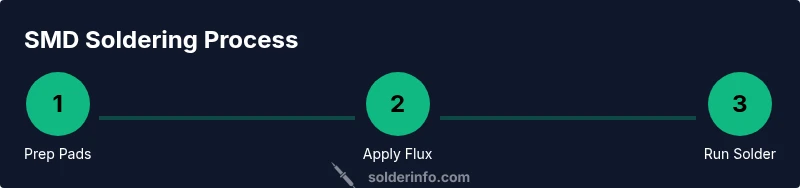
- Prepare the board and pads; clean and inspect.
- Apply a thin coat of flux to the pads.
- Place the component precisely using tweezers.
- Tack one end with a tiny solder bridge.
- Solder the opposite pad and check for bridging.
- Reflow remaining joints with minimal heat.
- Clean residues and inspect under magnification.
Tools & Materials
- Fine-tipped soldering iron (0.3–0.6 mm tip)(Temperature-controlled if possible; set to a moderate, heat-respecting range for lead-free solder)
- Flux (rosin-based or no-clean)(Apply a very thin film to pads before placing components)
- Solder (lead-free preferred, 0.5–0.8 mm diameter)(Choose eutectic or near-eutectic alloy for predictability)
- Magnification (10x loupe or stereo microscope)(Essential for aligning tiny components and inspecting joints)
- ESD protection (anti-static mat and wrist strap)(Prevents component damage from static electricity)
- Solder wick (desoldering braid)(Use for correcting bridging or lifting pads)
- Tweezers (anti-magnetic SMT tweezers)(Fine tips for precise placement)
- Isopropyl alcohol (99%) for cleaning(Removes flux residues after soldering)
- Hot air rework station(Optional but very useful for larger or dense BGA-style work)
Steps
Estimated time: 60-90 minutes
- 1
Prep the board and components
Clean the pads with isopropyl alcohol and inspect for oxidation. Align the footprint with the component orientation marker. Ensure the work area is static-free and well-lit. Why: Clean pads prevent poor wetting and misalignment.
Tip: Use a magnifier to verify pad condition before placing the part. - 2
Apply flux to the pads
Apply a thin, even line or dot of flux to both pads. Flux improves surface wetting and reduces the chance of cold joints. Avoid excessive flux that can spread to adjacent pads.
Tip: A flux pen gives precise control for small packages. - 3
Position the component
Grasp the component with non-marring tweezers and place it on the pads, aligning the orientation notch or marker with the PCB footprint. Use magnification to confirm alignment.
Tip: Double-check orientation before applying heat. - 4
Tack one end
Apply a tiny amount of solder to one pad to anchor the component without forming a bridge. This holds the part in place while you work the opposite pad.
Tip: Keep heat duration short to avoid shifting. - 5
Solder the opposite pad
Gently apply heat to the opposite pad while feeding a small amount of solder if needed. Watch for proper wetting and a smooth fillet. Stop when the joint looks glossy.
Tip: If bridging occurs, pause, reflow, and remove excess solder with wick. - 6
Inspect and rework if needed
Check for bridges, tombstoning, or cold joints. Rework small issues by selectively reheating or removing with wick and reapplying flux as needed.
Tip: Use a loupe to verify each joint before moving on. - 7
Clean residues
Wipe away flux residues with isopropyl alcohol and a lint-free cloth. Residue can be corrosive in some flux formulations over time.
Tip: Ensure the board is completely dry before powering up. - 8
Final verification
Perform a visual inspection and measure resistance or continuity where applicable. If possible, power the board in a controlled test setup to confirm functionality.
Tip: Document findings for future boards.
Quick Answers
What is soldering SMD components?
SMD soldering attaches surface-mount devices directly to PCB pads using precise heat and flux to create reliable electrical joints. It contrasts with through-hole methods and requires careful control and inspection.
SMD soldering means attaching surface-mount parts directly to the board using careful heat and flux to form reliable electrical joints.
Can I hand-solder SMDs without a rework station?
Yes, for simple components you can hand-solder with a fine-tipped iron and good magnification. For dense or large packages, a hot air rework station makes the job easier and more reliable.
Yes, with a fine-tipped iron and magnification you can hand-solder some SMDs; a rework station helps with more complex parts.
What causes tombstoning in SMD resistors?
Tombstoning happens when one end of a two-terminal component wets before the other, often due to uneven wetting or heat distribution. Ensuring even heating and symmetric pad design reduces the risk.
Tombstoning occurs when one end wets before the other due to uneven heating; ensure even heat and pad symmetry.
What is the best flux for SMD work?
No-clean flux is commonly used for SMD work because it requires minimal cleanup, but rosin-based flux can offer stronger wetting for challenging joints. Choose based on your workflow and cleanliness requirements.
No-clean flux is common for SMD work, but rosin flux can help with tough joints depending on your workflow.
How do I remove a misaligned SMD component?
Use a small amount of flux to reheat and lift the component gently, then rework the pads with solder wick or reflow tools. Work slowly to avoid pad damage.
Reheat gently, lift the part with tweezers, then cleanly rework the pads with flux and wick.
Is lead-free solder safe to use for SMD work?
Lead-free solder is widely used and safe when proper ventilation is maintained and PPE is used. It has a higher melting point, so adjust heat and time accordingly.
Lead-free solder is common and safe with proper ventilation; it requires slightly higher heat.
Watch Video
Top Takeaways
- Master clean pads, precise alignment, and controlled heating.
- Choose flux and solder appropriate for package size and density.
- Use magnification and ESD protection for reliable joints.
- Inspect every joint and practice on scrap boards before critical assemblies.
- Document techniques and outcomes for continuous improvement.