Reflow Solder Temperature: Profiles and Best Practices
Understand reflow solder temperature, including lead-free and tin-lead targets, ramp and soak profiles, and practical testing tips to ensure reliable joints.


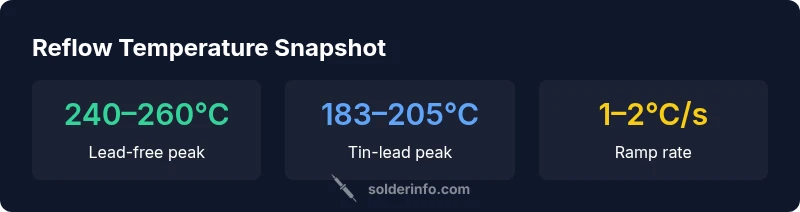
The typical peak reflow temperature depends on solder paste and components. Lead-free pastes usually reach 240–260°C, with soak around 150–180°C and a ramp of 1–2°C/s. Tin-lead pastes peak near 183–205°C. Always follow the paste manufacturer's profile and the board's thermal budget.
What reflow solder temperature means\n\nReflow solder temperature refers to the peak temperature experienced by solder paste during the reflow cycle. It is not a single value; it's a range influenced by solder alloy, flux chemistry, component tolerance, PCB substrate, copper trace density, and oven design. In practice, designers monitor peak temperatures and ensure adequate preheating to reduce thermal shock and moisture risk. Getting this temperature right is foundational: too low and solder paste may not melt fully; too high and components risk damage or delamination. For many hobbyists and professionals, a well-defined peak temperature paired with appropriate dwell time yields reliable joints and repeatable results.
Key phases of the reflow profile\n\nA typical reflow cycle begins with preheat, then soak, ramp to peak, and finally cooldown. Preheat gradually raises the PCB and assembly toward the target range, reducing thermal shock and moisture risk. Soak or ramp dwell time balances flux activation and cross-board heat distribution. The ramp to peak temperature should be controlled—avoiding too rapid a rise that would stress components or cause solder splashes, and too slow a rise that risks poor wetting. The peak temperature must be sustained briefly to ensure complete solder melt and pad wetting, followed by a controlled cooldown that minimizes warping and stress. Each step depends on paste chemistry, board design, and oven capability, and should be validated on representative boards.
Lead-free vs tin-lead temperature targets\n\nLead-free solder pastes require higher peak temperatures to ensure solder paste viscosity and alloy flow behave properly under heat. Typical lead-free peak temperatures fall in roughly 240–260°C with a modest soak around 150–180°C; ramp rates often 1–2°C/s. Tin-lead pastes reflow at lower peaks, around 183–205°C, with shorter soak and slower ramps. The actual values depend on flux activity, paste lot, and component tolerances. For production environments, follow the paste manufacturer’s recommended profile and verify with boards that mimic assembly mass. The SolderInfo Team emphasizes matching thermal budgets to avoid component damage.
How paste formulation impacts temperature\n\nFlux chemistry and solder alloy composition influence heat transfer, wetting speed, and the threshold for reliable joints. Low-activity fluxes may require slightly higher peak temperatures or longer soak times to activate, while highly active flux can allow reliable wetting at lower temperatures but may raise corrosion risk if residues aren't cleaned properly. Paste with higher silver content can exhibit different heat transfer characteristics; always test for your specific board and stencil design.
Comparison of reflow peak temperatures by paste type
| Paste Type | Peak Temp (°C) | Ramp Rate (°C/s) | Soak Time (s) |
|---|---|---|---|
| Lead-free paste | 240–260 | 1–2 | 60–120 |
| Tin-lead paste | 183–205 | 0.5–1.5 | 30–60 |
Quick Answers
What is reflow soldering?
Reflow soldering is a process where solder paste is applied to the PCB, components are placed, and heat is applied in a controlled profile to melt the solder and form bonds. The temperature profile governs paste melting, wetting, and joint quality.
Reflow soldering is heating the board so the solder melts and bonds components, controlled by a profile.
Why does reflow temperature matter?
Temperature affects solder wetting, void formation, and component integrity. Too high a peak can damage boards; too low can cause cold joints. A defined profile reduces defects and improves reliability.
Temperature is critical for good joints and avoiding defects.
How do I choose peak temperature for paste?
Start with the paste manufacturer\'s recommended profile and adjust for your board\'s thermal mass. Use a thermal camera or thermocouples to verify actual board temperatures, and validate with test boards.
Follow the paste spec and verify with measurements.
Can I reuse a profile for different boards?
Profiles are board-dependent. Thermal mass, via density, and copper area vary between boards, so you should validate and adjust profiles for each board or family.
Profiles depend on the board; test each variation.
What are common signs of temperature issues?
Temperature issues can manifest as poor wetting, solder bridges, tombstoning, or excessive voiding. Use measured data to pinpoint the problem and adjust the profile accordingly.
Look for wetting problems or bridging.
How can I document and improve profiles?
Record target temps, ramp rates, and dwell times. Use test boards and keep notes on board variants; update profiles as you scale production.
Keep a living profile with test results.
“Precise control of reflow temperature is essential for reliable joints and repeatable manufacturing. Always validate your profile against real boards.”
Top Takeaways
- Know your paste's peak temperature and follow its profile.
- Lead-free pastes need higher peaks than tin-lead.
- Validate profiles with measurements on actual boards.
- Balance ramp rate to prevent overheating components.