Solder Ring vs End Feed: Plumbing Soldering Guide
A detailed, objective comparison of solder ring and end feed methods for plumbing joints. Learn definitions, best-use scenarios, installation steps, troubleshooting tips, and long-term considerations to choose the right technique for copper piping and beyond.


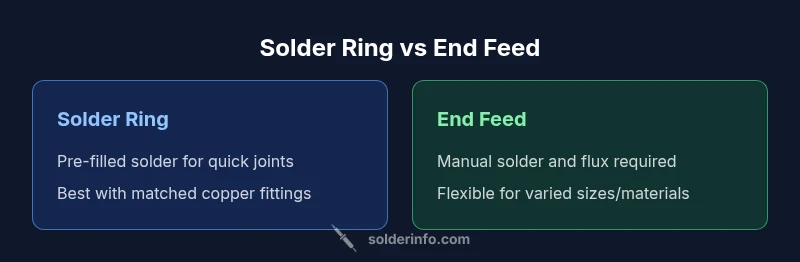
Compared to end feed, solder ring joints use pre-filled solder around the fitting, delivering faster, cleaner results on standard sizes. End feed relies on separate solder inserted during heating, offering greater flexibility for non-standard pipes but demanding careful heat control. Choose solder ring for quick, repeatable connections; opt for end feed when you need size variability or mixed materials.
Overview: solder ring vs end feed – what you need to know
In plumbing, the choice between solder ring and end feed hinges on how you want the joint to behave under heat and pressure. The phrase solder ring vs end feed is widely discussed among professionals and DIYers alike because each method reflects different manufacturing realities and field constraints. According to SolderInfo, the decision is not simply a matter of preference; it reflects pipe material, fitting availability, and the installer’s skill level. The SolderInfo team found that for standardized copper runs with matching fittings, solder ring joints offer predictable timing and cleaner results, since the solder is pre-loaded into the ring. By contrast, end feed joints rely on the installer to supply solder and flux during the heating cycle, which gives flexibility for non-standard sizes, mixed alloys, or retrofits. This upfront difference influences how you plan a project, source parts, and approach leak testing. In practice, you will weigh speed, reliability, and compatibility with your local plumbing codes. By the end of this guide, you’ll have a clear framework for evaluating solder ring vs end feed in common residential and commercial settings, with practical tips drawn from field experience and industry guidance.
Solder Ring: definition and mechanism
A solder ring is a pre-fabricated joint insert that carries solder around the interior surface of a fitting, typically used with copper pipe. When the joint is heated, capillary action draws the molten solder into the joint, sealing the connection as the metal cools. This method reduces the amount of flux you need to apply on the pipe itself and minimizes the risk of solder dripping onto surrounding surfaces. For installers, the main advantage is consistency: the amount of solder is fixed, so repeatable joints become feasible across multiple installations. However, the rings come in standard sizes and are most reliable when pipe diameters and fittings match exactly. Solder ring availability and compatible fitting options vary by region, so assessing local supply is part of planning. The SolderInfo team notes that, when used correctly, solder rings can deliver robust leak resistance with less on-the-spot decision-making during heating. Nevertheless, skilled heat control remains essential to avoid overheating and damming of the joint. Builders who value speed and uniform results often lean toward ring rings for straight runs and factory-fitted configurations.
End Feed: definition and mechanism
End feed fittings rely on a groove in the fitting where solder is placed manually, and the joint is heated from the outside while solder is drawn into the joint by capillary action. This method requires a careful hand with both flux application and heat management: you must feed solder as the joint heats to ensure a steady flow and a complete seal. The advantage of end feed is flexibility: you can accommodate a wider range of pipe sizes and material combinations, especially in retrofit projects or repairs where standard rings won’t fit. End feed is often preferred for older homes or configurations with irregular pipe runs. Because the installer supplies the solder, control over the amount and timing is more variable, which means higher skill and experience tend to correlate with better results. The technique also tends to require additional tools, including a compatible torch and a steady hand to avoid scorching or overheating nearby components. SolderInfo’s perspective emphasizes that end feed is a versatile approach when encountering diverse field conditions, but it demands greater operator discipline to ensure a leak-free joint.
Material compatibility and pipe types
Both solder ring and end feed methods are most commonly associated with copper piping, but there are important differences in compatibility with other materials. Solder rings are ideally paired with properly sized copper fittings and seamless copper pipe, delivering fast, reliable joints when the diameters are matched. End feed, by contrast, offers more flexibility for mixed-material runs (such as copper to brass) when appropriate flux and solder types are used, and when joint geometry allows for effective heat transfer. In settings where pipe types vary across a system, end feed can simplify logistics by reducing the need for multiple different ring sizes. However, performance still hinges on using compatible fluxes (rosin-core or acid-core depending on the alloy) and selecting solder with the correct composition for the pipe material. From a reliability perspective, copper-to-copper connections with solder rings tend to be highly repeatable in factory-grade installations, while end feed shines in retrofit projects where pipe sizes deviate from standard diameters. SolderInfo highlights the importance of verifying code compliance and manufacturer guidance for all material combinations to ensure a compliant and durable joint.
Application scenarios and best practices
The choice between solder ring vs end feed should start with a clear assessment of project scope. For standardized runs in new construction or tight-building environments where pipe diameters align with pre-sized rings, solder ring can dramatically speed up installation and reduce flux mess. In contrast, end feed is often the better option for renovations, repairs, or multi-material systems where fitting availability and sizing are irregular. Where to apply each method? Use solder ring for: close-proximity joints on well-matched copper systems; repetitive, high-volume installations; situations where a clean, controlled process is valued. Use end feed for: mixed-material joints; non-standard sizes; retrofit projects in older structures; scenarios requiring on-site adjustments to accommodate unusual pipe layouts. Best practices for either method include: ensuring clean, burr-free pipe ends; degreasing the copper surface prior to assembly; selecting flux and solder compatible with the pipe material; maintaining consistent torch distance and motion to prevent overheating; and finishing with a thorough leak test after cooling. SolderInfo notes that a well-planned approach, including supplies and a quick test rig, can save time and reduce rework in the field.
Step-by-step installation: solder ring (quick-start guide)
- Inspect fittings and pipes for damage; cut square and deburr ends. 2) Apply a light amount of flux to the outside of the pipe, focusing on the portion that will enter the fitting. 3) Slide the copper pipe into the solder ring fitting until fully seated. 4) Heat evenly with a propane or map gas torch, circling the joint to encourage even metal flow. 5) Watch for capillary action drawing solder into the joint; apply steady heat until the joint gleams with a clean bead and the flame recedes. 6) Allow the joint to cool undisturbed for several minutes, then wipe away any oxidation and inspect for gaps. 7) Perform a leak test at low pressure, gradually increasing to normal operating conditions. Remember to work in a well-ventilated space and follow local codes.
Step-by-step installation: end feed (quick-start guide)
- Prepare the pipe and fittings: trim, deburr, and clean thoroughly. 2) Apply flux along the ends and insert the solder into the end groove or the joint area as specified by the fitting manufacturer. 3) Bring the joint up to temperature with an even, controlled flame; do not overheat nearby components. 4) Feed solder into the joint as it heats, allowing capillary action to pull the metal into the joint. 5) Remove heat once the joint is fully filled and the solder has flowed. 6) Quench or allow to air-cool, then wipe excess flux and inspect for uniform solder flow. 7) Test for leaks using a pressure test and inspection under pressure. Adhere to code requirements and safety guidelines during all steps.
Common pitfalls and troubleshooting
A common pitfall with both methods is overheating, which can lead to burned flux, weakened joints, or damaged pipe insulation. In solder ring installations, mismatched ring size or poor ring seating can cause gaps, leaks, or poor flow; verify the ring is the correct size and fully seated before heating. For end feed, inconsistent solder feed or uneven heating can produce cold joints or voids. Always inspect joints after cooling; look for a bright, smooth seam with no gaps or gray oxidation indicating poor flow. If leaks are detected, disassemble if possible, clean components, and reattempt with adjusted heat or different solder type. In cold environments, the joint may take longer to flow; consider warming the joint slightly to reduce thermal gradient. SolderInfo emphasizes documenting the process and testing each joint with a pressure test to ensure long-term reliability.
Maintenance, inspection, and long-term considerations
Once installed, pipe joints should be tested to ensure a reliable seal and to prevent future leaks. Regular inspection of solder ring and end feed joints includes checking for discoloration, corrosion, or signs of moisture around joints. In regional climates with temperature fluctuations, movement can stress joints; ensure proper support and minimize vibration near joints. For critical systems (hot water lines, gas lines, or irradiated environments), schedule periodic inspections and adopt a proactive maintenance plan. Consider keeping spare fittings and a small supply of flux and solder on hand for minor repairs. Documentation of the installation method used for each joint will help future maintenance work and code compliance audits. SolderInfo recommends maintaining a traceable record of material, method, and test results to support reliability across the system.
Comparison
| Feature | solder ring | end feed |
|---|---|---|
| Solder availability/compatibility | Pre-filled solder around the ring for quick joints | Requires supplied solder and flux; flexible for materials |
| Heat control requirements | Requires precise heat timing to ensure proper flow | Requires careful heat control and steady technique |
| Installation speed | Fast for standardized runs | Slower due to manual soldering and flux handling |
| Best use case | Standard copper runs with matched fittings | Non-standard sizes or mixed materials |
| Cost | Moderate; cost tied to rings and fittings | Moderate to high depending on flux/solder usage |
| Reliability/leak risk | High when joints are properly seated and cooled | High with inconsistent heat or incomplete fill |
Advantages
- Faster joints with consistent results for standard runs
- Cleaner work area due to reduced flux spill
- Good repeatability on matched fittings
- Lower skill threshold for basic installations
Cons
- Limited to compatible ring sizes and fittings
- Less flexible for unusual pipe sizes or retrofits
- Requires precise heat control to avoid overheating
- Availability may vary by region
End feed is generally more flexible for varied pipe sizes and mixed materials; solder ring excels in fast, repeatable standard joints.
If your project uses standard copper fittings and sizes, solder ring speeds up work with consistent results. For renovations or systems with irregular sizes, end feed offers better adaptability. The SolderInfo team recommends choosing the method based on pipe standardization and installation context, and validating with a leak test after completion.
Quick Answers
Is solder ring suitable for all pipe materials?
Solder rings are most reliable with properly sized copper fittings and copper pipes. They may not perform as expected with dissimilar materials unless the fittings are designed for such transitions. Always consult manufacturer guidance and local codes before mixed-material use.
Solder rings work best with copper piping and matching fittings; for other materials, check compatibility first.
Can I transition from solder ring to end feed mid-project?
Yes, in many cases you can change methods if each joint is compatible with the chosen technique and you have the right fittings and flux. Plan the transition zones carefully and verify that all joints meet code requirements after the change.
You can switch methods for different joints if you plan and verify compatibility.
Which is faster for professional installations?
Solder ring generally offers faster performance on standardized runs due to pre-loaded solder. End feed can be slower because it requires manual solder application and heat management, but it provides more flexibility in the field.
Solder rings are usually faster for standard jobs, end feed is more flexible for varying setups.
Do I need special torches for end feed?
End feed requires a torch capable of controlled heating with even distribution to promote solder flow. Propane is common, but some jobs benefit from map-pro or propane-air torches depending on pipe size and joint configuration.
You’ll typically use a steady torch with good control for end feed.
Are there leaks common with end feed?
Leaking can occur if heat is uneven, solder flow is incomplete, or flux residue is not cleaned. Following a careful heating technique and leak testing helps mitigate these risks.
Yes, leaks can happen if the heat isn’t managed or the joint doesn’t fill properly.
Is solder joint strength comparable between methods?
With proper technique, both methods can create strong joints. Strength depends on clean surfaces, correct flux, proper heating, and complete solder flow rather than the method alone.
Both methods can be strong if done correctly.
Top Takeaways
- Choose solder ring for standardized copper runs and quick installations
- Opt for end feed when working with varied sizes or mixed materials
- Prioritize clean surfaces, proper flux, and controlled heating for leak-free joints
- Always perform a leak test after cooling and inspection
- Document the installation method for future maintenance and compliance