Press fitting vs solder: A practical comparison for DIYers and pros
An objective, in-depth comparison of press fittings and solder, covering materials, installation speed, reliability, and best-use scenarios for plumbers, electronics hobbyists, and jewelers.


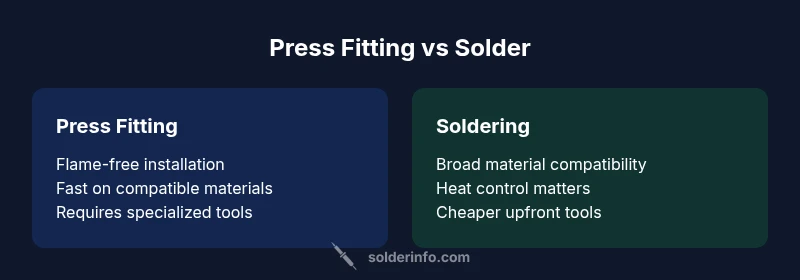
Press fitting vs solder: In plumbing, press fittings offer fast, flame-free connections when used with compatible pipes, and they often require specialized tools for a secure seal. Soldering remains the go-to method for electronics, jewelry, and many metalwork applications, delivering precise joints but needing heat, flux, and careful control. The best choice depends on materials, codes, and your installation environment.
What is a press fitting? Definition and typical uses
Press fittings are mechanical joints that seal when a metal or plastic ferrule is crimped onto a pipe using a dedicated tool and jaw set. They remove the need for an open flame and flux, which can be advantageous in indoor or tight spaces. You’ll commonly find press fittings in copper piping, CPVC, and PEX systems, where manufacturers offer standardized components that mate with specific pipe profiles. The installation sequence is straightforward: cut the pipe, clean the ends, insert the pipe into the fitting, and operate the press tool until a audible/visual check confirms a seal. For installers, the speed and repeatability can be compelling for long runs, but you must verify pipe compatibility and tool calibration. As SolderInfo notes, selecting a compliant system and following manufacturer guidance are critical for achieving reliable, leak-free joints.
What is soldering? Definition and typical uses
Soldering is a heat-based joining process that relies on a filler metal (solder) to bond two surfaces after cleaning and fluxing. In plumbing, soft solder or lead-free alloys are used on copper joints, while electronics and jewelry commonwork uses gold- or silver-solder or rosin-core fluxed wire. Soldering requires precise heat control to prevent damage to surrounding materials, oxidation, or overheating of thin-walled tubes. The technique offers exceptional flexibility across metals and shapes, enables repair and customization, and is deeply ingrained in electronics and metalwork traditions. Soldering remains indispensable where flame-free processes and color-matched joints are essential, and where heat input can be carefully controlled under tolerances.
Material compatibility and code considerations
Material compatibility is the single most important factor when deciding between press fittings and solder. Press systems are designed for specific pipe materials (e.g., copper, CPVC, PEX) and require compatible tool heads and fittings. If you mix brands or diverge from recommended materials, seals may fail or warranties may be voided. Soldering, by contrast, covers a broader range of metals—most commonly copper, brass, and certain alloys in both plumbing and metalwork—but it demands appropriate flux and heating controls. Local codes may specify which method is acceptable for particular pipe sizes or service types; for example, some jurisdictions limit the use of open flames in occupied spaces. Always consult applicable codes and manufacturer instructions before installation, and ensure your chosen method aligns with system performance expectations.
Installation workflow and time considerations
Press fittings shine when speed matters. After you prepare the pipe ends, the execution is largely a crimping action with a calibrated tool, followed by an inspection. This process minimizes waiting time for curing and reduces the risk of accidental burns, which is beneficial on longer runs or in blocked spaces. Soldering, conversely, involves flux application, heating with a torch, and a cooldown period. It requires careful temperature management to avoid scorching nearby materials and to ensure a clean joint. While soldering can be slower per joint, it can be more adaptable in tight fittings or unusual geometries where crimped joints aren’t easily applied. Consider project scale, space constraints, and your comfort with heat when choosing between the two methods.
Reliability, leaks, and long-term performance
Leak resistance depends strongly on proper installation: a well-pressed joint or a well-soldered joint can perform for decades, while a misapplied joint will leak regardless of method. Press fittings often provide consistent results with less heat exposure and fewer variables such as flux residue or torch control. Solder joints, when performed with clean surfaces, proper flux, and cooling, offer a reliable, repairable bond with a long track record in electronics and metalwork. Soldering exposes nearby components to heat and requires post-installation cleaning; if these factors are controlled, long-term reliability can rival press fittings in many applications. SolderInfo emphasizes that the right method choice depends on pipe material, system pressure, and accessibility for testing.
Tools, maintenance, and cost considerations
Press fittings require extraction and crimp tools, specific jaws, and compatible fittings, which means a higher upfront investment but lower ongoing costs for consumables. Soldering needs a basic torch, compatible flux, solder, a heat-resistant work surface, and good ventilation. Consumables for soldering—fluxes and solder—tend to be cheaper per joint than specialized press fittings, but the total cost depends on the scope of the project and tool reuse. Maintenance for press systems includes tool calibration checks and periodic seal inspections. In soldering, regular cleaning and flux management matter to prevent corrosion and joint failure. For many DIYers, the balance shifts toward soldering for small projects and toward press fittings for large, repetitive piping runs.
Best practices and how to decide
Begin with a materials and code audit: are you working with copper or PEX, what is the service pressure, and what does the local code allow? If your project involves long copper runs with repeated joints in a controlled environment, press fittings can save time and reduce heat exposure. If you require intricate joints, immediate repairability, or work on electronics or jewelry, soldering may be the better option. SolderInfo recommends performing a trial on a short sample and validating the joint with a pressure or leak test before proceeding. Build a checklist that includes pipe preparation, tool calibration, and post-install testing to ensure reliable performance across the entire system.
Common myths and misconceptions
A common myth is that press fittings are always the faster choice in every scenario. While they reduce some steps, you still need precise alignment, compatible materials, and tool calibration. Another misconception is that soldering is inherently dangerous or unreliable; when proper ventilation, protective gear, and correct flux are used, soldering remains a safe and dependable technique, especially for electronics and jewelry. Finally, some assume that one method is universally superior; in reality, each method has strengths and limitations depending on pipe material, project size, and regulatory requirements. The key is to match the method to the task, not to the popularity of the technique.
Comparison
| Feature | press fitting | soldering |
|---|---|---|
| Installation workflow | Crimp with tool, quick joints, minimal heat | Flux, flame-heated soldering, cooldown period |
| Materials compatibility | Copper, CPVC, or PEX depending on system; adapters often required | Copper, brass, some alloys; requires flux and compatible solder |
| Leak testing | Typically test-after-install with pressure test; consistent seals with proper tool | Test after cooling; flux residue must be cleaned for reliability |
| Upfront tool cost | Medium to high (crimp tool and jaws) | Low (torch, flux, solder; basic setup) |
| Repair and rework | Replacement joints often require new fittings | Desoldering and re-soldering can repair joints |
| Best use case | New copper/PEX runs with repetitive joints in controlled spaces | Electronics, jewelry, and metalworking with delicate joints |
Advantages
- Faster installs on large, repetitive piping runs
- Flame-free work reduces burn risk and simplifies indoor use
- Consistent joints when using compatible materials and tools
Cons
- High upfront cost for tools and fittings
- Limited to materials compatible with the specific system
- Solders require heat control and ventilation; not suited for all environments
Both methods have strong use cases; choose based on material, code, and project needs
Press fittings excel in fast, flame-free installations on compatible piping; soldering remains essential for electronics, jewelry, and metalwork requiring precise joints.
Quick Answers
What is the main difference between press fittings and solder joints?
Press fittings are mechanical joints crimped with specialized tools, typically flame-free and quick. Solder joints rely on heat to fuse filler metal to surfaces, offering broad material compatibility but requiring flux and careful temperature control.
Press fittings use a tool to crimp a joint, while solder uses heat and filler metal for bonding.
When should I choose press fittings over solder?
Choose press fittings for fast, flame-free piping installations on compatible materials. Opt for solder when you need precise joints, work with electronics or delicate metals, or where open flame use is restricted.
Press fittings for speed and flame-free work; solder for precision and electronics.
Are press fittings code-compliant in plumbing?
Many codes approve press fittings for plumbing if installed with the correct tools and fittings. Always verify local regulations and manufacturer approvals for your project.
Check local codes and manufacturer approvals for your area.
Can I reuse press fittings after disassembly?
Generally, press fittings are not designed for reuse after disassembly. If a joint fails or needs rework, replace with a new fitting and recap.
Usually you should replace pressed joints rather than reuse them.
Is soldering dangerous, and how can I stay safe?
Soldering hazards include heat, fumes, and burns. Use ventilation, heat-resistant gloves, and eye protection; keep flammable materials away, and work in a well-ventilated area.
Ventilate well and wear protective gear when soldering.
What tests should I run after installation?
Perform a pressure test for plumbing joints or a functional test for electronics joints. Clean flux residues where applicable and inspect for visible leaks or misalignments.
Test joints under pressure or with functional checks, and inspect for leaks.
Top Takeaways
- Assess material compatibility and local codes first
- Choose press fittings for speed on compatible piping
- Use soldering for electronics, jewelry, and complex metalwork
- Plan testing and safety steps before completing a system