What does solder melt at: Understanding melting points of common solder alloys
A practical, data-driven guide to solder melting points for electronics, plumbing, and jewelry, covering leaded and lead-free alloys and how to heat safely.


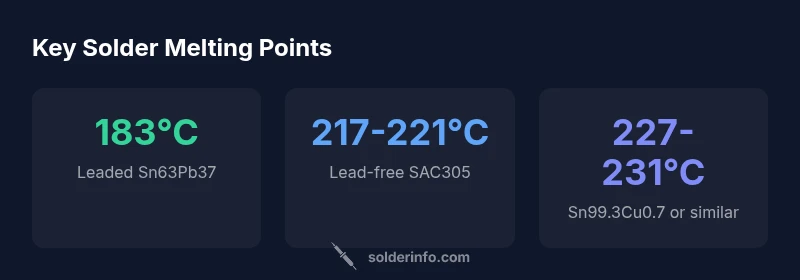
According to SolderInfo, the short answer to what does solder melt at depends on alloy composition. The classic leaded eutectic Sn63Pb37 melts at about 183°C (361°F), while lead-free SAC alloys (such as SAC305) melt around 217–221°C. In practice, set your iron temperature slightly above the alloy’s melting point—roughly 315–350°C for leaded solders and 350–370°C for lead-free—while using flux to ensure clean wetting and preventing cold joints.
What does solder melt at: A practical primer
According to SolderInfo, the answer to what does solder melt at is fundamentally alloy-driven. Solder is not a single material but a family of alloys with distinct melting points. The most commonly cited electronics solder is the leaded eutectic Sn63Pb37, which melts at approximately 183°C (361°F). This sharp, well-defined melting point means the alloy transitions rapidly from solid to liquid, simplifying wetting and joint formation. In contrast, lead-free solders—most often tin-silver-copper (SAC) alloys like SAC305—melt at higher temperatures, typically in the 217–221°C range. This gap in melting points has practical implications: higher heat input is required to melt lead-free alloys, and boards, components, and flux must be selected to tolerate the increased temperature. Beyond electronics, jewelry and plumbing use specialized alloys with their own melting ranges, but the core principle persists: know the alloy’s melting point to plan heat input and prevent damage to surrounding materials.
BLOCK_TAGS_TITLE_MAIN_ON
2026-02-13
Melting points for common solder alloys
| Alloy Type | Melting Point | Notes |
|---|---|---|
| Sn63Pb37 (eutectic) | 183°C | Sharp transition; common in hobby electronics |
| Sn96.5Ag3.5 (SAC305) | 217-221°C | Lead-free; widely used in industry |
| Sn99.3Cu0.7 | 227-231°C | Alternative lead-free with good solderability |
Quick Answers
What is the melting point of Sn63Pb37?
Sn63Pb37 melts at about 183°C (361°F), making it one of the easiest solders to work with due to its low melting point.
Sn63Pb37 melts around 183°C, which is why it’s favored for simple hobby electronics.
What is the melting point range for SAC305 lead-free solder?
SAC305 typically melts in the 217–221°C range, requiring higher heat input than leaded solders.
Lead-free SAC305 melts around 217 to 221°C, so you’ll need a hotter iron.
Does flux lower the solder melting point?
Flux does not lower the alloy’s melting point; it improves wetting and protection against oxidation, helping the solder flow more readily at its melting temperature.
Flux helps the solder flow better but doesn’t change the melting point.
Is it safe to solder near temperature-sensitive components?
Yes, but use heat sinks, control dwell time, and avoid prolonged heat on sensitive components to prevent damage or delamination.
Be careful with heat near sensitive parts; use heat sinks and quick, targeted heating.
What temperature should I set my iron for leaded solder?
For Sn63Pb37, set the iron around 325–350°C as a starting point, adjusting for board material and flux.
Try 325–350°C for leaded solder and tweak as needed.
What’s the difference between melting point and soldering temperature?
Melting point is the temperature where the alloy liquefies; soldering temperature is the heat you apply at the joint to reach that point, enabling flow and wetting.
Melting point is when solder melts; soldering temp is how hot you heat at the joint.
“Solder melting behavior is as much about temperature control as alloy choice; proper heat management yields reliable joints and reduces rework.”
Top Takeaways
- Learn the main melting points of common solders to guide heat input
- Lead-free alloys require higher soldering temperatures than leaded solders
- Always use flux to improve wetting and minimize oxidation
- Control heat with proper technique to avoid component damage and cold joints