Solder vs Weld vs Braze: A Practical Comparison
A balanced, in-depth comparison of solder vs weld vs braze, covering temperatures, fillers, strengths, and domain-specific guidance for electronics, plumbing, and jewelry.


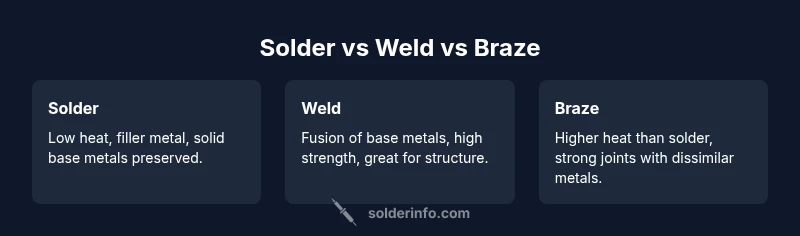
Solder, weld, and braze are three distinct metal-joining processes with different heat requirements, fillers, and joint outcomes. This comparison clarifies when to use each method for electronics, plumbing, and jewelry, focusing on material compatibility, joint strength, and service conditions. Soldering uses low heat and a filler metal; brazing uses higher heat with a separate filler; welding fuses base metals directly.
Solder vs Weld vs Braze: Core Differences
Solder, weld, and braze are three primary metal-joining approaches, each with its own physical and chemical basis. Understanding these core differences helps set expectations for strength, heat impact, and long-term reliability. According to SolderInfo, the most practical choices come from matching joint requirements to process capabilities rather than chasing the easiest fix. In soldering, a filler metal with a lower melting point than the base metals is melted to bridge the gap without melting the parts themselves. Brazing uses a similar filler-metal concept but at higher temperatures, allowing the filler to flow and capillary-wick between joints while the bases remain solid. Welding, by contrast, fuses the base metals together to form a metallurgical bond. Each method has a niche where it excels and a set of tradeoffs that influence heat tolerance, corrosion resistance, leak-tight performance, and the feasibility of repair. This section sets the stage for a deeper dive into how heat, fillers, and geometry shape performance.
Heat input and distortion: how temperature shapes outcomes
Temperature is the defining differentiator among solder, braze, and weld. Soldering uses relatively low heat, typically staying well below the melting points of the base metals, which minimizes thermal distortion and reduces the risk of damage to heat-sensitive components. Brazing operates at higher temperatures, which increases the risk of distortion and annealing in some metals, but this approach creates strong, capillary-tight joints ideal for thicker sections and dissimilar metals. Welding introduces the highest heat input, and while it can produce very strong joints, it also carries the greatest risk of warping, residual stress, and microstructural changes if not controlled. Effective distortion management—feeder blocks, heat sinks, and staggered heat application—plays a pivotal role in achieving reliable joints across all three methods. Practitioners must design around heat pathways to safeguard nearby features and maintain precise tolerances.
Fillers and flux: roles and choices
Filler materials and flux are central to how each process achieves a joint. Soldering relies on a solder alloy as the filler metal along with flux to reduce oxide formation and improve wetting. Brazing uses a dedicated brazing filler metal, which must have a melting point above the base metal but below the critical heat-affected limits of adjoining components; flux helps the filler flow and fill gaps uniformly. Welding typically uses little or no filler metal for simple fusion, though many processes (MIG, TIG, stick) introduce filler in the form of welding wire to tailor strength and compatibility with the base metals. The choice of filler dramatically affects corrosion resistance, thermal expansion compatibility, and mechanical properties. Appropriate flux composition and cleanliness are essential to prevent oxide layers from sabotaging joint quality.
Mechanical properties and joint strength
Joint strength is a key differentiator among the three methods. Soldered joints are typically suitable for low-stress or electrical connections where precision and heat control matter; they can be surprisingly durable when joints are designed well and materials are compatible. Brazed joints offer significantly higher strength than soldered joints and perform well with dissimilar metals, thick sections, and leak-tight requirements, such as heat exchangers or plumbing joints, when properly executed. Welded joints can provide the strongest, most rigid connections for structural or high-load applications, but they require precise joint geometry and heat management to prevent cracking or distortion. In all cases, joint design—fit, fillet size, and access for heat delivery—drives final performance more than any single technique alone.
Material compatibility and base metals
Material compatibility guides the method choice. Solder is well suited to electronics, some jewelry, and thin copper or tin-based assemblies where the base metals remain intact. Brazing shines with dissimilar metals, thicker assemblies, and situations demanding good corrosion resistance and leak-tight seals, such as copper to brass or stainless-to-brass interfaces. Welding is the go-to for high-strength steel, aluminum after surface preparation, and thick metal sections where fusion provides the required mechanical integrity. Certain alloys, coatings, and heat-treat conditions can favor or impede successful joins, so selecting a method requires careful assessment of base-metal chemistry, thermal history, and potential for intermetallic formation. Cleanliness and proper preparation are non-negotiable across all methods.
Applications by domain: electronics, plumbing, jewelry
In electronics, soldering enables small, precise connections toPrinted Circuit Boards (PCBs) with controlled heat and minimal risk of component damage. Plumbing often relies on brazing for strong, leak-tight joints on copper tubes and fittings, where higher heat and filler metal create robust bonds. Jewelry brazing and soldering permit strong seals and delicate joins on rings and clasps, with careful temperature control to prevent damage to gems or sensitive settings. Welding dominates in construction, automotive frames, and heavy machinery where load-bearing joints must endure dynamic stresses. Each domain has established best practices, standards, and typical failure modes, so practitioners should align technique selection with application-specific demands and inspection criteria.
Safety considerations and fumes management
All three methods involve heat and potentially hazardous fumes. Soldering and brazing require proper ventilation and fume extraction, as fluxes and metal vapors can irritate eyes and lungs. Welding produces fumes with more particulate matter and potential exposure to burning contaminants, so dedicated ventilation, personal protective equipment (PPE), and fume capture are essential. Work area shielding, heat-resistant gloves, eye protection, and appropriate training reduce burn risks and improve joint quality. Adhering to material safety data sheets (MSDS) for chosen alloys and fluxes helps prevent exposure to toxic elements and ensures safer, more reliable joints.
Costs, equipment, and learning curve
The upfront cost and complexity rise with the strength and complexity of the joint. Soldering requires a modest investment: a basic iron, flux, and solder are sufficient for many hobby and electronics tasks. Brazing needs a dedicated torch, appropriate flux, and a filler metal designed for the base metals involved, representing a step up in cost and safety considerations. Welding demands a range of equipment (welding machine, torches or wire-feed systems, protective gear) and substantial safety training due to higher heat and fumes. The learning curve escalates with joint geometry and material types, but fundamentals can be learned quickly for simple projects. Routine maintenance, calibration, and adherence to technique prevent common issues like cold joints or missed wetting.
Design considerations and failure modes
Effective design reduces failure modes across solder, braze, and weld. Solder joints rely on proper pad geometry and adequate fillet or pad design to prevent shear or pull-apart failures. Brazed joints depend on flow control and filler-metal wetting, with failures often related to improper flux or insufficient capillary action. Welds can fail due to porosity, incomplete fusion, or heat-affected zone cracking if heat input is not managed. Designers should consider service temperature, vibration, corrosion exposure, thermal cycling, and joint stiffness. In practice, a robust design couples process capability with material selection to yield joints that tolerate expected operating conditions.
Decision framework: when to choose which method
A clear decision framework helps teams select solder, braze, or weld. Start by evaluating load requirements, thickness, and whether the joint must be leak-tight. Then assess material compatibility and service temperature. For electronics and delicate assemblies, soldering often wins on heat control and precision. For dissimilar metals and moderate-to-high strength needs, brazing can be the best compromise between strength and heat input. For structural, load-bearing, or pressure-containing joints, welding may be the only viable option. Finally, factor in accessibility, cost, training, and required inspection methods. A disciplined approach reduces rework and improves overall reliability.
Common myths and pitfalls
Common myths include assuming all heat-based joints are equally strong or that filler choice alone determines joint quality. In reality, joint geometry, surface cleanliness, flux quality, and heat management govern performance. Pitfalls include improper flux selection, insufficient surface preparation, and neglecting heat-control during the operation. Jewelry and electronics demand pristine cleanliness and careful temperature management to avoid damage. Debunking these myths and adhering to established guidelines yields more consistent, reliable joints.
Maintenance, inspection, and longevity of joints
Maintenance and regular inspection extend joint life. Inspect soldered joints for cracks or dull wetting, brazed joints for uniform filler flow and absence of voids, and welded joints for cracks or distortion. Clean connections, protect from corrosion, and apply appropriate coatings when necessary. Periodic non-destructive testing (where appropriate) helps detect subsurface issues. Proper storage, temperature control, and avoiding repeated thermal cycles further enhance longevity. In practice, proactive inspection and timely rework prevent costly failures in critical systems.
Feature Comparison
| Feature | Solder | Weld | Braze |
|---|---|---|---|
| Typical temperature range | low-temperature process; base metals largely preserved | high heat input; fusion of base metals | high temperature; filler melts above base metals |
| Filler/flux role | filler metal with flux to wet surfaces | often uses filler wire; flux may be optional depending on process | filler metal required with flux to help flow and capillary action |
| Base-metal interaction | bases remain mostly intact; joints rely on coating | bases fuse together; some distortion possible | bases remain solid; filler creates the joint |
| Best for | small, delicate, low-stress joints (electronics, jewelry) | structural or high-stress joints; metal-to-metal fusion | dissimilar metals; thick sections; leak-tight requirements |
| Required equipment | soldering iron, flux, solder | welding machine (MIG/TIG/Stick), safety gear | brazing torch, brazing filler, flux |
Advantages
- Low heat minimizes damage to heat-sensitive parts
- Simple, portable setups for soldering
- Relatively inexpensive consumables
- High precision for small joints (electronics, jewelry)
- Easily reversible or repairable joints in many cases
Cons
- Lower mechanical strength for high-load applications
- Limited thickness and gap tolerance for some joints
- Solder may be susceptible to corrosion or creep under high temps
- Brazing and welding require more complex safety and ventilation
Welding generally offers the strongest joints for structural needs; brazing excels with dissimilar metals and thicker sections; soldering remains ideal for small, heat-sensitive, or precision joints
Choose solder for delicate electronics and jewelry. Use braze when you need strong, leak-tight joints with dissimilar metals. Reserve welding for heavy-duty, load-bearing applications where maximum strength is essential. The right choice hinges on material, geometry, and service conditions, with proper safety and design still critical.
Quick Answers
What is the main difference between solder, brazing, and welding?
Soldering uses low heat to join with a filler metal that melts below the base metals. Brazing uses higher heat and a separate filler metal; bases stay solid. Welding fuses the base metals themselves, creating a metallurgical bond.
Soldering uses a low-temp filler to join parts, brazing uses higher heat with its own filler, and welding fuses the metals together for a strong bond.
Can you join copper pipes with solder?
Yes, solder is common for copper plumbing joints, especially small-diameter pipes and fittings. For larger or pressurized systems, brazing or mechanical connections may be preferred.
Yes, soldering copper pipes is common for small joints; for bigger systems, braze or other methods may be better.
Is solder weaker than brazing or welding?
In general, soldered joints are weaker than brazed or welded joints for many load-bearing applications. Brazing offers higher strength and corrosion resistance, while welding provides the strongest metallic bonds when done correctly.
Solder joints are usually weaker than brazed or welded ones, though well-made solder joints can be reliable for light-duty tasks.
What tools are required for each method?
Soldering needs a heat source like a soldering iron, flux, and solder. Brazing requires a torch, brazing filler and flux. Welding needs a welding machine and safety gear. Each method also demands proper ventilation and PPE.
Soldering uses a soldering iron, brazing uses a torch, welding uses a welder; all need ventilation and PPE.
Can a welded joint be repaired with solder?
In some cases, soldering can repair non-structural elements or joints where heat exposure is not detrimental. For primary structural welds, repair typically involves re-welding rather than soldering.
Sometimes you can solder non-structural parts, but major welded joints usually need welding repairs.
Is it safe to solder around heat-sensitive electronics?
Careful temperature control and shielding are essential when soldering near electronics. Use heat sinks, low-melt alloys, and avoid prolonged exposure to prevent component damage.
Be cautious with heat-sensitive parts; use shields and slow, controlled heating.
Top Takeaways
- Match joint strength to application requirements
- Prioritize heat management for delicate components
- Choose filler and flux based on materials and environment
- Plan joint geometry for reliable fusion or wetting
- Inspect and maintain joints to extend longevity