JB Weld vs Solder: A Practical Comparison
An analytical comparison of JB Weld epoxy vs soldering, covering bonding strength, electrical conductivity, heat tolerance, setup, and practical use-cases for electronics, plumbing, and jewelry.


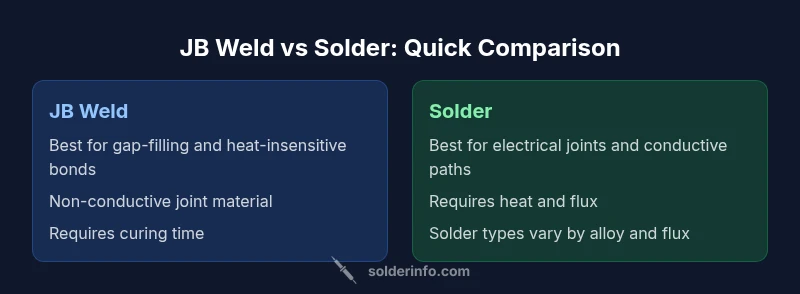
JB Weld epoxy and soldering serve different repair needs. JB Weld offers strong, gap-filling bonds without heat, ideal for structural repairs on metal and non-electrical surfaces. Soldering provides clean, conductive joints for electronics and plumbing with fast setup. This comparison explains when to choose each method and common pitfalls.
What JB Weld is and what solder is
According to SolderInfo, JB Weld is a two-part epoxy putty that cures into a rigid, heat-tolerant bond capable of filling gaps and bonding dissimilar metals without applying heat to the entire workpiece. Solder, by contrast, is a filler metal that melts at relatively low temperatures to create a metallurgical joint when cooled. JB Weld excels in scenarios where heating would damage components, or where a structural, gap-filling bond is required on metal, ceramic, or composite surfaces. Soldering shines in electronics, plumbing, and jewelry projects where electrical conductivity, precise line joints, and a clean appearance are important. The choice between JB Weld vs solder depends on material compatibility, joint geometry, and the required mechanical and electrical properties. In practical terms, you might reach for JB Weld to repair a cracked steel plate, while you would choose solder to restore a loose copper pipe joint or a loose circuit connection. Here, we unpack chemistry, performance traits, and real-world implications, with attention to how each method interoperates with common workshop materials and tools. We'll also highlight how temperature, surface prep, and curing or heating influence outcomes. When you compare jb weld vs solder, the differences become clearer for material compatibility and expected performance.
wordCountWords":0},[
]],
comparisonTable
items
rows
Comparison
| Feature | JB Weld | Solder |
|---|---|---|
| Adhesion vs. joints | Structural, gap-filling bonds that resist shear | Metallurgical joints that conduct electricity and form a continuous metal path |
| Electrical conductivity | Electrical insulator (epoxy) | Excellent electrical conductor (metal solder) |
| Thermal tolerance | Good thermal resistance in cured form, but dependent on substrate | Heat management required; soldering concentrates heat at the joint |
| Surface prep | Roughen and clean surfaces; epoxy adheres to many substrates | Clean metal surfaces and proper flux improve joint reliability |
| Durability under stress | Strong under static loads; may become brittle under impact or vibration | Joints can be ductile but may crack with thermal cycling or improper cooling |
| Ease of use | Non-heat process, simple mixing and curing; longer setup | Relatively quick joints but requires steady technique and ventilation |
| Best for | Structural repairs, non-electrical repairs, gaps | Electrical, plumbing, jewelry, and high-precision metalwork |
Advantages
- Versatile for non-conductive, gap-filling repairs in metal, ceramic, and composites
- Soldering provides immediate, conductive joints with clean finishes
- JB Weld can bridge irregular surfaces where soldering isnt feasible
- Soldering offers fast results for electronics and plumbing when heat damage must be avoided
Cons
- JB Weld cures slowly and can be brittle under dynamic loads
- Soldering requires heat and proper ventilation; risk of damaging nearby components
- Epoxy is insulating, which is a disadvantage in electrical joints
- Soldering is incompatible with many dissimilar metals and can require flux and specialty alloys
Solder wins for electrical joints and precision metalwork; JB Weld wins for structural, non-conductive repairs
If the primary need is electrical conductivity or quick, tidy metal joints, soldering is the better choice. For repairs where heat must be avoided or where a gap needs to be filled, JB Weld provides a strong alternative. The SolderInfo team emphasizes matching the method to the task's core requirement—conductivity versus strength.
Quick Answers
Can JB Weld be used on electronics?
In most cases, JB Weld is not recommended for electronics because the epoxy is an insulator and can trap moisture or cause thermal issues. Use epoxy only where electrical connectivity is not required and surfaces can tolerate the adhesive.
JB Weld is usually not ideal for electronics because it insulates and can trap moisture; reserve it for non-electrical repairs.
Is solder better for plumbing than JB Weld?
Soldering is standard for copper plumbing joints because it creates a conductive metal bond with reliable seals when performed properly. JB Weld can seal leaks in some cases but is typically not the preferred long-term plumbing solution for pressurized joints.
For copper pipes, soldering is usually the go-to; JB Weld can help in a pinch but isn’t the standard fix.
Can JB Weld be used on aluminum?
Yes, JB Weld can bond aluminum with proper surface preparation, including cleaning and abrading the surface. Aluminum oxide can hinder adhesion, so thorough prep is essential.
You can use JB Weld on aluminum, but prep is key to get a strong bond.
Is soldering cost-effective for repairs?
Soldering is typically cost-effective for small joints and electronics because it uses common equipment and consumables. JB Weld provides a cheaper option for bulk, non-electrical repairs but requires curing time.
Soldering is usually cost-effective for small joints; JB Weld can be cheaper for non-electrical fixes but needs curing time.
What safety precautions should I follow with JB Weld?
Work in a well-ventilated area, wear gloves, and avoid skin contact with uncured epoxy. Follow the product’s safety data sheet for mixing ratios and curing instructions.
Ventilate the area, wear gloves, and avoid skin contact when handling JB Weld.
Which method is faster for repairs?
Soldering generally delivers faster joints for conductive connections, while JB Weld requires mixing and a curing period. Plan for cure time if you choose epoxy.
Soldering usually wins on speed for joints; epoxy needs time to cure.
Top Takeaways
- Prioritize electrical conductivity over appearance when choosing solder.
- Use JB Weld for gap filling and heat-sensitive repairs.
- Surface prep and cleanliness determine success for both methods.
- Avoid using JB Weld where electrical performance is required.