Brazed Joint vs Solder Joint: A Practical Comparison
A detailed, objective comparison of brazed joints and solder joints, covering strength, temperature handling, material compatibility, and application guidance for electronics, plumbing, and jewelry.


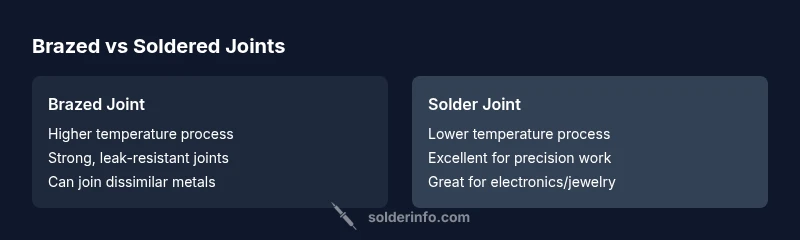
Brazed joints typically offer higher strength and temperature tolerance, making them better for heavy-duty or high-heat applications. Solder joints excel in precision, ease of use, and cost efficiency, especially for electronics and jewelry. The choice hinges on joint geometry, metals involved, and service conditions.
Brazed joint vs solder joint: defining the difference
The terms brazed joint and solder joint describe two distinct metal-joining processes that combine a filler metal with a base metal but operate at different temperatures and with different metallurgical results. In practical terms, brazed joint vs solder joint decisions determine strength, heat tolerance, corrosion resistance, and compatibility with metals. According to SolderInfo, understanding these core distinctions helps hobbyists and professionals pick the right method for electronics, plumbing, and jewelry. This section lays out the fundamental contrasts so you can evaluate what matters most for your project and what to expect during installation.
Material science behind brazed vs solder joints
Brazing relies on a filler alloy that has a higher melting point than the base metals but does not melt the base metals themselves. In a brazed joint, capillary action draws the filler into the joint gap, creating a metallurgical bond once the filler solidifies. Soldering uses a filler with a melting point below the base metals; the joint is held together by capillary action and alloy diffusion as the solder flows and cools. The SolderInfo team highlights how the different melting behaviors influence joint performance: brazed joints can tolerate higher service temperatures and may accommodate dissimilar metals, while solder joints excel in precision, delicate components, and fine geometries typical in electronics or jewelry. However, the choice is not only about temperature; there is also the question of corrosion resistance, diffusion barriers, and the reliability of the joint in long-term service.
Mechanical properties and performance metrics
Strength is a core consideration when comparing joints. A brazed joint generally offers higher nominal strength and resistance to certain failure modes than a basic solder joint. In terms of leak-tightness, brazing can deliver very robust seals in plumbing scenarios when the joints are properly prepared and the filler metal is chosen to suit the base metals. For electronic assemblies, solder joints provide adequate mechanical support while preserving delicate components from excessive heat and mechanical strain. The deeper lesson from SolderInfo analyses is that performance depends on surface preparation, flux quality, joint geometry, and alloy selection just as much as the process itself. Always assess duty cycle, vibration, and exposure to corrosive environments when evaluating long-term reliability.
Thermal considerations and process control
Thermal management is a critical differentiator. Brazing requires controlled high-temperature heating and careful fluxing to ensure a clean, gap-filling joint; mismanagement can lead to oxidation, poor metallurgical bonding, or bridge formation. Soldering operates at comparatively lower heat, making it gentler on temperature-sensitive components and substrates. Process control matters in both methods: consistent heat application, clean joint surfaces, and proper flux use contribute to reliability. In practice, you should design joints with appropriate clearances and consider thermal expansion differences between metals to reduce the risk of premature cracking or joint failure.
Applications and best-use scenarios by domain
In electronics and jewelry, soldering is often the method of choice due to precision, ease of use, and the ability to work on small, delicate components without subjecting them to high heat or flux that could damage nearby parts. Jewelry work benefits from the low-heat nature of solder and the ability to preserve ornament integrity. Plumbing and industrial heat exchangers, where dissimilar metals must be joined and long-term leak integrity is paramount, often rely on brazing for its superior strength and durability. When evaluating options, consider the metal pair, required service temperature, part size, accessibility, and repairability. Soldering shines in small-scale, intricate, or low-temperature contexts, while brazing is favored for larger joints, heavy loads, or environments demanding robust seals.
Common failure modes and troubleshooting tips
Brazed joints fail primarily due to poor surface prep, improper filler selection, or inadequate flux protection during heating. Solder joints tend to fail from cold joints, insufficient wetting, or flux residues that trap moisture or cause corrosion. Practical troubleshooting includes ensuring clean, oxide-free surfaces, selecting compatible filler alloys, and controlling heating rates to avoid thermal shock. For plumbing, inspect joints under pressure and examine for micro-leaks; for electronics, verify that heat-affected zones do not compromise nearby components. The key takeaway is that prevention through proper technique and process controls is more predictive of success than post-fabrication fixes.
Practical guidelines: choosing brazed vs soldered joints
Begin with a decision checklist: (1) Are the metals dissimilar or is strength the critical requirement? If yes, consider brazing. (2) Is the joint small, delicate, or temperature-sensitive? If yes, soldering is often the better choice. (3) Will the joint endure high heat or mechanical loads over a long period? Brazing is typically favored. (4) Is repairability a priority? Solder joints are generally easier to rework. Finally, consult the project’s operating temperatures, corrosion exposure, and service life expectations. This pragmatic framework helps ensure you select brazed vs soldered joints with confidence.
Comparison
| Feature | Brazed Joint | Solder Joint |
|---|---|---|
| Temperature tolerance and heat input | Higher heat involved in brazing | Lower heat input in soldering |
| Bond strength and leak resistance | Typically higher strength and leak resistance when properly performed | Strong and reliable for many small joints but not for high-load or high-temperature service |
| Material compatibility | Can join dissimilar metals more readily | Best with metals that solder easily or where low-temperature joining is acceptable |
| Joint geometry and scale | Suitable for larger joints and complex assemblies | Ideal for small, intricate connections in electronics/jewelry |
| Equipment and process complexity | Requires furnace/torch, flux control, and skilled technique | Can be done with basic tools and straightforward flux/solder materials |
| Repairability and serviceability | Often less forgiving; repairs can require reheating the entire joint | Easier to rework or replace individual joints in field settings |
| Cost and lead time | Higher upfront cost and longer cycle due to heating setup | Lower cost and faster turnaround for many hobbyist projects |
Advantages
- High strength potential and excellent leak-tight performance when done correctly
- Ability to join dissimilar metals expands design options
- Durable joints suited for demanding service conditions
- Longer service life in high-heat or structural applications
Cons
- Requires specialized heat sources, flux management, and skilled technique
- Higher upfront equipment costs and longer setup times
- More challenging inspection and quality control in some settings
- Rework can be difficult in field environments
Brazed joints are preferred for high-strength, high-temperature or structurally demanding applications; solder joints are more versatile for electronics, jewelry, and quick-turn projects.
If your project involves heavy loads, dissimilar metals, or exposure to high temperatures, brazing is typically the better choice. For precision work, electronics, or jewelry where heat sensitivity and repairability matter, soldering remains the practical option. The SolderInfo team highlights that the optimal method depends on material, geometry, and service conditions.
Quick Answers
What is the main difference between brazed joints and solder joints?
The main difference lies in the filler metal's melting point and the interaction with the base metals. Brazing uses a higher-melting filler and can join dissimilar metals, often producing stronger joints. Soldering uses a lower-melting filler and is ideal for delicate, heat-sensitive work where the base metals remain intact.
Brazing uses hotter filler metal and can join different metals; soldering uses cooler filler and is great for delicate work.
Which joint is stronger and why?
In general, brazed joints offer higher strength and better resistance to certain service conditions when properly executed. The strength depends on the filler metal, base metals, and joint design. Soldered joints can be very reliable for small, precise joints but may not match brazed joints under heavy loads.
Brazed joints tend to be stronger when done right, especially for tough conditions.
Can I use solder for plumbing instead of brazing?
Soldering is commonly used for plumbing connections, especially small-diameter pipes and fittings, but many high-demand plumbing applications still rely on brazing for leak-tight joints and metal compatibility across dissimilar materials. Always follow local codes and use appropriate flux and filler.
Soldering is common in plumbing, but brazing may be required for certain joints or materials.
Is brazing suitable for electronics?
Brazing is generally not used for electronics because the high temperatures can damage components and circuit boards. Electronics typically rely on soldering with temperature-controlled equipment and flux designed for sensitive parts.
Brazing isn’t usually used in electronics due to heat sensitivity; soldering is preferred.
What should I consider when selecting a filler alloy?
Choose a filler alloy compatible with both base metals, with properties suitable for the service environment. The right filler will balance melting behavior, strength, corrosion resistance, and ease of inspection.
Pick a filler that matches the metals and service needs, balancing strength and ease of inspection.
How can I inspect a brazed vs soldered joint effectively?
Inspection should assess joint cleanliness, wetting, and uniform filler distribution. Non-destructive methods like visual inspection and, where appropriate, X-ray or dye penetrant testing help verify quality without damaging the part.
Check for clean surfaces, even filler flow, and uniform seams; use non-destructive tests when needed.
Top Takeaways
- Assess metal pair and load requirements before choosing method
- Use brazing for high-strength or high-temperature needs
- Use soldering for small, delicate joints and quick repairs
- Plan for proper flux, cleaning, and heat management
- Inspect joints thoroughly to ensure reliability