Flood Solder vs Crimp: A Thorough Comparison
A detailed, analytical comparison of flood soldering and crimping for electronics, jewelry, and plumbing. Explore joint formation, durability, inspection, tools, and best-use cases to decide which method fits your project best.


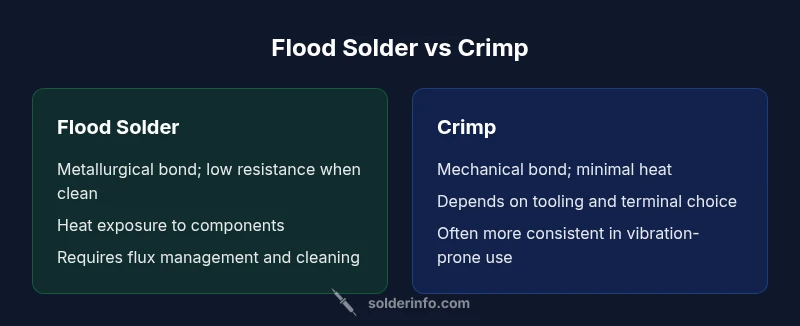
Flood soldering creates a continuous, conductive joint by melting solder to envelop the conductors, while crimping uses a pre-formed sleeve pressed around the wire to establish contact. Flood solder can provide excellent wetting and low resistance when done correctly, but it demands skill and flux control. Crimp joints rely on proper tooling and terminal sizing, delivering consistent results with minimal heat exposure.
Flood Solder vs Crimp: Core Concepts
According to SolderInfo, deciding between flood solder and crimp is not about a single best method, but about matching the technique to the application, environment, and maintenance expectations. Flood soldering involves melting solder around conductors to create a continuous joint, often aided by flux to improve wetting and prevent oxidation. Crimping uses a pre-formed metal sleeve that is mechanically compressed around the conductor and optionally insulated to establish a reliable contact. Both approaches can yield low resistance connections when performed with proper process controls, but they differ in heat exposure, inspection needs, and long-term durability.
Material and Solder Types
Solder materials have evolved toward lead-free formulations for safety and environmental reasons. In flood soldering, selecting a suitable flux and alloy matters as much as the iron temperature and dwell time. Rosin-based fluxes or water-soluble fluxes can influence residue removal and corrosion risk, especially in enclosed enclosures. In jewelry and some electronics work, solder alloys are chosen for compatibility with the base metals and to avoid brittle joints. Crimping, by comparison, relies less on solder chemistry and more on terminal material, conductor compatibility, and the quality of the crimp tool. Proper terminals, sleeves, and heat-shrink insulation are part of the overall reliability equation. In all cases, inspect for clean surfaces, no flux residues, and consistent terminal seating.
Joint Formation and Wetting
Effective wetting is the cornerstone of a reliable flood solder joint. Clean copper or other conductor surfaces, appropriate flux, and correct heat input enable solder to spread smoothly and fill gaps. Poor surface prep or excessive heat can lead to cold joints or insufficient wetting, particularly on larger gauge conductors. For crimped joints, the goal is to deform the sleeve around the conductor to create a secure mechanical lock and a metal-to-metal contact zone. The crimp geometry, tool calibration, and conductor cross-section all influence contact resistance. Underperforming joints in either method show signs such as loosening, high resistance, or visible gaps.
Mechanical Strength and Fatigue
Flood-soldered joints rely on metallurgical bonding formed by the alloy and the pad geometry. When done correctly, they can exhibit strong pull-out resistance for moderate vibration; however, repeated mechanical stress and thermal cycling may eventually loosen a joint if flux residues attract moisture. Crimped joints derive strength primarily from the sleeve deformation and the crimped shape; they offer uniform performance across multiple cycles and tolerate moderate vibration when properly secured. In high-vibration environments or where heat exposure is a concern, crimped connections often outperform soldered ones because there is less thermal cycling.
Environmental Durability and Moisture Exposure
Environmental exposure affects both methods differently. Flood-solder joints may be vulnerable to corrosion if flux residues are not cleaned, particularly in damp environments or when the joint sits in an enclosed space. Good flux choice, thorough cleaning, and appropriate encapsulation mitigate this risk. Crimped joints tend to be moisture-resistant when the sleeve and insulation remain intact, but improper crimp geometry can create micro-gaps that trap moisture. In any setting, applying conformal coating or protective insulation can extend service life for both techniques.
Inspection, Quality Assurance, and Repairability
Inspections for flood-solder joints include visual checks for fillet consistency, tack points, and a continuity test after cleaning flux residues. For crimp joints, look for proper sleeve deformation, uniform termination, and a successful pull test. Rework is more challenging with flood solder if the joint is cold or contaminated, requiring careful desoldering and reflow. Crimp rework is generally more complex because it may necessitate replacing the sleeve and re-crimping with the correct tool and terminals. Document and label joints to ease future maintenance.
Installation Time, Tooling, and Costs
Time and tooling shape the choice. Flood soldering demands a stable heat source, flux application, and post-cleaning steps; the process can be quicker for simple, small-diameter connections but increases with larger mating surfaces. Crimping uses a dedicated tool and a finite set of terminals, which can speed mass production and reduce operator variability when properly calibrated. In DIY settings, the cost of solder, flux, and a good torch or iron may be offset by the convenience of not purchasing specialized crimp tooling. In contrast, professional installations benefit from consistent assembly lines and standardized crimp terminals to ensure reproducibility.
Common Mistakes and How to Avoid Them
Common flood-solder mistakes include insufficient cleaning, excessive heat, and neglecting flux residue removal, which can lead to corrosion and unreliable joints. Over-soldering can create blobs that press against insulation or other conductors and cause shorts. For crimping, incorrect terminal size, degraded sleeves, or miscalibrated tools produce weak joints and increased contact resistance. Always verify tool calibration, inspect crimp seats, and perform post-assembly testing. A small test run can save large headaches in production.
Use-Case Scenarios: Electronics, Plumbing, Jewelry, Automotive
For electronics boards and wiring harnesses, flood soldering is common for low-impedance joints and where repairability matters. In plumbing, copper-to-copper joints benefit from specialized soldering with flux and careful cleaning, while crimp fittings are also widely used for pipe connections where soldering is impractical. Jewelry often requires delicate joints where heat control and material compatibility drive decisions; tiny crimp connections can be used for secure settings, while controlled soldering provides strong connections in other areas. Automotive wiring presents a mixed picture: crimping with high-quality terminals is typically preferred for vibration resistance, whereas certain heavy-duty harness segments may benefit from soldered joints after the necessary heat protection steps.
Maintenance and Repairability
Maintenance considerations include the ability to inspect, clean, and repair joints. Flood solder joints can be reworked with care, but ensure proper flux removal and reflow temperatures. Crimp joints may be less forgiving if the sleeve is compromised, requiring replacement of the terminal and retrim of the wire. Documentation of repair steps and version control for crimp tooling calibration helps sustain reliability across multiple technicians and time horizons.
Practical Decision Framework
- Identify environmental factors: humidity, vibration, temperature cycles. 2) Assess component sensitivity to heat and flux exposure. 3) Determine the criticality of inspection and future maintenance. 4) Evaluate tooling availability and operator proficiency. 5) Consider regulatory and industry standards applicable to the project. 6) Choose flood solder or crimping based on the best balance of reliability, cost, and maintenance expectations.
Authority Sources
- NFPA: https://www.nfpa.org/
- NIST: https://www.nist.gov/
- OSHA: https://www.osha.gov/
Comparison
| Feature | Flood Soldering | Crimping |
|---|---|---|
| Joint Formation / Wetting | Relies on metallurgical wetting with solder | Relies on sleeve deformation and mechanical contact |
| Electrical Conductivity | Low resistance when flux is controlled and joints are clean | Low resistance with properly sized terminals and good tool calibration |
| Mechanical Strength | Strong when heat control and flux are correct; vulnerable to thermal stress | Consistent strength with proper tooling, resistant to moderate vibration |
| Environmental Durability | Corrosion risk if flux residues aren't cleaned | Moisture resistance depends on sleeve integrity and insulation |
| Tooling & Setup | Soldering iron, flux, solder, and cleaning steps | Crimp tool, terminals, and sleeves |
| Repairability | Rework possible via desoldering and reflow | Rework possible by replacing sleeve and re-crimping |
| Inspection Needs | Fillets, wetting, and continuity checks | Crimp seat, deformation, and pull testing |
Advantages
- Potentially lower per-joint cost with crimping in mass production
- Flood soldering offers very low resistance joints when done correctly
- Crimping minimizes heat exposure to sensitive components
- Soldered joints can be inspected and reworked with proper skill
- Crimping provides consistent results when tooling is well-maintained
Cons
- Flood soldering requires skill, clean surfaces, and flux management
- Crimping depends on correct terminal size and calibrated tools
- Solder joints can be susceptible to corrosion if flux residues are not removed
- Crimp joints may be hard to rework if the sleeve is damaged
Crimping is typically the more reliable choice for vibration-prone environments; flood solder is preferred for permanent, low-resistance joints when heat exposure is controlled.
Choose crimping for consistency and durability in moving or heat-sensitive systems. Opt for flood solder when high current, repairability, and low impedance are paramount and you can control flux and cleaning processes.
Quick Answers
What is flood soldering vs crimping?
Flood soldering uses molten solder to form a metallurgical joint around conductors, while crimping mechanically bonds a metal sleeve to the conductor. Each method has unique requirements for surface prep, tooling, and inspection.
Flood soldering uses molten solder for a metallurgical join; crimping uses a sleeve pressed around the wire. Each has pros and setup needs.
When is flood soldering preferred?
Flood soldering is often chosen when very low electrical resistance is essential and the joint will not be exposed to extreme mechanical stress. It is common in controlled electronics work where opportunity for rework exists and proper flux management is possible.
Use flood soldering when you need low resistance and can manage flux and heat carefully.
When is crimping preferred?
Crimping is preferred for high-reliability joints in vibration-prone or heat-sensitive environments and where fast, repeatable assembly is needed with the right tooling. It is widely used in automotive, wiring harnesses, and field installations.
Crimping is the go-to for reliably fast joints in tough environments with proper tools.
Can I mix methods in a single harness?
In some cases, mixed methods are used to balance performance and practicality. However, consistent testing and clear labeling are essential to avoid maintenance confusion and potential failures.
It’s possible to mix methods, but plan testing and labeling carefully.
What inspection tests verify joint quality?
Visual inspection for fillet or deformation, followed by functional tests such as continuity and, if necessary, pull tests, help verify joint quality. Cleaning residues after soldering is also important.
Check visuals, run a continuity test, and ensure there’s no residue.
Are there standards governing flood solder vs crimp?
Standards exist in general electrical and safety guidelines; consult local regulations and manufacturer recommendations for your specific application. Industry best practices emphasize proper tool use, material compatibility, and inspection routines.
Follow local electrical codes and manufacturer guidance for best practices.
Top Takeaways
- Assess environment and maintenance needs before choosing a method.
- Crimping minimizes heat exposure and offers consistent results with proper tooling.
- Flood soldering can deliver very low resistance joints when flux and cleanliness are controlled.
- Use appropriate tooling, inspection, and documentation to ensure reliability.
- Plan for repairability and future maintenance in your joint strategy.