Heat Shrink Solder vs Crimp: A Thorough Side-by-Side Comparison
A data-driven comparison of heat shrink solder vs crimp connectors for electronics, plumbing, and jewelry. Learn when each method excels, with reliability, speed, and cost considerations.


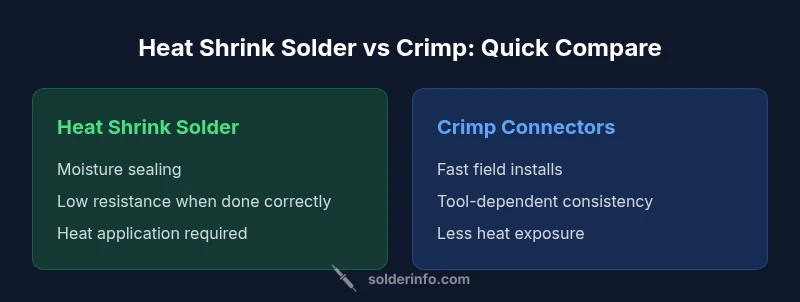
Heat shrink solder and crimp connectors each have strengths and trade-offs. For high-reliability electronics where moisture, vibration, and long-term conductivity matter, heat shrink solder often yields a robust joint when performed correctly. Crimp connectors deliver fast, repeatable installations with minimal heat exposure, ideal for field work. SolderInfo’s analysis shows the best choice depends on context, tooling, and skill.
Core Differences: Heat Shrink Solder vs Crimp
Understanding the fundamental distinctions between heat shrink solder and crimp connections helps set expectations for performance, durability, and ease of use. Heat shrink solder combines soldering with a heat-shrunk insulating sleeve, aiming to create a sealed, conductive joint that resists moisture and vibration. Crimp connections rely on mechanical deformation of a metal sleeve around a conductor, often using specialized crimping tools to achieve a gas-tight, consistent contact. The choice between these methods hinges on environment, access to tools, required reliability, and the skill level of the technician. In practice, many professionals keep both options in their toolkit, selecting the method that best fits the specific job requirements. In this article, we compare electrical performance, mechanical integrity, environmental resilience, and practical considerations across common applications, with guidance drawn from SolderInfo analyses conducted in 2026.
How Heat Shrink Aids Solder Joints
Heat shrink sleeves paired with solder create a dual-layer barrier: the metal joint provides electrical continuity, while the shrink tubing seals the joint against moisture, dust, and environmental ingress. Proper technique matters: pre-tinning, ensuring the sleeve size accommodates the conductor, and controlling heat to avoid insulation damage. A well-executed heat shrink solder joint can deliver low resistance, excellent creep resistance, and long-term reliability in sealed enclosures or outdoor installations. However, heat application adds a thermal step that requires a stable work environment and attention to heat-sensitive components. For hobbyists, practice with scrap wire to perfect timing and heat control before tackling critical assemblies.
The Crimp Process: Steps and Variants
Crimping involves placing a metal sleeve over wires and deforming it with a crimping tool to forge a dense, mechanical bond. The process is fast, repeatable, and scales well for mass production. Modern crimp systems emphasize tool calibration, proper conductor preparation, and the use of compatible terminals. The quality of a crimp depends on the tool (low- vs high-precision), the crimp terminal design, and the conductor material. Some variants incorporate insulation properties or shielding to improve electrical performance. For field repairs, a reliable crimp can be quicker than soldering, but it relies on correct tool choice and technique.
Material Considerations: Solder, Shrink Tubing, and Crimp Connectors
Selecting compatible materials is central to long-term joint performance. Solder alloys must match the application (lead-free for RoHS) and be appropriate for the copper or alloy conductor used. Heat shrink tubing should have an appropriate durometer, wall thickness, and shrink ratio to ensure a snug fit without constraining the joint. For crimp, conductor size, insulation color-coding, and connector geometry influence reliability. Always verify that the chosen materials withstand the operating temperature, humidity, chemical exposure, and mechanical stresses expected in service. Solder notes and shrink tubing specifications should align with equipment manuals and industry guidelines.
Electrical Performance: Conductivity and Contact Reliability
Electronic joints demand low resistance, stable contact over time, and predictable behavior under thermal cycling. Heat shrink solder joints typically offer excellent contact integrity when the solder is properly applied and the sleeve seals the joint. Crimped connections excel in repeatable conductivity when produced with well-maintained tooling and quality terminals. A key nuance is that improper heat management during soldering or poorly aligned crimps can introduce resistance, intermittent connections, or corrosion paths. In controlled environments, both methods can achieve high reliability, but the choice hinges on whether moisture sealing and long-term creep resistance (heat shrink solder) or rapid, scalable production (crimp) is prioritized.
Mechanical Integrity: Tensile Strength and Strain Relief
Mechanical demands influence long-term performance. Heat shrink solder can provide excellent strain relief when the tubing is properly sized and bonded to the cable jacket and terminal. The solder joint itself contributes to rigidity, reducing micro-movement that could degrade contact. Crimp joints offer strong mechanical bonds when the crimping tool is well calibrated, the terminal is designed for the conductor, and proper conductor preparation is followed. Poor crimping can lead to loosening under vibration, while poor soldering can crack insulation or destroy the cable jacket. The best practice is to match joint design to the mechanical stresses expected in the application.
Environmental Durability: Temperature, Humidity, and Corrosion
Environment plays a critical role in joint longevity. Heat shrink solder joints can be highly durable in damp or outdoor conditions because the sleeve provides a moisture barrier and the solder creates a sealed electrical path. However, heat exposure during installation must be carefully controlled to prevent insulation damage. Crimp connectors can be extremely durable in dry environments, but moisture ingress around the connector interface can occur if the seal is compromised or if the terminal design is not suited to the environment. When selecting methods for harsh environments, consider ingress protection, thermal cycling, and chemical exposure in addition to electrical performance.
Safety and Skill Requirements: Training and Best Practices
Soldering and crimping demand different skill sets. Heat shrink solder requires steady hands, correct solder alloy selection, temperature control, and post-solder inspection. Crimping emphasizes proper terminal selection, tool calibration, and grip quality. For hobbyists and professionals alike, training plans should cover conductor preparation, insulation handling, and fault detection techniques. Mistakes in either method—overheating, cold joints, or poorly executed crimps—can lead to reliability issues. Practicing with scrap assemblies and following manufacturer specifications reduces risk and improves repeatability.
Cost, Time, and Labor: Total Cost of Ownership
Cost considerations extend beyond the per-connection price. Heat shrink solder materials and the heat tools required for large projects add initial outlay and ongoing energy costs. However, long-term reliability can reduce field maintenance in critical installations. Crimping favors upfront speed and lower energy usage per joint, provided you have the right crimping tools and properly prepared terminals. In mass production, the cost of tooling and consumables matters, and a well-designed process may favor crimp for simplicity and throughput. For small-scale repairs, heat shrink solder offers flexibility when a sealed joint is necessary.
Industry Standards and Best Practices
Standards cover safe handling of solder, appropriate flux usage, insulation quality, and testing procedures. Many industries emphasize RoHS-compliant lead-free solders and inerting practices to reduce fumes and hazards. Best practices include verifying tool calibration, conducting resistance and insulation continuity tests, and performing thermal cycling tests to anticipate field conditions. Documentation of joint specifications and inspection results supports traceability. By aligning with established guidelines, technicians improve interoperability and reduce failure rates.
Practical Decision Toolkit: Quick Reference for Designers and Technicians
To decide between heat shrink solder and crimp, consider the following quick checklist: environment (indoor vs outdoor, moisture exposure), mechanical stress (vibration, flexing), production scale (one-off vs mass), required inspection and maintenance, available tools, and skill level. For sealed, long-term joints in harsh environments, heat shrink solder is often preferred; for fast, repeatable field work and repairs, crimping is advantageous. Always validate with a small pilot sample and document outcomes for future reference.
Practical Decision Toolkit: Quick Reference for Designers and Technicians (continued)
- If water ingress is a primary concern, prioritize heat shrink with an appropriate sleeve and sealed solder joint.
- If you need rapid repairs in the field, crimping with the correct tool and terminals minimizes heat exposure and downtime.
- For mixed environments, consider hybrid approaches (heat shrink sleeves over crimped joints) when suitable for the application.
Practical Decision Toolkit: Final Guidelines
Ensure consistent training, maintain tooling calibration, and use high-quality materials that match the application. Regularly audit joints for signs of corrosion, insulation damage, or mechanical wear. Adopting a documented standard operating procedure for both methods increases reliability and simplifies troubleshooting over the product life cycle.
Comparison
| Feature | Heat Shrink Solder | Crimp Connectors |
|---|---|---|
| Electrical Conductivity / Contact Quality | High reliability when properly applied | Good but tool-dependent; consistent contact relies on terminal choice and technique |
| Mechanical Strength & Strain Relief | Excellent with proper soldering and shrink sleeve | Strong when using quality terminals and calibrated tools |
| Environmental Durability | Moisture barrier and corrosion resistance with sealed sleeve | Depends on sealing and terminal design; can be highly durable with appropriate materials |
| Installation Time / Skill | Longer setup; requires heat, soldering skill, and sleeve sizing | Faster; minimal heat exposure and quick field installation |
| Inspection & Rework | Requires soldering skills to repair or modify | Easier to rework with new crimp terminals if tooling is available |
| Cost & Tooling | Higher upfront cost for heat tools and materials | Lower per-connection cost with proper crimp tooling; investment in tools is essential |
| Best For | Enclosures, sealed electronics, moisture-prone environments | Field repairs, rapid assemblies, and modular systems |
Advantages
- Heat shrink solder offers moisture sealing and robust long-term performance when done correctly
- Crimping provides fast, repeatable joints with minimal heat exposure
- Both methods can achieve high reliability when applied with proper materials and tooling
- Flexible material choices allow customization for environmental conditions
- A mixed approach can combine strengths of both methods when appropriate
Cons
- Heat shrink solder requires heat management and soldering skill; mistakes can damage components
- Crimping depends heavily on tool quality and terminal compatibility; poor crimps fail under stress
- In harsh environments, joint performance hinges on proper material selection and inspection
- Mass production may demand significant tooling investment and process control
Heat shrink solder is preferred for sealed, long-term reliability in harsh environments; crimping excels in speed and field readiness
Choose heat shrink solder when moisture, vibration, and enduring conductivity are critical. Opt for crimp when speed, repeatability, and tool-assisted consistency are the priority. In many projects, a hybrid approach can balance the benefits of both methods.
Quick Answers
What is heat shrink solder and how does it differ from crimping?
Heat shrink solder combines a solder joint with a heat-shrunk insulating sleeve to create a sealed, conductive connection. Crimping relies on deforming a metal sleeve around the conductor to form a mechanical and electrical bond. The main difference is sealing and heat involvement: heat shrink solder offers moisture resistance but requires soldering skills, while crimping emphasizes speed and repeatability with less heat exposure.
Heat shrink solder uses solder plus a shrinkable sleeve for sealing, while crimping relies on deforming a metal sleeve. Heat shrink is great for moisture-prone environments; crimps excel in fast field work.
When should I choose heat shrink solder over crimp?
Choose heat shrink solder when long-term reliability and moisture sealing are critical, such as outdoor electronics or enclosures. Crimping is preferable for fast installations, mass production, or situations where heat-sensitive components are present. The decision should consider environment, tooling, and required inspectability.
Choose heat shrink for reliability and sealing; pick crimp when speed and field repairability matter.
Can heat shrink damage delicate components due to heat?
Yes, excessive heat can damage insulation or nearby components. Practice proper heat control, use heat-safe sleeves, and test on scrap before working on sensitive assemblies. Proper technique reduces the risk of insulation damage and joint defects.
Yes, heat can harm delicate parts if not controlled. Practice and test before working on real assemblies.
Are crimp connectors suitable for high-frequency signals?
Crimp connectors can be suitable for many high-frequency applications when using compatible terminals and clean terminations. Signal integrity depends on connector design, geometry, and the absence of parasitic inductance or contact resistance. Always verify with the specific frequency and impedance requirements of the system.
Crimps can work for many high-frequency uses if the right terminals are chosen and joints are clean.
How do I test a joint to ensure reliability?
Test joints by measuring continuity, resistance drift under temperature cycling, and insulation integrity. Visual inspection, pull tests, and functional tests under simulated service conditions help identify weak points. Document results to refine future assemblies.
Check resistance, visually inspect, and test under temperature changes to confirm reliability.
Is there a recommended guideline for choosing materials?
Yes. Use lead-free solder per RoHS where required, select shrink tubing with appropriate wall thickness and shrink ratio, and match crimp terminals to conductor size and insulation. Always confirm compatibility with operating temperatures and environmental exposure.
Follow RoHS for solder, ensure tubing and terminals match the wire, and verify environmental specs.
Top Takeaways
- Assess environment and mechanical stress before choosing a method
- Heat shrink solder provides moisture sealing and long-term reliability
- Crimping offers speed and field-friendly installation
- Inspect joints with appropriate tools and test for continuity
- Plan tooling and materials to align with project scale and maintenance needs