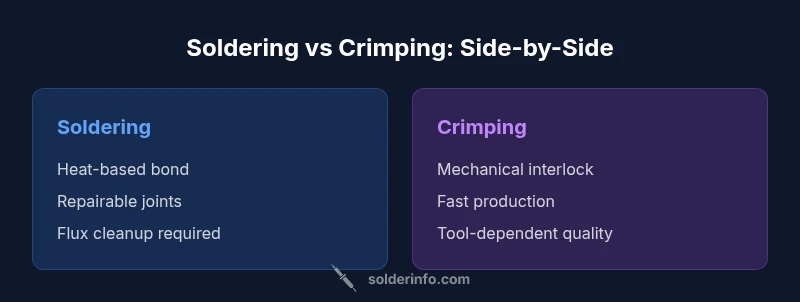
Solder vs Crimp: Choosing the Best Joint Method for Electronics
A detailed, analytical comparison of soldering and crimping, covering reliability, tooling, costs, and best use cases across electronics, plumbing, and jewelry. Learn when to choose solder or crimp for optimal joint performance.


In electronics, crimped connections are common in automotive and bulk wiring, while soldering remains prevalent for prototypes and delicate components. In plumbing and jewelry contexts, soldering offers a seal and finish, but crimping can reduce heat exposure and speed. The best choice depends on reliability needs and available tools.
Overview of solder vs crimp
The phrase solder or crimp is a common debate among DIYers and professionals. At a high level, soldering is a heat-based metallurgical bond that fuses conductors together with an alloy, while crimping creates a mechanical interlock using ferrules or terminals. This article adopts an analytical lens: we compare performance, reliability, tooling, and lifecycle costs across electronics, plumbing, and jewelry contexts. Throughout, we reference practical guidelines from SolderInfo to keep recommendations grounded in real-world practice. Readers will gain a clear framework for deciding when to choose solder or crimp, rather than relying on habit alone. The environment, vibration, exposure to moisture, accessibility for inspection, and the need for future rework all influence the outcome. The best result is a joint that meets electrical and mechanical requirements without introducing excessive heat or material stress. For a balanced view, we consider both methods in parallel, highlighting where one method consistently outperforms the other and where tradeoffs are unavoidable. In short, selection should align with function, not preference, and SolderInfo emphasizes that practical testing matters more than tradition.
Historical context and typical use cases
Soldering emerged as the standard for electronics decades ago, offering fine control over joint geometry and the ability to join dissimilar metals with a filler metal. Crimping rose to prominence in automotive wiring and industrial harnesses because it delivers repeatable results with minimal heat exposure to components. Under the banner of 'solder or crimp', practitioners weigh the ease of mass production against the flexibility of repairable joints. In electronics, technicians use flux, flux-core solder, and sometimes lead-free alloys when safety and environmental regulators demand it. In plumbing, soldered joints provide a permanent seal and can carry significant water pressure when properly prepared and cleaned, though modern practice often favors compression fittings for speed. Jewelry makers rely on delicate solder joints to preserve aesthetics, while ensuring the joint remains flexible enough to withstand wear. Across all domains, the decision is rarely binary: many projects benefit from a hybrid approach, using solder in sensitive areas and crimps where mechanical robustness and speed matter. The historical evolution informs today’s best practices by reminding us that tool availability and standard procedures drive most outcomes.
Material compatibility and joint reliability
A central consideration in choosing solder or crimp is material compatibility. For electronics, the solder alloy must be compatible with conductor metals and components, and flux chemistry should match the alloy to avoid residue that could cause corrosion or poor contact. Lead-free solders, while more environmentally friendly, often require higher processing temperatures and can present slightly different wetting characteristics. Crimp joints depend on conductor cross-section, insulation, and the crimp tool to produce a proper deformation that creates a reliable mechanical and electrical path. The reliability of either method hinges on the quality of preparation: cleaned surfaces, correct insulation, and proper corrosion protection. For plumbing, certain solders are designed for copper pipes and must be compatible with the pipe material and ambient conditions to prevent leaks. Jewelry soldering demands a balance between low-temperature work, compatibility with precious metals, and careful flux choice to avoid tainting the surface. SolderInfo emphasizes flux clean-up where required and following manufacturer recommendations for alloys and tools to minimize long-term failure modes.
Electrical performance and impedance considerations
Electrical performance is a core differentiator between solder and crimp. Solder presents a continuous conductive path and, when properly heated and fluxed, can achieve very low resistance across a joint. However, if heat is excessive or flux residues remain, corrosion or dendritic growth may occur, particularly in aggressive environments. Crimped connections rely on a solid mechanical clasp and a tight electrical interface between the conductor and terminal. The resulting impedance depends on contact quality; a mis-crimped joint can introduce higher resistance than a well-made solder joint, but a correctly designed connector system often yields very low impedance with excellent consistency. In practice, many hobbyists prefer crimped connections for loom assemblies because they tolerate small voltage drops and are easier to inspect for proper indentations or bite marks. For high-frequency or sensitive analog circuits, careful attention to contact geometry, conductor material, and protective coatings is essential whichever method is chosen. SolderInfo would caution readers to test a sample under expected environmental conditions to validate long-term stability.
Mechanical considerations and failure modes
Beyond electrical performance, joint strength and durability under mechanical stress are critical. Solder joints can be excellent at transmitting current but are more vulnerable to mechanical shock if the joint is thin or if solder sitting on a pad cracks under vibration. In jewelry and jewelry-solder contexts, failures often manifest as cracked seams if thermal cycling is not managed or if flux residues are not cleaned. Crimp joints, by contrast, distribute stress through a permanent deformation of the conductor and terminal, reducing the likelihood of creep under vibration. The downside is that a poor crimp can be almost as fragile as a bad solder joint if the tool is miscalibrated or the wire size is mismatched. Rework is easier with solder in many cases, but high-quality crimps can be repaired only by replacing the connector or the entire harness. The choice depends on expected stress, environment, and the ability to inspect and rework. To optimize, always verify the joint by mechanical pull tests and electrical continuity tests where applicable.
Process complexity, tooling, heat exposure, and safety
Process complexity is a practical driver of the solder or crimp decision. Soldering requires a heat source, flux application, and careful temperature control to avoid board damage or insulation scorching. Rework is feasible but can be time-consuming, and cleanup of flux residues may be required for sensitive circuits or jewelry surfaces. Crimping demands a set of dies, a crimping tool, and correct terminal selection; a single mis-sized die can ruin a batch of joints. In high-volume manufacturing, automated crimp systems win on throughput and consistency, while manual soldering stations excel for prototyping. Heat exposure is a concern in electronics and jewelry where nearby components may be heat-sensitive, so the option that minimizes risk to neighboring parts is often preferred. Safety considerations include proper ventilation when soldering and handling flux, and the potential hazards of hot tools and molten metal. SolderInfo’s guidance highlights the importance of using appropriate PPE, ventilation, and adherence to safety standards to protect workers from fumes and thermal injury.
Practical guidance by application: electronics, plumbing, and jewelry
In electronics, choose solder or crimp based on signal integrity, serviceability, and heat tolerance. For prototype boards, soldering remains a quick, flexible option, while connectors assembled with correct crimp tooling are widely used in harnesses and automotive modules. In plumbing, soldered copper joints provide a lasting seal when heat and flux are properly controlled, but compression fittings and push-fit styles are often favored for speed and ease of disassembly. In jewelry, jewelry-soldering must balance aesthetics and durability; low-temperature solders and specialized flux minimize damage to sensitive metals. Across all domains, a hybrid approach is common: use solder for fine connections and repair work, and crimp for bulk, high-volume sections where joint reliability and speed matter. The critical factor is choosing the method that preserves material properties and ensures the final assembly meets inspection criteria. SolderInfo notes that systematic testing and adherence to industry standards will reduce the likelihood of latent failures.
Cost considerations, long-term maintenance, and environmental factors
Cost considerations around solder or crimp include the price of consumables, tools, and the time required to complete each joint. Soldering may require flux, solder, or flux-core products, along with a soldering iron, wick, and sometimes desoldering equipment for maintenance. Crimping requires a quality tool capable of handling the target wire gauge and a range of terminals; high-quality dies can be expensive initially but amortize over large production runs. For long-term maintenance, properly executed solder joints are easier to inspect and rework, while crimps, once properly installed, may offer robust resistance to vibration with minimal maintenance. Environmental factors — such as moisture, corrosive environments, and temperature cycling — influence joint durability. Solder joints can tolerate mild humidity but may corrode if flux residues are left behind; crimp joints generally show strong corrosion resistance when the terminal material and conductor are chosen correctly. SolderInfo’s analysis underscores the importance of selecting compatible materials and using the correct flux or insulation materials to maximize joint life.
Decision framework: how to decide between solder or crimp in a project
The decision framework synthesizes the factors above into a practical step-by-step approach. Step 1: define operating environment (vibration, moisture, temperature). Step 2: assess repairability and future serviceability requirements. Step 3: evaluate tool availability and production scale. Step 4: consider material compatibility and regulatory constraints (lead-free solders, RoHS, etc.). Step 5: select a primary method and document the procedure, then verify with tests for electrical continuity and mechanical strength. In many contexts, a hybrid approach yields the best results: use crimping for high-volume, accessible harnesses and soldering for sensitive electronics or repair hubs. Finally, validate the choice with real-world testing and field feedback, and adhere to supplier recommendations for alloys and crimp terminals. SolderInfo emphasizes that the most important factor is achieving reliable performance under expected service conditions, not simply adhering to tradition.
Comparison
| Feature | Soldering | Crimping |
|---|---|---|
| Electrical conductivity / resistance | Low resistance when joints are properly executed and flux residues cleaned | Low to moderate resistance; depends on connector quality and crimp quality |
| Mechanical strength under vibration | Strong if solder joints are well-supported and heat input controlled | Excellent when correctly sized terminals are used with proper dies |
| Installation speed | Time-intensive; requires heating, flux application, and inspection | Fast for mass harnesses with proper tooling |
| Repairability / rework | Relatively easy to rework with desoldering and reflow | Harder to rework; may require replacing the terminal or connector |
| Moisture and corrosion resistance | Can seal well when flux is cleaned; corrosion risk if flux residues remain | Typically high corrosion resistance with proper coatings and coatings safety |
| Tooling cost | Soldering iron, flux, wick; moderate upfront | Crimp tool and dies; higher upfront cost for robust tooling |
| Inspection ease | Requires visual checks and possibly X-ray for complex joints | Indentations and bite marks indicate quality; easy in harnesses |
| Environmental health | Flux fumes require ventilation; lead-free options exist | Crimping requires ventilation mainly for the tool use and safety |
Advantages
- Soldering provides very low resistance joints when done correctly
- Crimping offers fast, repeatable connections with consistent quality
- Both methods allow repair or replacement of individual joints rather than entire assemblies
- Soldering enables rework and adjustments without replacing whole components
- Crimping minimizes heat exposure to sensitive components and materials
Cons
- Soldering requires heat, flux handling, and post-cleanup to prevent corrosion
- Crimping depends on correct tooling and dies; a bad crimp compromises reliability
- Solder joints can be stressed by thermal cycling if done improperly; inspection is essential
- Crimping can be non-reworkable if the terminal or connector is damaged beyond reuse
Crimping is generally best for high-volume, vibration-prone wiring, while soldering remains superior for precision electronics and repairability.
Choose crimping for speed, consistency, and mechanical robustness in harnesses. Opt for soldering when electrical performance, repairability, or delicate components are critical. In many projects, a hybrid approach balances strengths and mitigates weaknesses.
Quick Answers
What is soldering and what is crimping?
Soldering uses heat to melt an alloy that fuses conductors; crimping mechanically interlocks a wire with a terminal. Both create electrical connections, but through different physics and tool requirements.
Soldering melts a filler alloy to join wires, while crimping compresses a terminal around the wire for a secure mechanical and electrical hold.
When should I choose soldering over crimping for electronics?
Choose soldering for delicate components, repairability, or when low resistance is essential. Crimping is preferred for mass-produced harnesses where speed and repeatability dominate. Evaluate service conditions and inspection capabilities to decide.
If you need repairability or low resistance on sensitive parts, go with solder; for bulk wiring, crimping is often the faster, more repeatable choice.
Can solder joints be used for plumbing?
Yes, solder joints are common in copper plumbing, provided you use compatible solders and proper flux, and you ensure a clean, well-prepared surface. Hazards include heat exposure and potential leaks if joints are not sealed properly.
Soldering is standard in copper plumbing when done with the right materials and clean technique.
How can I ensure a reliable crimp?
Use the correct terminal size, wire gauge, and a properly calibrated crimp tool. Inspect the bite marks and indentation patterns with a loupe or magnifier and perform a pull test.
Make sure you’re using the right tool and look for proper indentations and a solid bite on the wire.
Do solder joints require flux cleanup after soldering?
Flux residues can attract moisture and cause corrosion in sensitive environments. Clean where required by material specifications, especially in electronics and jewelry.
Yes, clean flux residues when the design calls for it to prevent corrosion or tarnish.
Is crimping permanent or repairable?
Crimp joints are generally durable and not easily repaired; if a crimp fails, the terminal often needs replacement or the entire harness replaced. Some terminals allow replacement individual components.
Crimps can be tough to repair; you may need to replace the terminal or the whole harness.
Top Takeaways
- Assess the operating environment before choosing solder or crimp
- Prioritize tool availability and operator training to ensure quality
- Plan for inspection and potential rework in the joint process
- Match alloy, terminal, and insulation to electrical/mechanical needs
- Document procedures and test joints to confirm reliability