Solder vs Crimp: What Is Better for Connectors?
An objective, evidence-based comparison of solder and crimp techniques for electrical connectors, offering practical guidance for hobbyists, electronics pros, and DIYers.


Solder and crimp each excel in different contexts. Soldering delivers excellent electrical continuity when joints are properly cleaned and heated, but can suffer under vibration if joints are overheated or strained. Crimping offers consistent mechanical strength and rapid installation with proper tooling, yet its electrical reliability hinges on using the right terminals and correct termination force. The best choice depends on environment, production scale, and repair needs.
What is Better Solder or Crimp? Context and Definitions
In the world of electrical connections, two primary methods compete for space on the bench and in the field: soldering and crimping. Soldering involves melting a filler metal to join wires or terminals, creating a contiguous metal path. Crimping uses a mechanical deformation of a connector’s contact against the conductor to establish contact without molten metal. The core question—what is better solder or crimp—depends on conditions such as voltage and current levels, expected mechanical stress, environmental exposure, and whether the joint must be easily reworked. According to SolderInfo, the choice is not binary: the appropriate method balances electrical performance with mechanical durability and manufacturability. This article compares the two side by side, emphasizing practical decision factors for hobbyists, electronics enthusiasts, jewelers, plumbers, and professionals.
Quick note on scopes and terminology
Soldering typically targets electrical continuity and low resistance paths, while crimping is optimized for robust mechanical engagement and repeatable mass production. Solder joints can be inspected for cleanliness, wetting, and fillet formation, whereas crimped connections rely on terminal design, tool calibration, and correct seating. For readers exploring the topic—what is better solder or crimp—the key distinction is not only the joint itself but the surrounding process: preparation, tooling, testing, and environmental exposure.
Electrical performance: conductivity, resistance, and signal integrity
Electrical performance is a core differentiator. Solder joints, when cleaned and tinned, typically provide a continuous metal path with minimal contact resistance. Crimp connections rely on a metal-to-metal interface that can be equally conductive when made with the correct terminal and conductor combination. However, solder can develop micro-cracks or flux residues if overheating occurs, potentially increasing resistance over time. Crimps can also degrade if the termination force is incorrect or if the connector material corrodes or loosens under vibration. The overarching lesson, echoed by SolderInfo, is that both methods must be executed correctly, with attention to conductor sizing, flux cleanliness, and connector compatibility.
Mechanical durability: vibration, strain relief, and long-term reliability
Mechanical durability is where crimping often shines. A well-executed crimped connection, using proper tools and quality terminals, can exhibit predictable strain relief and resistance to loosening under vibration. Soldered joints are more susceptible to fatigue if the wire flexes repeatedly at the joint or if heat cycles degrade the solder fillet. In high-vibration environments, a properly designed crimp connector with strain relief can outperform a soldered joint unless negative factors (such as excess heat or poor flux cleaning) are carefully controlled. The bottom line is to align method with environment: crimp for motion, solder for static electrical joints with thermal considerations.
Environmental exposure: temperature, moisture, and corrosion resilience
Environment drives reliability. Heat, moisture, and corrosive exposure can affect both methods. Solder joints can suffer from thermal cycling, leading to joint embrittlement or tin whiskers in some solders, particularly in older alloys. Crimp joints rely on the corrosion resistance of terminal materials and the quality of the seal against moisture ingress. Properly plated terminals and corrosion-resistant solders help, but the environment will still shape long-term performance. SolderInfo’s guidance emphasizes selecting compatible materials and protective coatings when joints operate in harsh climates.
Production speed, cost, and repeatability at scale
From a manufacturing perspective, crimping often wins on speed and consistency. Automated or semi-automated crimp systems can terminate thousands of connections per hour with repeatable force and seating depth, assuming tool calibration is maintained. Soldering, while slower per joint, can be advantageous for small runs or repair work where the number of joints is limited and the operator can manage precise heat control. This becomes a decision about scale: crimping shines in high-volume contexts, soldering in niche, repair, or high-reliability niches where joint inspection is feasible.
Tools, techniques, and best practices for solid joints
Successful soldering requires clean surfaces, appropriate flux, correct temperature control, and proper tinning. Indium or lead-free solders demand careful temperature management to prevent wick-back. Crimping requires the right terminals, correctly matched to wire size, and calibrated tools that apply the specified crimp height and force. Best practices include inspecting crimp seats with magnification, verifying solder joints using pull tests, and ensuring no nicked wires or conductor cores. A disciplined approach to tooling and technique is essential for reliable outcomes.
Real-world scenarios: which method fits which application
Consider hobby electronics projects where serviceability matters; soldering is often acceptable for low-stress, infrequently disconnected joints. For automotive wiring harnesses or industrial equipment with frequent vibration, crimped connectors with sealed housings may offer superior reliability. Plumbing-specific contexts typically use solder or mechanical couplings rather than electrical crimp terminals, but when electrical splices are required, both methods are viable if performed to spec. The practical decision hinges on the expected service life, maintenance access, and exposure to mechanical stress.
Comparison
| Feature | Solder | Crimp |
|---|---|---|
| Electrical conductivity | Very good to excellent with proper cleaning | Excellent when terminals are properly seated and sized |
| Mechanical strength under vibration | Can be vulnerable if overheated or cracked | Typically strong when tool calibration is correct |
| Installation speed (per joint) | Labor-intensive, depending on heat control | Fast with automated or trained operators |
| Inspection ease | Fillet quality, oxidation, and wetting checked visually | Seat depth and crimp height require tools/fixtures |
| Repairability | Relatively easy to rework with heat; may damage conductor | Often non-reworkable without replacing terminal |
| Equipment and tooling cost | Basic soldering iron is inexpensive; flux and solder add ongoing cost | Dedicated crimping tools and dies can be a higher upfront investment |
| Environment suitability | Sensitive to heat and flux residues; good in controlled environments | Resistant to shock/vibration when properly executed; moisture protection depends on terminals |
| Best use case | Low to mid production, repair work, high-reliability finishes when controlled | High-volume production, field installs, vibration-prone scenarios with proper terminals |
Advantages
- Excellent electrical continuity when joints are clean and properly heated
- Good for repair work where replacing a section is feasible
- Heat management can be controlled to protect sensitive components
- Versatile for small-scale projects and hobbyist experiments
- Soldering supplies are widely available and low-cost
Cons
- Requires skill and careful temperature control to avoid damage
- Thermal stress can degrade joints over time under cycling
- Inspection is more challenging if flux residues are not cleaned
- Rework can be messy or damage insulation if not done carefully
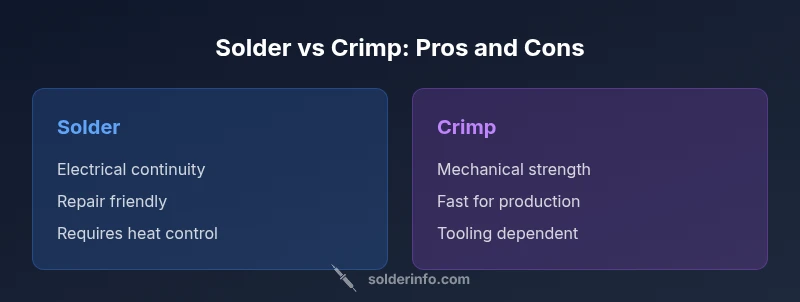
Crimp generally wins for production speed and vibration resilience; solder wins for static electrical joints and repairability when done with care
Choose crimp for high-volume or vibration-prone environments with correct tooling. Opt for solder where thermal protection is critical or where repairability is a priority; ensure proper technique and materials for reliable results.
Quick Answers
Is solder or crimp better for automotive wiring?
Automotive wiring often favors crimped connections due to vibration and environmental exposure. When crimped correctly with the right terminals and seals, crimp joints provide durable mechanical strength and resistance to loosening. Solder may be used in secure, sheltered locations or for repairs, but crimping is generally the preferred mass-production method.
For cars and heavy machinery, crimped joints are usually the best choice because they resist vibration well when done with proper terminals and tools.
Can solder joints be used in high-vibration environments?
Solder joints can be suitable in some high-vibration contexts if the joint is designed to tolerate movement and strain and if proper heat control is maintained to prevent fatigue. In many cases, crimped connectors are preferred for vibration-prone applications due to their mechanical stability.
Yes, solder can work, but vibration often favors crimped connections when done correctly.
Does one method serve both power and signal lines equally well?
There is no one-size-fits-all method. For low-frequency or signal integrity-critical joints, soldering can minimize contact resistance with careful technique. For power lines and high-current paths, crimping with suitable terminals often provides more reliable mechanical strength and consistent connections.
It depends on the current, exposure, and need for serviceability.
What inspection methods verify joint quality?
Inspect solder joints for fillet formation, wetting, and cleanliness; check for cold joints and flux residues. For crimps, verify seating depth, crimp height, and conductor fill with appropriate tools and, if possible, pull testing. Non-destructive tests like X-ray are rarely needed for standard practice but may be used in critical assemblies.
Look for clean joints, proper seating, and consistent force. Use a pull test where possible.
Are there safety concerns when choosing solder vs crimp?
Safety concerns include handling molten solder safely to avoid burns and exposure to fumes, and ensuring crimp tools are operated correctly to prevent injury and avoid improper terminations. Both methods require proper PPE and ventilation where soldering.
Wear eye protection and work in a ventilated area; follow tool safety guidelines.
How should I approach a mixed-method project decision?
For projects requiring both reliability and speed, consider a mixed approach: use crimping for main connections and reserve soldering for critical joints or where insulation integrity matters. Document the rationale to improve future maintenance decisions.
Mix methods intelligently: crimp for most, solder for critical joints.
Top Takeaways
- Assess environment and vibration before choosing method
- Solder offers low resistance when joints are clean and heat is controlled
- Crimping provides consistent mechanical strength with proper tooling
- Inspect joints carefully for quality in both methods
- Balance cost, speed, and reliability in your workflow