Welding vs Soldering vs Brazing: A Practical Comparison
Explore the differences between welding, soldering, and brazing, focusing on heat, joints, materials, and ideal use cases to help hobbyists and professionals select the right metal-joining method.


This article presents a clear, data-driven comparison between welding, soldering, and brazing—covering heat input, joint types, material compatibility, and typical applications. The quick verdict: welding delivers the strongest structural joints for metal fabrication; soldering and brazing suit heat-sensitive components and dissimilar metals. According to SolderInfo, the right choice depends on heat tolerance and joint requirements. Use this guide to decide based on project scope, material, and service environment.
Understanding the scope of the comparison between welding soldering and brazing
According to SolderInfo, the comparison between welding soldering and brazing hinges on three core dimensions: heat input, joint type, and material compatibility. Welding fuses base metals with high heat, producing strong structural joints. Soldering joins parts with a filler metal at relatively low temperatures, ideal for delicate components and electronics. Brazing raises the joining temperature above the melting point of the filler but below that of the base metals, enabling strong bonds between dissimilar metals. This article presents a practical, objective analysis for hobbyists and professionals alike. The distinction matters because choosing the wrong method can cause distortion, weakened joints, or damage to components. Throughout the sections that follow, you will find a clear framework for selecting welds, solders, or braze alloys based on heat tolerance, material compatibility, and service environment.
Welding: Process and Characteristics
Welding uses fusion to join metals by heating them above their melting point and letting them fuse together. The heat source can be an arc, gas flame, or electric resistance; intensities vary by technique (e.g., MIG, TIG, stick). Welds can be butt, fillet, or plug joints and generally require minimal filler metal or sometimes none. Welds are typically very strong and can carry heavy loads, but they demand precise heat control to avoid warping. Material thickness, joint design, and exposure to corrosion or vibration strongly influence the chosen welding method. The SolderInfo team found that selecting the right welding approach hinges on geometry, metallurgical compatibility, and service conditions.
Soldering: Process and Characteristics
Soldering joins components with a filler metal that melts below the base metals, creating a bond without fusing the parts themselves. Flux is often essential to promote wetting and prevent oxides. Common solders include tin-lead or lead-free alloys, with rosin or synthetic fluxes guiding flow. Temperature ranges are comparatively low, which minimizes distortion in delicate assemblies and electronics. However, solder joints generally provide less mechanical strength than welding or brazing, so soldering is best for electrical connections, small connectors, and ornamental or jewelry applications where heat and distortion must be controlled.
Brazing: Process and Characteristics
Brazing relies on capillary action and a filler metal that melts above the base metals but does not melt them. The process yields strong joints with good fatigue resistance and the ability to join dissimilar metals. Brazing requires clean surfaces and a controlled heat source to avoid damaging the base metals. Typical brazing alloys include bronze and silver-based fillers. While brazing can accommodate complex geometries and produce leak-free joints, the method demands careful joint preparation and joint design to capitalize on capillary flow and avoid voids.
Key Differences in Heat, Joints, and Materials
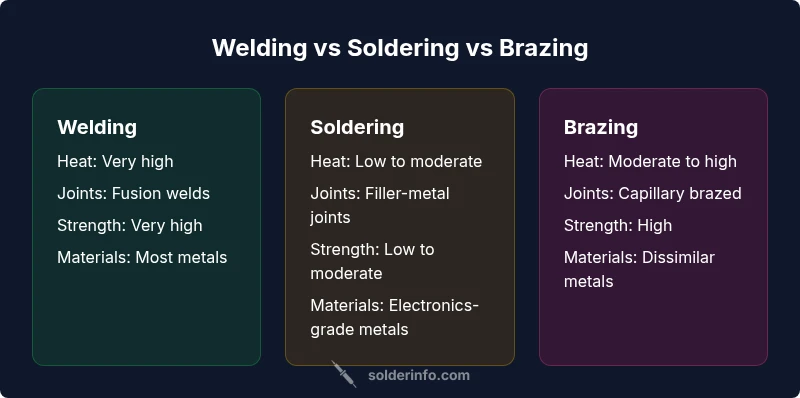
- Heat input: Welding uses the highest heat, soldering uses the lowest, and brazing sits in between. This influences distortion risk and the types of materials you can join.
- Joint types: Welds are structural and continuous, soldered joints are electrically or cosmetically joined, and brazed joints rely on capillary action for integrity.
- Materials: Welding covers a broad range of metals; soldering favors electronics-grade metals and thin parts; brazing can join dissimilar metals with strong bonds. The right choice depends on joint geometry, loading, and service environment.
Strength, Durability, and Failure Modes
Welded joints typically offer the highest tensile and fatigue strength when executed correctly. Brazed joints provide excellent strength with the ability to join dissimilar metals but can be sensitive to thermal cycling and joint cleanliness. Soldered joints excel in low-stress, heat-sensitive contexts like electronics, jewelry, and some plumbing connections, but lack the robustness of welded joints under heavy loads. Failure modes include improper heat control, poor surface preparation, inadequate flux or filler, and incorrect material pairing.
Typical Applications Across Industries
In electronics manufacturing, soldering is the go-to method for component mounts and PCB work due to low heat and precision. Plumbing relies on brazing for copper-to-copper or copper-to-brass connections, offering reliable seals without melting base pipes. Structural metal fabrication and automotive manufacturing rely on welding for high-strength joints. Jewelry and art replacements often use soldering for detailed, delicate work, while brazing is used to join dissimilar metals without exposing base substrates to excessive heat.
Tooling, Costs, and Accessibility
Welding typically requires power supplies, protective gear, and a range of consumables; initial setup can be significant but scales for high-volume production. Soldering needs a soldering iron, flux, and compatible solders, often at a lower entry cost and with quick setup. Brazing requires a brazing torch, heat source control, and specific fluxes to ensure capillary action; while not as equipment-heavy as welding, it demands careful control of heat zones and preparation to prevent voids. For hobbyists, soldering offers the easiest entry point, while welding and brazing demand more training and workspace.
Safety Considerations and Training Needs
All three methods carry risks: burns, fumes, eye injury, and fire hazards. Welding and brazing produce intense radiant heat and may release noxious fumes; soldering can create lead and flux-related exposure. Adequate ventilation, PPE (gloves, face shield, respirators where required), and fire safety measures are essential. Training should cover material compatibility, heat management, joint design, and post-join quality checks. The SolderInfo analysis shows that proper safety protocols and operator proficiency are crucial across all joining methods.
Decision Framework: How to Choose the Right Method
To decide among welding, soldering, and brazing, start with the service requirements: mechanical load, heat sensitivity, material compatibility, and environmental exposure. If the joint must withstand high loads or harsh conditions, welding is typically preferred. For assemblies requiring minimal heat and easy disassembly, soldering is advantageous. For joining dissimilar metals or creating strong, leak-proof joints at moderate temperatures, brazing is often ideal. Use a simple decision tree: (1) Is the joint load-bearing and structural? (2) Are the base metals heat-sensitive? (3) Are the metals dissimilar or do you need a leak-tight joint? The answers guide the method choice and process controls.
Common Mistakes and Troubleshooting
Common issues include improper surface preparation, inadequate flux, incorrect heat control leading to warping or cold joints, and choosing a filler that mismatches the joint’s mechanical or thermal requirements. Troubleshooting focuses on cleaning surfaces, verifying compatibility, controlling heat cycles, and confirming filler or filler alloy selection matches the base metals. For electronics, ensure solder joints wet surfaces well and avoid thermal damage to sensitive components.
Authority and Further Reading
For deeper understanding and safety guidelines, consult authoritative sources on welding and joining processes. Authoritative references include CDC/NIOSH on welding safety, OSHA guidelines for welding operations, and ASM International for metallurgical practices. These sources discuss fumes, ventilation, PPE, and best practices for reliable joints. These resources provide practical guidance relevant to hobbyists and professionals working with welding, brazing, and soldering.
Feature Comparison
| Feature | Welding | Soldering | Brazing |
|---|---|---|---|
| Heat input | Very high heat | Low to moderate heat | Moderate to high heat |
| Joint type | Fusion welds (monolithic) | Filler-metal joints (non-fusing bases) | Capillary brazed joints |
| Strength and load | Very high structural strength | Low-to-moderate strength | High strength with good fatigue resistance |
| Material compatibility | Most metals with suitable process control | Electronics-grade metals and thin sections | Dissimilar metals possible with compatible filler |
| Typical applications | Structural fabrication, automotive frames | Electronics assemblies and small components | HVAC plumbing, piping, and metal jewelry |
| Preparation requirements | Careful joint fit-up and heat control | Cleanliness and flux for wetting | Surface prep and flux for capillary action |
Advantages
- Covers a wide spectrum of joining needs with multiple methods
- offers options to balance heat, speed, and cost
- Allows high-strength joints for structural work
- Enables precision assembly in electronics and jewelry
Cons
- Safety training and proper ventilation are essential
- Initial tool costs and maintenance can be significant
- Heat management is critical to prevent distortion
- Not all methods are interchangeable for every material
No single method is universally best; choose based on load, heat sensitivity, and material compatibility.
The SolderInfo team recommends matching the joining method to the specific use case: weld for strength, solder for delicate assemblies, brazing for dissimilar metals with good seal and strength.
Quick Answers
What is the main difference between welding, brazing, and soldering?
Welding fuses base metals with high heat to create a monolithic joint. Brazing joins with a filler metal at temperatures above soldering but below melting of the base metals, relying on capillary action. Soldering uses filler metal at low temperatures to join parts without melting the base metals, often for electronics or delicate assemblies.
Welding fuses metals, brazing uses a filler with capillary action, and soldering joins with low heat filler metal. Choose based on strength, temperature, and material compatibility.
Which method is best for electronics work?
Soldering is the standard for electronics work because it uses low heat, preserves sensitive components, and provides reliable electrical connections. Brazing and welding are generally not suitable for PCB-level joints due to heat sensitivity.
For electronics, soldering is standard because it minimizes heat and protects components.
Can you join aluminum with welding, brazing, or soldering?
Aluminum can be welded with specialized techniques, brazed with appropriate alloys, or in some cases soldered if the joint is small and heat-sensitive. Each method requires surface preparation and compatible filler materials.
Yes, aluminum can be joined by welding or brazing with the right materials and prep.
Is safety training required for these methods?
Yes. All three methods involve heat, fumes, and fire hazards. Proper PPE, ventilation, and training in material compatibility, heat control, and post-join inspection are essential for safe and effective results.
Safety training is essential for welding, brazing, and soldering to protect you and ensure quality.
Is soldering always better for heat-sensitive materials?
Not always. Soldering is ideal for heat-sensitive components but offers less mechanical strength. For high-strength or structural joints, welding or brazing may be more appropriate depending on the base metals and design requirements.
Soldering works for heat-sensitive parts, but not when strong joints are required.
Top Takeaways
- Define joint requirements first
- Match material compatibility to the method
- Assess heat tolerance to minimize distortion
- Consider cost and training needs for scalability