Lead vs Lead-Free Solder: An In-Depth Comparison
A thorough, analytical comparison of lead-based and lead-free solders for electronics, plumbing, and jewelry, covering composition, performance, safety, and regulatory considerations.


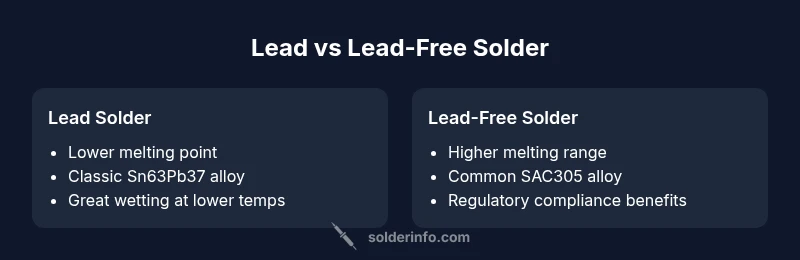
Lead-based solder and lead-free solder differ in composition, melting behavior, and safety. Leaded solders (for example Sn63Pb37) offer easy wetting at lower temperatures, but carry health and environmental risks. Lead-free alloys (commonly SAC305) require higher processing temperatures and more precise flux control, yet they align with RoHS and reduce lead exposure. For most new work, lead-free is preferred; legacy repairs may still require leaded solder.
What exactly are we comparing? Lead vs Lead-Free Solder
Solder is an alloy used to join metal parts by melting and fusing them with a flux. The modern discourse centers on two broad families: lead-based and lead-free solders. Lead-based formulations typically employ tin mixed with a substantial fraction of lead, in classic examples like Sn63Pb37 or Sn60Pb40. Lead-free solders replace lead entirely with other elements, most commonly tin-silver-copper (SAC) alloys such as SAC305. The critical differences between these families go beyond the color of the alloy; they drive processing temperatures, joint characteristics, reliability under thermal cycling, and safety implications. According to SolderInfo, the distinction isn’t merely regulatory; it reflects fundamental metallurgy and practical workability across electronics, plumbing, and jewelry contexts. The goal of this article is to provide a structured, evidence-based comparison so readers can choose the right alloy for a given application, while avoiding unnecessary tradeoffs.
Melting Behavior and Wetting: Temperature profiles and solder flow
Leaded solders typically melt at lower temperatures, with Sn63Pb37 commonly cited at around 183°C, which translates into smoother wetting for hobbyists and swift rework. Lead-free options, such as SAC305 (96.5Sn-3.0Ag-0.5Cu), exhibit a higher, broader melting range around 217–221°C. This difference affects reflow profiles, heat sensitivity of components, and the risk of thermal damage to plastic encapsulants. Wetting speed and flow are also influenced by flux formulation and surface finish. In practice, lead-free solders demand meticulous flux activation, clean boards, and adequate preheating to ensure reliable joints, especially on densely populated or fine-pitch assemblies. According to SolderInfo, understanding these temperature differences helps prevent cold joints and tombstoning during board assembly. The takeaway is that temperature control and flux quality are central to successful soldering with either family, but the baseline heat requirements are notably higher for lead-free formulations.
Alloys and Formulations: Common leaded and lead-free alloys
The classic leaded alloy Sn63Pb37 remains a stable, forgiving workhorse for many decades of electronics repair. In contrast, lead-free workhorses are dominated by SAC305 (96.5Sn-3.0Ag-0.5Cu) and related SAC variants. These alloys move us away from lead toxicity but introduce other considerations, including higher melting ranges, potential brittleness if misapplied, and variations in filler metal properties with silver content. Another label you may encounter is SAC387 or SAC405, each with slightly different tin-silver-copper ratios that tune melting behavior and mechanical performance. Understanding the alloy family you choose informs flux selection, rework strategies, and long-term joint performance. As a practical rule, select lead-free formulations that match your component tolerances and reflow capabilities, and avoid cross-mixing incompatible alloys without a structured process plan.
Application-specific implications: Electronics, Plumbing, Jewelry
For electronics, the board and components are designed to tolerate the thermal budget required by lead-free alloys. Modern consumer devices typically assume RoHS-compliant materials, and lead-free solders have become the default in many regions. In plumbing, lead-free solders are now required for potable water systems in many jurisdictions, with legacy Pb-based joints phased out or restricted. Jewelry soldering often uses lower-melting alloys and careful flux control to protect delicate metals, while achieving aesthetic finishes. In all cases, ensure flux compatibility and surface preparation are appropriate to the alloy family used. The overarching pattern is that lead-free soldering emphasizes higher peak temperatures and stricter cleanliness, while leaded soldering tolerates lower temperatures and more lenient surface conditions. According to SolderInfo, choosing the right alloy hinges on the end-use constraints, safety expectations, and regulatory compliance guiding the project.
Health, Safety, and Regulatory Context
Lead exposure remains a critical concern in manufacturing and hobby contexts alike. Lead-based solders contain lead and require strict handling, ventilation, and waste disposal protocols to minimize health risks. RoHS and related directives push the electronics industry toward lead-free alloys, reducing environmental lead release during manufacturing and at end-of-life. Even with lead-free solders, handlers must observe appropriate personal protective equipment and proper disposal practices for flux residues and dross. A pivotal aspect of regulatory compliance is ensuring that all materials meet the relevant environmental standards for your market. The SolderInfo analysis highlights that adherence to lead-free products is not just about policy; it also reduces occupational hazards and aligns with consumer expectations for safer electronics and plumbing products.
Reliability, Durability, and Long-Term Performance
Joint reliability under thermal cycling is a central consideration when choosing between lead and lead-free solders. Lead-based joints typically exhibit excellent ductility, which can mitigate some thermal stresses but at the cost of higher hazard risk. Lead-free joints can be more brittle, particularly if the design does not account for the higher modulus and potential tin whisker formation. Proper board design, copper thickness, and component choice influence long-term survival more than any single alloy. Tin whiskers, a phenomenon with lead-free tin-based solders, can pose intermittent short circuits in dense assemblies if not mitigated by proper plating and encapsulation strategies. The long-term performance of either family hinges on process discipline, cleaning, storage, and environmental exposure. SolderInfo notes that the reliability delta is highly contextual—board material, flux, and reflow history all shape outcomes.
Process Considerations: Flux, Cleaning, and Rework
Flux choice and cleaning strategy are central to achieving robust joints with either solder family. Lead-free fluxes often require longer activations and precise residue removal to prevent corrosion or dendritic growth. No-clean fluxes are common in consumer electronics, but residues can trap moisture and increase corrosion risk if not properly managed. Rework with lead-free solders demands careful heat control to avoid delaminating components and scorching solder masks. When working with leaded solders, a slightly wider temperature window can be forgiving but at the expense of safety and regulatory alignment. The practical guideline is to tailor your flux type, preheat strategy, and tip selection to the alloy at hand, while maintaining a clean, dry work surface. SolderInfo emphasizes that mastering flux activation, temperature management, and post-solder cleaning is the most reliable route to durable joints.
Tooling and Techniques: Soldering irons, tips, and profiles
Tools and technique adapt to the alloy in use. Leaded solders respond well to lower peak temperatures and smaller tip sizes when used with properly tuned preheats. Lead-free work often benefits from slightly higher peak temperatures, robust heat transfer, and properly chosen tip geometries to promote even heat distribution across pads. The choice of flux, nozzle geometry, and reflow profile can dramatically influence joint quality and cycle time. For hobbyists, setting a conservative preheat and ramp rate helps reduce thermal shock for delicate components. For professionals, a well-matched reflow profile and proper oven control are essential when transitioning from leaded to lead-free processes, ensuring consistent results across production runs. SolderInfo reinforces that equipment readiness and process consistency are the keys to high-quality solder joints.
Cost, Availability, and Lifecycle
Long-run costs depend on alloy formulation, supply stability, and the regulatory environment. Leaded solders have historically been cheaper and abundant, which once favored legacy repair work. Lead-free solders tend to be slightly more expensive and subject to price fluctuations based on raw materials and supply chain dynamics. Availability can vary by region and by the flux/paste systems used with each alloy. For many manufacturers, the cost delta is offset by regulatory compliance benefits and reduced hazard exposure. The lifecycle management for solder materials also encompasses recycling and waste handling considerations, where lead-free materials align with broader environmental objectives. SolderInfo notes that total cost of ownership matters more than upfront price, especially in high-volume electronics production or critical plumbing installations.
Transition Strategies for Mixed Environments
Organizations with a legacy installed base or mixed-solder environments should plan a staged transition to lead-free systems. This includes ensuring compatible flux chemistries, rework capabilities, and documentation for traceability. When boards contain both leaded and lead-free joints, consider separate process zones or dedicated heat-tamil profiles to minimize cross-contamination and thermal stress. In some repair contexts, dual-solder strategies might be warranted, provided that risk assessment and regulatory allowances permit. Effective transition requires training, process control, and clear change management, with a focus on preserving reliability while meeting safety and compliance goals. SolderInfo advises a deliberate, data-driven approach to migration that minimizes disruption to existing products and customer expectations.
Practical Takeaways for Hobbyists and Professionals
- Start with lead-free solder for new projects to align with safety and regulatory trends.
- If working on legacy boards or non-potable plumbing lines, assess whether leaded solder is permissible and safe for the specific application.
- Invest in good flux, clean surfaces, and reliable temperature control to achieve durable joints in either family.
- Monitor tin whisker risks and plan for post-solder cleaning and inspection, especially for dense electronics.
- Keep a documented rework and transition plan to avoid surprises during firmware or hardware updates.
Comparison
| Feature | Lead solder | Lead-free solder |
|---|---|---|
| Composition | Tin-lead alloy (e.g., Sn63Pb37) | Tin-silver-copper alloy (e.g., SAC305) |
| Melting Point | Approximately 183°C (eutectic Sn63Pb37) | Approximately 217–221°C (typical SAC305 range) |
| Wetting & Flow | Excellent wetting at lower temps; forgiving for beginners | Requires higher peak temps and precise flux control |
| Mechanical Properties | Generally more ductile; higher elongation | Can be slightly more brittle; depends on alloy and cooling rate |
| Toxicity/Health Risk | Contains lead; health/environmental hazards if mishandled | Lead-free; reduced lead exposure, but still requires safe handling |
| Regulatory Status | Historically allowed; increasingly restricted in consumer electronics | RoHS-compliant; common requirement in modern devices |
| Rework Difficulty | Easier rework at lower temps | Harder rework due to higher temps and thermal stress risk |
| Availability & Cost | Widely available and typically cheaper historically | Slightly more expensive; price volatility with materials |
| Best For | Legacy projects and budget-sensitive work | New designs requiring RoHS compliance |
Advantages
- Meets RoHS and environmental regulations for new products
- Reduces lead exposure risk for workers and users
- Supports modern electronics with standardized lead-free alloys
- Improved disposal and recycling compatibility
Cons
- Higher processing temperatures can stress boards and components
- Lead-free alloys can be more brittle and prone to tin whiskers if misapplied
- Solder pastes and fluxes can be more expensive and require stricter quality control
Lead-free solder is generally the recommended default for new designs; leaded solder remains acceptable for legacy repair when temperature control and compatibility are properly managed.
The lead-free choice is driven by safety, regulatory compliance, and long-term sustainability. Reserve leaded solder for controlled legacy scenarios where it is explicitly allowed and carefully managed.
Quick Answers
What is the main difference between lead and lead-free solder?
The main difference is alloy composition and melting behavior: lead-based solders use tin-lead alloys with lower melting points, while lead-free solders use tin-silver-copper formulations with higher melting points. This affects your reflow temperature, component tolerance, and long-term reliability, along with regulatory considerations for safety.
Lead-based solders melt at lower temperatures but carry health risks; lead-free solders require higher temperatures but comply with safety regulations.
Is lead-free solder harder to work with than leaded solder?
Lead-free solders typically require higher peak temperatures and more precise flux control, which can complicate delicate boards. With proper cleaning and temperature profiling, results can match or exceed leaded performance, but beginners may face a steeper learning curve.
Yes, lead-free can be trickier due to higher heat, but good technique, flux, and timing resolve most issues.
Can I mix leaded and lead-free solders on the same board?
Mixing different solder chemistries on the same board is generally discouraged because of differing melting temperatures and thermal characteristics, which can cause joint instability or remelting of nearby joints. If unavoidable, use separate heat zones and confirm no cross-contamination.
It's best to avoid mixing; if you must, separate heat zones and validate joints carefully.
What regulatory requirements affect the use of lead-free solder?
RoHS and similar environmental directives drive the shift toward lead-free solders in many electronics markets. Some regions and applications still tolerate leaded solders in specific non-potable or legacy contexts, but compliance and documentation are key.
Regulations like RoHS push lead-free usage, with some legacy exceptions depending on the region.
Is lead-free solder safer for health and the environment?
Lead-free solders reduce lead exposure in manufacturing and consumer products, which improves environmental safety. They can introduce tin whisker risks if not properly managed and still require good handling, ventilation, and disposal practices for residues.
Yes, lead-free solder reduces lead exposure, but you still need safe handling and disposal practices.
How do melting temperatures influence soldering profiles?
Higher melting temperatures for lead-free solders require adjusted reflow profiles, preheating, and cooling rates to avoid thermal stress. Electronic components and PCB substrates have maximum thermal tolerances—design profiles accordingly to protect sensitive parts.
Higher temps mean you must adapt profiles and preheating to protect parts.
Top Takeaways
- Prioritize lead-free for new designs due to safety and compliance
- Leaded solders offer lower melting temps but higher health risks
- Control flux and cleaning to ensure reliability with either alloy
- Transition thoughtfully: plan, train, and document changes
- Evaluate regulatory requirements and end-use needs before selecting alloy