Lead Solder vs Non-Lead Solder: A Practical Comparison
A technical comparison of lead solder vs non-lead solder, covering health, regulation, performance, and best-use scenarios for electronics, jewelry, and plumbing projects.


Lead solder vs non lead solder presents a clear safety and regulatory trade-off. For new electronics, RoHS-compliant lead-free solders are usually recommended; lead-based solders remain convenient for legacy projects under controlled conditions. This quick answer outlines the core considerations—safety, performance, and compliance—so you can choose the right solder for your project.
Material properties, health, and regulatory context
When weighing lead solder vs non lead solder, you must consider not only melting points and flow but also health hazards and regulatory pressure. Lead-containing solders deliver reliable joints at relatively moderate temperatures and are forgiving of flux choices, which is why they persisted in hobbyist and professional workflows for decades. However, lead exposure, especially in fumes and dust, raises workplace safety concerns, and many jurisdictions restrict or ban its use in consumer electronics and furniture products. The SolderInfo team notes that the shift toward lead-free alternatives is driven by broader environmental and occupational health goals, not just regulatory compliance. For DIY electronics and jewelry, you can still encounter leaded solders in controlled environments, but that choice carries additional duties, including ventilation, PPE, and disposal considerations. Understanding the difference between lead solder and non lead solder means weighing convenience against long-term safety and liability. In practice, most modern workshops favor lead-free formulations for new work, reserving leaded options for legacy repairs or highly controlled settings.
Alloys and chemistry overview
Different solder chemistries shape performance, handling, and health considerations. Leaded solders combine tin with lead to form a predictable, forgiving alloy that flows readily and wets many substrates. Lead-free formulations rely on tin-only matrices with small alloying additions such as copper, silver, or bismuth to improve strength and melting behavior. According to SolderInfo, leaded solders often provide smoother surfaces and easier initial wetting, while lead-free alloys prioritize safety and regulatory compliance, sometimes at the cost of slightly more challenging wetting or higher peak temperatures. Understanding these chemistry differences helps you choose the right alloy for electronics, jewelry, or plumbing. In practice, most hobbyists and many professionals maintain a stash of both types, using leaded solders for legacy repairs where permitted and lead-free for new work or regulated environments. Keep in mind that flux choice and cleaning practices interact with alloy chemistry, affecting joint appearance and long-term reliability.
Performance and reliability trade-offs
Performance trade-offs between lead solder and non lead solder hinge on wetting, creep resistance, and age hardening. Leaded solders generally wet substrates quickly and form uniform fillets at moderate temperatures, making them forgiving for beginners and repair work. Lead-free solders can produce excellent joints but often require cleaner flux and precise temperature control to avoid cold joints or solder balling. Reliability under thermal cycling depends on the substrate, paste or flux type, and board design. When used correctly, both types can yield robust joints; the key is to match solder chemistry to project requirements and cleaning routines. For electronics, ensure you are using compatible flux and avoid contamination that could hinder wetting. For jewelry and plumbing, consider the ductility and corrosion resistance of the chosen alloy, as well as the ease of cleanup after soldering. This section emphasizes balancing ease of use with long-term durability in practical settings.
Temperature and reflow considerations
Lead-free solders typically require higher peak temperatures and more precise heat control to avoid overheating neighboring components. This difference affects equipment choices, such as iron wattage, reflow profiles, and solder tips. Leaded solders remain forgiving at lower temperatures and can tolerate minor heating variations, which is why some technicians prefer them for delicate boards or jewelry work with thin-walled components. When working with lead-free formulations, ensure your flux is compatible and your tip geometry supports stable wetting. Additionally, the increased tin content in many lead-free alloys can raise surface tension locally, impacting bridging if your flux is not well chosen. In all cases, use proper ventilation and keep lead exposure to a minimum. These temperature considerations impact maintenance schedules and equipment upgrades as you transition from leaded to lead-free processes.
Health, safety, and disposal practices
Lead exposure is a critical occupational hazard; fumes and dust can accumulate in breathing zones and on surfaces. Use a fume extractor or well-ventilated workspace, and wear appropriate PPE such as safety glasses and gloves when handling solder with lead. Proper disposal of lead-containing waste is essential, following local regulations for hazardous materials. Lead-free solders reduce long-term health risk, but they still require good ventilation because flux fumes can irritate eyes and lungs. Cleaning the work area promptly reduces residue that can contaminate future joints. For jewelry and plumbing applications, rinse and store scrap metal separately to minimize cross-contamination. In short, safety is a continuous practice: plan ahead, minimize exposure, and follow local guidelines on disposal and recycling. SolderInfo emphasizes that responsible handling safeguards workers and the environment.
Regulatory landscape and compliance implications
Regulatory frameworks increasingly favor lead-free solders for consumer electronics. RoHS and related directives influence material choices, supply chains, and end-of-life planning. For repairs and specialized industries, exemptions may exist, but the trend favors phasing out lead in new designs. Non-compliance carries penalties and market restrictions, so teams adopt sourcing policies, supplier audits, and training programs to ensure adherence. Even in regions with looser rules, manufacturers may choose lead-free alloys to simplify global distribution and avoid liability. This section outlines how to align solder selection with regulatory expectations, documentation, and compliance testing. SolderInfo notes that forward-looking teams plan for regulatory shifts and build flexibility into their soldering workflows.
Practical guidelines by application: electronics, jewelry, and plumbing
Electronics: favor lead-free solder for boards in consumer devices; maintain careful flux and cleaning routines to ensure reliable joints. Jewelry: often benefits from lead-free formulations with a focus on ductility and clean surfaces; in some cases, specialized solders with low maturing times and clear flux residues help maintain metal aesthetics. Plumbing: plumbing solders vary by code and pipe material; many plumbers prefer lead-free alloys for potable water systems due to safety and compliance, while leaded solders may still be used for certain piping repairs in non-potable contexts. The key is to match the alloy to the substrate, flux, and service environment, and to document material choices for future maintenance. By keeping dedicated kits for electronics, jewelry, and plumbing, technicians minimize cross-contamination and ensure better results.
Maintenance, beginner tips, and common mistakes
Newcomers often underestimate the importance of flux selection and cleanliness; improper flux choices can cause poor wetting regardless of solder type. A common mistake is reusing a tip that has formed oxide; replace or clean regularly to maintain sharp wetting edges. Always store lead-containing solders away from food areas and avoid mixing with lead-free alloys to prevent cross-contamination. When transitioning to lead-free solders, gradually adjust heat settings and practice on scrap pieces to build muscle memory. Keep a dedicated safe area for soldering with good ventilation, and dispose of waste according to local guidelines. This section provides practical tips to improve consistency and reduce joint flaws across electronics, jewelry, and plumbing work.
Transitioning from leaded to lead-free solder
Transitioning to lead-free solder requires a structured approach: audit your tools, adjust temperatures, refresh flux choices, and retrain any technicians who are used to leaded workflows. Start with simple solder joints on scrap boards, then move to more complex assemblies as you gain confidence. Update your safety protocols to reflect the higher heat demands and ensure adequate ventilation and PPE. Over time, you may find new lead-free formulations with improved wetting characteristics that meet your standards for reliability. The goal is to minimize risk during the shift while preserving joint quality. SolderInfo recommends planning the transition in phases, validating results, and documenting lessons learned to support future projects.
Comparison
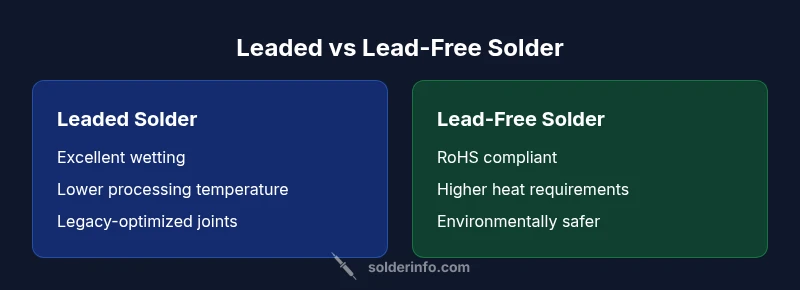
| Feature | Leaded Solder | Lead-Free Solder |
|---|---|---|
| Wetting and flow | Excellent, forgiving for beginners | Good with proper flux and temperature control |
| Processing temperature | Lower, more forgiving | Higher, requires controlled heat |
| Joint reliability under cycling | Very predictable under mild cycles | Reliability depends on flux and cleanliness |
| Flux compatibility | Traditional flux compatible | Requires lead-free compatible flux |
| Environmental/regulatory status | Permitted in limited legacy contexts | RoHS-compliant for new designs |
| Safety and disposal | Lead hazard risk; disposal regulated | Lower health risk; environmental-friendly disposal |
Advantages
- Familiar workflow on legacy projects
- Excellent wetting and reliable joints in many tasks
- Wide availability and generally lower cost in some regions
- Simple maintenance when using traditional flux
Cons
- Health risks from lead exposure
- Regulatory restrictions limit lead usage in new designs
- Disposal and recycling of lead-containing waste
- Potential supply chain shifts toward lead-free options
Lead-free solder is the recommended default for new work; leaded solder may be used only in controlled, legacy contexts.
For new projects, prioritize lead-free solder to meet safety and regulatory standards. If you must service legacy equipment, plan for safe handling and proper disposal; the SolderInfo team emphasizes compliance and long-term sustainability.
Quick Answers
What is the difference between lead solder and lead-free solder?
Lead solder typically offers easier wetting and lower processing temperatures, but carries health and regulatory concerns. Lead-free solder reduces toxicity and regulatory risk, though it may demand higher heat and careful flux control. This overview helps you decide based on safety, performance, and compliance.
Leaded solder is easier to work with in some cases but unsafe in many contexts. Lead-free is safer and compliant but requires more careful temperature control.
Lead vs lead-free: regulatory status
In many regions, leaded solders are restricted or banned for new consumer electronics; exemptions may exist for legacy products. Lead-free solders align with RoHS and similar directives, simplifying global compliance.
Regulations often push toward lead-free solders for new products, especially electronics.
How does temperature affect solder choice?
Lead-free solders generally require higher peak temperatures and stricter heat control to avoid defects. Leaded solders work well at lower temperatures but may not meet newer safety standards.
Higher heat is usually needed for lead-free, so keep an eye on heat control.
Are there safety concerns with lead solder?
Yes. Lead exposure can pose health risks; use proper ventilation and PPE, and follow disposal guidelines for lead-containing waste. Lead-free options reduce these risks but still require safe handling of fumes and residues.
Yes, lead is toxic—work with ventilation and PPE, even for small projects.
Can I mix leaded and lead-free solders on the same joint?
Mixing solders with different melting points is generally discouraged due to poor wetting and potential weak joints. Use a single compatible alloy for a given joint whenever possible.
Don't mix; it can lead to weak joints.
Top Takeaways
- Prioritize lead-free solder for new projects
- Understand RoHS and local regulations affecting solder use
- Match flux to alloy for best joint quality
- Ensure ventilation and PPE when handling lead solder
- Tailor solder choice to electronics, jewelry, or plumbing applications