Viega ProPress vs Solder: A Practical Comparison
A thorough, analytical comparison of Viega ProPress versus traditional soldering for copper piping. Explore installation speed, safety, code acceptance, material compatibility, and long-term reliability to determine which method fits your project.


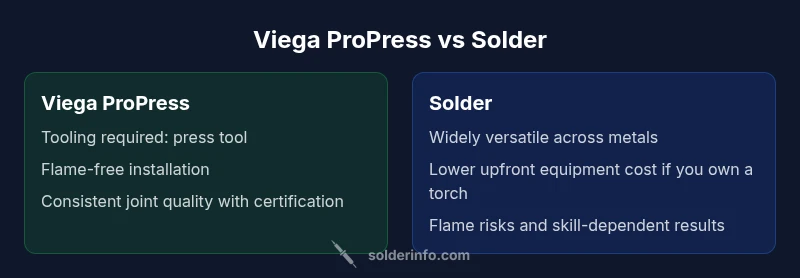
In the viega propress vs solder debate, ProPress often delivers faster, flame-free installation for copper piping, especially on long runs, while traditional soldering remains versatile and widely accepted in many residential contexts. The choice depends on project scale, safety requirements, and local code acceptance. Consider tool availability, training, and ongoing maintenance when deciding which method to use.
Why Viega ProPress vs solder matters for plumbing projects
When planning plumbing installations, choosing between Viega ProPress and traditional soldering influences not only speed and safety but also long-term reliability and compliance with local codes. According to SolderInfo, the decision hinges on project scale, workforce skills, and regulatory requirements. For DIYers, soldering can be approachable and inexpensive, but ProPress offers flame-free operation and repeatable results that many professionals prize on commercial jobs. Understanding the trade-offs helps you select the method that minimizes risk while meeting performance expectations. The viega propress vs solder question is not about one best tool for all situations; it’s about aligning the technique with your project constraints and expertise.
Note: Throughout this comparison, we’ll reference general industry practice and code considerations rather than specific product claims. The aim is to equip you with a framework to evaluate when ProPress or soldering is the better fit for your copper piping projects.
wordCountInBlock":null}, {
How ProPress works: technology and workflow
Viega ProPress relies on a specialized press tool that crimp-fits copper tubes with compatible ProPress fittings. The process creates a seal through controlled deformation of the fitting’s ferrule against the tube, aided by sealing rings or o-rings depending on the model. The workflow is designed to be flame-free and predictable, which can reduce on-site variability when performed by trained technicians. ProPress fittings come in various configurations to accommodate ½
.
How soldering works: flux, heat, and joint formation
Traditional soldering relies on flux to prepare the copper surface, heat applied with a torch, and the flow of solder to form a metallurgical bond as the joint cools. Proper flux removal and cleaning are essential to prevent corrosion and leaks. Soldering is versatile for a range of copper sizes and is widely understood by hobbyists and professionals alike. The quality of the joint hinges on surface cleanliness, heat control, and the technician’s skill with torch handling and flux management. The viega propress vs solder comparison here emphasizes the fundamental difference: soldering is flame-based, manual, and skill-dependent, while ProPress is tool-assisted and standardized.
wordCountInBlock":null}, {
Material compatibility and system limitations
ProPress systems are designed for copper piping and certain plastic-to-metal transition fittings, with specific tool-and-fitting combinations recommended by Viega. Not all plastics or metals are compatible; compatibility lists and installation manuals should be consulted for each project. Soldering, by contrast, is more broadly adaptable across metals (copper, brass, certain steels) but may face limitations when used with plastic piping or in environments where heat exposure risks are a concern. In the viega propress vs solder framework, material compatibility and transition needs often steer the decision: for retrofits in restricted spaces, ProPress can outperform traditional soldering in terms of safety and speed, while soldering remains flexible for mixed-material runs when permissible by code.
wordCountInBlock":null}, {
Installation workflow and time considerations
ProPress installations typically require less time per joint once the crew is trained, since there’s no flame setup, solder wicking, or waiting for solder to cool. The time savings compound on long runs and multi-branch installations. Soldering demands careful prep, fluxing, heating, and cleaning, which can lengthen per-joint duration and introduce more variables for human error. In practice, the viega propress vs solder decision often comes down to project tempo: for high-volume commercial work, ProPress can yield meaningful throughput gains; for small-scale residential work, the elimination of specialized tool costs may be less compelling if the crew already relies on traditional methods.
wordCountInBlock":null}, {
Code compliance, certifications, and best practices
Code acceptance of ProPress versus soldering varies by jurisdiction. Some codes authorize ProPress for copper water service with specific certification and inspection requirements, while others permit soldered joints under standard plumbing codes. For both methods, adherence to manufacturer instructions, proper tool calibration, and technician training are critical. Soldering often requires a broader set of code references due to its long history and versatility, whereas ProPress demands that installers demonstrate competency with the press tool and understanding of the fitting system. The viega propress vs solder guidance emphasizes verifying local code allowances before choosing a method for a given project.
wordCountInBlock":null}, {
Cost of ownership: upfront vs ongoing labor and maintenance
A ProPress setup entails upfront costs for the press tool, consumables, and certified fittings. The ongoing costs include tool maintenance, calibration checks, and periodic tool inspections. Traditional soldering generally presents lower upfront equipment costs if the torch and solder are already on hand, but labor costs can accumulate if joints require meticulous cleaning and inspection. In the viega propress vs solder framework, you should weigh the total lifecycle cost: the tool-based speed and fuel-free workflow of ProPress against the flexibility and lower initial expenditure of soldering, factoring in local labor rates and project size.
wordCountInBlock":null}, {
Reliability, failure modes, and maintenance considerations
Joint reliability for ProPress hinges on proper tool operation and the integrity of the fittings and seals. Misalignment or under-pressing can cause leaks, while periodically inspecting tool jaws and seals helps maintain performance. Solder joints depend on surface preparation and heat control; cold solder joints or overheating can lead to leaks or brittle joints. In the viega propress vs solder analysis, it’s essential to implement quality control measures: testing joints under pressure, maintaining clean surfaces, and ensuring proper storage of consumables. The long-term behavior of either method relates to installation precision and material compatibility more than the method itself.
wordCountInBlock":null}, {
Practical decision-making: scenarios for ProPress installations
ProPress is often favored in commercial spaces, multiple-branch systems, or retrofit projects where flame safety and rapid throughput are prioritized. In tight crawl spaces or occupied buildings, the flame-free workflow reduces disruption. For new builds with access to a press tool, ProPress can streamline installation and improve consistency across crews. Consider ProPress when you require standardized joints and quick scale-up, provided you have access to the proper tooling and certification.
wordCountInBlock":null}, {
Practical decision-making: scenarios for traditional soldering
Soldering remains advantageous for low-volume jobs, custom configurations, or where you don’t want to invest in a press tool. In DIY settings or small renovations, soldering offers flexibility and broad compatibility with a range of fittings and materials without requiring specialized equipment. Solder-based workflows let skilled technicians adapt on the fly and may be more economical when the project scales are modest or when code allowances favor soldered joints in specific jurisdictions. This section highlights that viega propress vs solder is not a one-size-fits-all choice; it depends on project scope, skill level, and regulatory context.
wordCountInBlock":null}],
comparisonTable
prosCons
verdictBox
keyTakeaways
faqSection
mainTopicQuery
Comparison
| Feature | Viega ProPress | Solder |
|---|---|---|
| Installation Time | Typically faster per joint with ProPress (flame-free) | Longer per-joint time with soldering due to heating and cooling cycles |
| Tools Required | Press tool + compatible fittings | Torch, flux, solder, brushes, cleaning tools |
| Joint Reliability (with proper technique) | Consistent leak-free joints when properly installed | Reliability depends on flux cleanliness and heat control |
| Material Compatibility | Copper piping and select ProPress variants for plastics | Copper/brass with soldering; limited plastics unless solder is compatible |
| Code Acceptance/Certifications | Widely accepted where ProPress is approved with certification | Widely accepted for copper piping, dependent on local codes |
| Initial Cost | Higher upfront due to tool investment | Lower upfront if tools are already available; consumables differ |
| Best For | Commercial, multi-unit, flame-free environments | Residential DIY, small upgrades, versatile material use |
Advantages
- Potentially faster installation for larger projects
- Flame-free workflow reduces fire hazards
- Consistent results with trained operators
- No need to heat joints near sensitive components
- Reduced on-site variability when performed correctly
Cons
- Higher upfront costs for tooling and fittings
- Requires certification/training for proper use
- Tool maintenance and calibration add ongoing costs
- Not universally allowed in all building codes or retrofit scenarios
ProPress is typically preferred for professional, high-volume, flame-free installations; soldering remains practical for small-scale work and flexible material use.
Choose ProPress when speed, consistency, and flame safety are priorities in larger projects or where codes approve press fittings. Opt for soldering for smaller jobs, tighter budgets, or scenarios where tool access or code restrictions limit ProPress adoption.
Quick Answers
Is Viega ProPress allowed in all plumbing codes?
Code approval varies by jurisdiction. Some codes authorize ProPress with specific certification and inspection requirements, while others permit soldered joints under standard plumbing codes. Always verify local regulations and obtain any required approvals before selecting ProPress for a project.
Code rules vary by location, so check your local authority before choosing ProPress.
Can ProPress joints be used with PEX or plastic piping?
Yes, certain ProPress systems and fittings support PEX or plastic transitions, but you must use the appropriate tool and fittings specified by the manufacturer. Confirm compatibility for your exact piping material and wall thickness.
Yes, but only with the correct fittings and tools.
What metals can be joined with traditional soldering?
Traditional soldering is most common with copper and certain alloys; it’s less suited for some stainless or galvanized components without special alloys or techniques. Always verify material compatibility and code guidance for your project.
Copper and some alloys are standard, but check for material limits.
Do I need professional certification to use ProPress?
Many regions require technician certification or training to operate ProPress tools and perform specified joints. This ensures proper tool usage and joint integrity, aligning with safety and code standards.
Often yes, depending on where you work.
Are solder joints as durable as ProPress joints?
Durability depends on installation quality in both methods. ProPress joints are designed for consistent results when installed correctly; solder joints rely on proper flux, heat control, and surface prep. Both can be durable with proper technique and inspection.
Both can be durable with proper technique.
What maintenance is required for ProPress tools?
ProPress tools require regular maintenance, calibration checks, and occasional jaw replacements as part of a maintenance schedule. Following manufacturer guidelines helps sustain performance and joint quality.
Regular maintenance keeps the tool performing well.
Top Takeaways
- Assess project scale to decide between speed and flexibility
- Factor upfront tool costs against potential labor savings
- Check local codes for ProPress acceptance before selecting a method
- Plan for tool maintenance and technician training
- Ensure proper joint testing and inspection regardless of method