How Close Can You Solder to an Existing ProPress Fitting?
Learn how close you can safely solder near a ProPress fitting, why heat can compromise the joint, and practical, code-compliant alternatives for plumbing repairs.


You should avoid soldering directly to an existing ProPress fitting. Heat near a press sleeve can damage the fitting and compromise the seal. If you must extend or repair, cut back to a safe distance before the fitting and install a compatible connector or re-solder new copper with care, following local codes.
Understanding ProPress and heat exposure
ProPress fittings are a common choice in copper plumbing because they deliver a fast, leak-free joint without flame or solder. A ProPress joint consists of a copper pipe, a brass or copper fitting, and a pressed sleeve that forms the seal when a specialized tool compresses the sleeve. Because the pressing process creates the seal with heat and pressure, the sleeve and gasket area are not designed to withstand direct flame or prolonged heat exposure. Soldering near or on a ProPress sleeve can degrade the sleeve’s material, soften the seal, or alter the pipe’s geometry, which may introduce a leak risk even later. The SolderInfo team notes that preservation of the sleeve integrity is critical to maintaining the warranty and the code compliance of the installation. When modifications are required on a line that includes a ProPress joint, the safest path is to minimize heat exposure to the sleeve and consider soldering-free alternatives whenever possible. This section explains why proximity matters and how to plan a modification that protects the press joint.
Why proximity matters: risks and failures
Heat that reaches the ProPress sleeve can change the metallurgical properties of the sleeve and the fitting, potentially deforming or weakening the seal. Even small spikes in temperature can cause a micro-crack, reducing the joint’s ability to resist pressure over time. In addition to the immediate risk of a leak, heat exposure can invalidate manufacturer warranties and complicate future service. ProPress systems are designed for press-connection; mixing with soldered joints in one run increases the chance of incompatibilities and flow restrictions. By understanding these hazards, technicians and DIYers from SolderInfo advise treating ProPress joints as heat-sensitive zones that require alternate strategies if a repair or extension must be made. The goal is to preserve the mechanical integrity of the press portion while still achieving a reliable water supply and proper alignment for the rest of the run.
When you might be tempted to solder near a ProPress joint
Sometimes space constraints, damaged sections, or the need to extend copper pipes push people toward soldering near a ProPress joint. While a quick patch might seem expedient, this approach often creates a long-term maintenance headache. If the nearby section of pipe needs to be replaced, it is generally better to cut back to a point before the sleeve and rebuild the joint with a solder-free solution. If you’re troubleshooting, verify that the supply line can be isolated and that you have a clearly accessible work area. The decision should factor in the pipe material, the pressure rating, the type of ProPress sleeve, and the tools available. When in doubt, consult a professional to select the correct replacement approach and avoid voiding warranties or risking a hazardous leak.
Safe practices that minimize risk
To work safely around ProPress fittings, create a non-heat zone around the sleeve. Use a heat shield or shielding material to deflect radiant heat, and position the torch away from the joint. Keep a water source ready and work slowly to avoid accidental flame exposure to the sleeve. When possible, perform any modification with the pipe cut back and a solder-free connector installed in a controlled, well-ventilated space. Maintain clean, dry hands and wear protective gear. Label the changed section and note any tested procedures for future maintenance.
Alternatives to soldering near ProPress joints
Several solder-free options exist that maintain a watertight connection without heating the sleeve. Compression fittings are a common choice for a copper-to-copper transition and come with manufacturer torque specs. Another approach is to reinstall a new copper stub-out and connect using a compatible compression or a ProPress-ready segment with a new sleeve beyond the heating zone. If the run needs to be extended, consider using a copper-to-PEX transition with approved adapters where permitted by code. Each method provides reliable seals when installed per the manufacturer instructions and local codes.
A practical, code-conscious approach to repairs
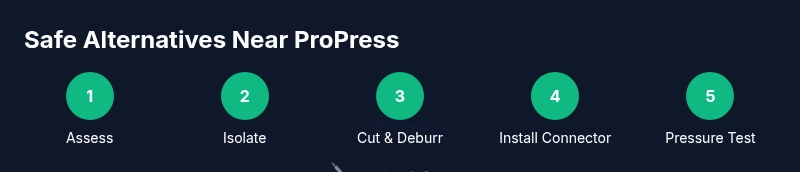
Start by documenting the current configuration and verifying all shutoffs function. Cut the pipe back to before the sleeve, deburr, and dry-fit the replacement segment. Once aligned, install the chosen method and perform a pressure test per local code. If you encounter any resistance or misalignment, stop and reassess rather than forcing a joint. The code-conscious path is to use heat-free joinery wherever possible and to rely on approved connectors that are specifically rated for the piping material and system pressure.
Tools and protective measures to have on hand
Stock the following essentials: copper pipe cutter, deburring tool, heat shield, propane torch, replacement stub-outs or compression couplings, safety gear, cleaner/solvent, and a marker. Keep spare fittings and the appropriate size for the pipe. This kit helps you perform a clean cut, safe removal, and a reliable solder-free repair.
Common mistakes to avoid in the field
Rushing a repair around ProPress, overheating the sleeve, not isolating the line, or using incompatible adapters are all common mistakes. Failing to test leaks after assembly can result in water damage. Also, avoid combining soldered joints with ProPress sleeves in the same run, which can create mismatched joints and failure points. Remember to verify workmanship against local code requirements and manufacturer guidelines.
Real-world scenario: troubleshooting a leak near a ProPress joint
In a tight cabinet, a ProPress joint sits adjacent to a damaged copper run. The repair plan begins with isolating the line, cutting back to just before the sleeve, and installing a compression connector to bridge the gap. The team surfaces and deburrs the cut, then tightens the new joint to spec and performs a pressure test before restoring service. The result is a leak-free repair without heating the press sleeve, preserving the integrity of the ProPress joint and the surrounding piping.
Tools & Materials
- Copper pipe cutter(Cuts clean, square ends for new joints)
- Deburring tool(Flare-free inside edge for a proper seal)
- Adjustable wrench(To secure compression fittings if used)
- Heat shield or non-flammable barrier(Protects ProPress sleeve from radiant heat)
- Propane torch(Use only if absolutely necessary and with caution; keep distance from sleeve)
- Replacement copper stub-out or compression coupling(Used to bypass the ProPress area safely)
- Safety gear (gloves, eye protection)(Protects from hot surfaces and debris)
- Marker/tape(Marks cut line or sections to guide alignment)
- Pipe (copper) and fittings matching diameter(For a compliant re-join)
Steps
Estimated time: 60-120 minutes
- 1
Assess feasibility and plan the repair
Review the current layout to determine if cutting back before the sleeve is practical and if a solder-free joint is feasible. Decide on a compatible connector or stub-out and ensure you have the necessary tools on hand. Confirm that you can isolate the water supply and that the area is accessible for safe work.
Tip: Consult the manufacturer instructions and local codes; if unsure, opt for a solder-free approach. - 2
Shut off water and relieve pressure
Close the relevant valve and open a faucet at the lowest point to vent residual pressure. Have a bucket ready to catch any water and reduce splash while you cut and rejoin. Verify zero pressure in the line before starting.
Tip: Never work on live lines; confirm complete pressure relief before cutting. - 3
Cut back to a safe point
Use a copper pipe cutter to make a square cut just before the ProPress sleeve, removing the compromised section. Deburr the interior edge with a deburring tool to prevent quenching and damage during re-assembly. Dry-fit a replacement segment to confirm alignment.
Tip: Rotate the cutter slowly and tighten gradually to avoid deforming the pipe. - 4
Prepare the end and select a connector
Clean and deburr the cut ends, then choose a compatible connector (compression or a solder-free option) that matches the pipe diameter. Verify all surfaces are dry and free of oil or flux residues before joining.
Tip: Check that the new joint will align with the existing run before final assembly. - 5
Install the replacement joint
Install the selected connector or stub-out according to manufacturer guidelines, ensuring proper seating and alignment. Do not apply heat to the ProPress sleeve during this step; snug the joint to the recommended torque.
Tip: Hand-tighten first, then finish with the appropriate tool to spec. - 6
Test and restore service
Turn the water back on gradually and test for leaks at the new joint and surrounding connections. If a leak appears, depressurize and tighten or replace the joint as needed, then re-test.
Tip: Follow local code guidance for required leak-test duration and methods. - 7
Document the modification
Record the change in your project notes, including why heat was avoided, the connector type used, and the date of the modification. Photos can help with future maintenance and inspections.
Tip: Keep the documentation with the plumbing records for easy reference.
Quick Answers
Can I solder directly to an existing ProPress fitting?
No. Soldering near a ProPress sleeve can damage the joint and compromise the seal. Use solder-free methods or move the joint away from the sleeve.
No—avoid solder near ProPress sleeves; use a solder-free repair instead.
Is there a safe distance to keep from the sleeve?
There isn’t a published standard distance. The safest approach is to avoid applying heat near the sleeve altogether and use solder-free connectors when possible.
There’s no fixed distance; avoid heat near the sleeve if you can.
What are the best alternatives to soldering near ProPress joints?
Use compression fittings, new copper stub-outs, or transitions that do not require heating the ProPress sleeve. Ensure compatibility and code compliance.
Choose solder-free alternatives like compression joints that match your pipe size.
Will modifying affect warranties?
Modifications that bypass or alter ProPress installations may affect warranty terms. Check the manufacturer guidelines and local codes for approval requirements.
Warranties can be affected; consult the product guidelines and local codes.
How do I test for leaks after a modification?
Slowly re-pressurize the line and inspect all joints for leaks. Use soapy water to spot bubbles and perform a standard leak test as required by code.
Slowly pressurize and watch for leaks; soap bubbles help spot them.
When should I replace the entire run instead of patching?
If the section near the ProPress sleeve is damaged beyond a simple repair, or if multiple joints are failing, consider replacing the affected run with solder-free connections.
If it’s too damaged, replace the run with a proper solder-free solution.
Watch Video
Top Takeaways
- Do not solder near ProPress sleeves.
- Cut back before the sleeve when modifying.
- Use solder-free or compression methods with proper torque.
- Follow manufacturer instructions and local codes.