Solder or ProPress: A Practical Plumbing Comparison
An objective comparison of solder or propress in plumbing. Learn when traditional soldering vs ProPress shines, covering tools, costs, speed, durability, and code considerations for DIYers and professionals.


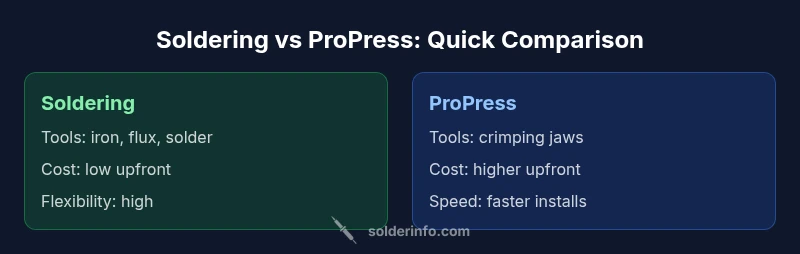
According to SolderInfo, traditional soldering and ProPress each fit different project needs. Soldering offers flexibility and low upfront costs, while ProPress delivers speed and leak-resistance with professional tooling. For DIY projects, soldering is often sufficient; for time-sensitive, code-focused installs, ProPress tends to excel. See our full chart.
Defining the Choice: Solder vs ProPress in Plumbing
Choosing between solder or propress is a common crossroads for DIYers and professionals alike. The two methods occupy different ends of the workflow spectrum: soldering emphasizes flexibility, repairability, and broad material compatibility; ProPress emphasizes speed, repeatability, and strong, code-friendly joints when installed with the right tools. The decision hinges less on one universal best and more on project goals, site constraints, and long-term maintenance expectations. According to SolderInfo, understanding the core trade-offs helps you pick the right method for copper piping projects, including repairs, retrofit work, and new installations. This article analyzes the practical differences, practical costs, and how to choose between them for solder or propress use.
How Traditional Soldering Works
Traditional soldering relies on heat to melt a filler metal (solder) that joins copper or compatible tubing with flux-assisted surfaces. The process requires a heat source such as a propane torch, flux to clean and promote bonding, and a compatible solder alloy. Joints must be well-cleaned, flux-residue carefully removed, and pressure tested after cooling. Soldering remains versatile for small-diameter runs, repair work, and situations where fittings or access are irregular. It supports a broad range of metals and adapter configurations, including some brass and certain low-volume applications. The trade-off is longer setup and finish times, the need for skilled manipulation to avoid leaks, and potential rework if joints are not perfectly cleaned.
How ProPress Crimping Works
ProPress is a mechanical joining method that uses a hydraulic or hydraulic-powered crimping tool to compress a pre-assembled fitting onto copper tubing. ProPress joints rely on a stamped index or visible mark indicating a secure seal. The system requires compatible fittings, a dedicated ProPress tool, and crimp jaws sized for the pipe diameter. ProPress can dramatically reduce on-site install time and often yields highly repeatable results, which is especially valuable on commercial projects with tight schedules. However, the initial investment in the tool and compatible fittings is higher, and certain jurisdictions require manufacturer training or certification for field use.
Key Differences in Joints, Materials, and Compatibility
- Joints: Soldering creates a metal-to-metal bond via filler metal; ProPress relies on a mechanical crimped seal.
- Materials: Soldering supports a wide range of metals with appropriate flux and alloys; ProPress is optimized for copper systems and compatible fittings.
- Compatibility: Soldering works with many bend radii and configurations, while ProPress depends on factory-approved fittings and compatible pipe sizes.
- Repairs: Solder joints can be reworked by reheating; ProPress joints are fixed once crimped and require replacement if faulty.
Tooling, Training, and Setup Costs
Soldering requires a basic torch, flux, solder, and simple hand tools. The capital barrier is relatively low, and most DIYers own or can borrow equipment. Training focuses on flux handling, heat control, and proper cleaning. ProPress demands a substantial upfront investment in a crimping tool, a set of specialized jaws, and a supply of compatible fittings. Training or certification is common in some jurisdictions, reflecting the requirement for consistent, code-compliant results. For large projects, the capex can be amortized across many joints, while small jobs may make soldering more economical.
Time, Labor, and Performance: Speed vs Reliability
Time-to-completion is a critical differentiator. Soldering is slower per joint due to cleaning, fluxing, heating, cooling, and inspection, but offers flexibility when joints are in awkward angles or hard-to-reach spaces. ProPress can complete joints in a fraction of the time with fewer variables, which is advantageous on multi-joint runs or tight deadlines. Reliability depends on proper preparation: soldered joints must be clean and flux-free to prevent leaks; ProPress joints rely on tool calibration and correct jaw sizing. In high-traffic systems or retrofits, the consistency of ProPress is a strong asset, while soldering remains a robust fallback when tool access is limited.
Long-Term Durability, Leaks, and Maintenance
Leaking joints drive maintenance costs. Soldered joints, when properly performed with fresh flux and clean surfaces, offer durable seals that can outlast many industrial cycles, but require periodic inspection and cleaning to avoid corrosion or flux residue buildup. ProPress joints typically provide strong leak resistance when installed correctly and backed by manufacturer warranties; however, a failed ProPress joint usually means replacing the entire fitting assembly. For ongoing maintenance, consider the availability of spare parts, ease of rework, and local code acceptance when balancing solder or propress choices.
Safety, Codes, and Compliance
Both methods carry safety considerations: soldering involves open flame, hot surfaces, and flux fumes, which require ventilation and PPE. ProPress operation involves press equipment, tool maintenance, and training to ensure correct jaw selection and tool calibration. Local plumbing codes may have explicit approvals or restrictions for each technique, and some jurisdictions prefer or require specific methods for potable-water systems. Verifying code acceptance in your area helps avoid costly reworks after inspection.
Practical Decision Framework: When to Choose Each Method
If your project is small, repair-oriented, or requires broad material compatibility with minimal initial investment, traditional soldering is typically the practical choice. If time efficiency, repeatability, and clean, leak-resistant performance are paramount—and you have access to the proper toolsets and training—ProPress is often the better option. Always plan for testing, consider local codes, and evaluate long-term maintenance costs. Understanding these trade-offs will help you decide whether to pursue solder or propress for your specific piping scenario.
Comparison
| Feature | Soldering | ProPress |
|---|---|---|
| Typical tools | Soldering iron, flux, solder | Crimping tool, ProPress jaws, fittings |
| Time to complete | Slower per joint due to prep and cooling | Faster on multi-joint runs with prepared fittings |
| Material compatibility | Broad compatibility with copper, brass, certain alloys | Best with copper systems using compatible fittings |
| Upfront cost | Low upfront tool cost | Higher upfront tool and jaw investment |
| Reliability | Requires precise technique to ensure leak-free joints | High leak resistance when installed correctly |
| Codes and approvals | Widely accepted; training varies | Some jurisdictions require certification for field use |
Advantages
- Low upfront cost and simple tools
- Broad material compatibility with soldering
- Flexible workflow for varied projects
- Easy to repair mistakes with flux and heat
Cons
- Longer install times for soldering on large runs
- Requires skilled workmanship to avoid leaks
- Open flame and flux fumes pose safety considerations
- ProPress requires substantial upfront tool investment and training
ProPress excels in speed and repeatable reliability for code-driven, commercial installs; soldering remains the versatile, cost-effective choice for DIY, repairs, and flexible configurations.
Choose ProPress when time and consistency matter, and you have access to the right tools and local code acceptance. Choose soldering for budget-conscious projects, repairs, and maximum material flexibility, especially in DIY settings.
Quick Answers
Is ProPress allowed for potable water in all jurisdictions?
Code acceptance varies by location. Some jurisdictions approve ProPress for potable water, while others require additional verification or certifications. Always check local plumbing codes before installation.
Codes vary by location, so check your local plumbing codes before using ProPress for potable water.
Can I retrofit ProPress to existing piping?
Yes, if you have compatible copper piping and the appropriate fittings. You may need to replace sections to ensure proper sealing and follow manufacturer guidelines.
Yes, retrofits are possible with the right fittings and tools.
Is soldering safer than ProPress?
Both methods have safety considerations. Soldering involves flames and fumes, while ProPress requires handling press tools and press jaws. Proper PPE and ventilation reduce risk for both.
Both have safety considerations; use PPE and ventilation for soldering, and educate on tool safety for ProPress.
What maintenance is required for solder joints?
Regular inspection for leaks, corrosion, and flux residue is recommended. Rework may be necessary if joints show signs of deterioration.
Inspect joints regularly; rework if you notice leaks or corrosion.
Which method is cheaper overall?
Soldering generally costs less upfront, making it cheaper for small jobs. ProPress can be cost-effective for large projects due to speed and labor savings, but requires tool investment.
Soldering is cheaper upfront; ProPress can save time and labor on big projects.
Do I need certification to install ProPress?
Some regions require training or certification for field use of ProPress tools. Check with local authorities and the tool manufacturer for requirements.
Check local rules and manufacturer requirements for ProPress training.
Top Takeaways
- Choose soldering for DIY, repairs, and broad material compatibility
- Choose ProPress for speed and repeatable, leak-resistant joints
- Account for tool costs and training when budgeting
- Verify local codes and approvals before selecting a method
- Test joints under pressure to confirm reliability