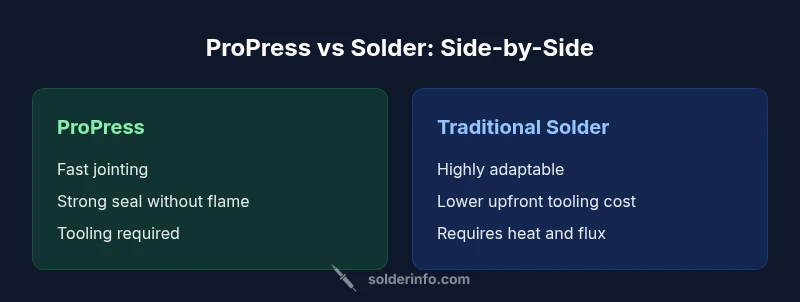
ProPress vs Solder: The Plumbing Jointing Showdown
A thorough, analytical comparison of ProPress vs solder for copper piping, covering installation speed, durability, cost, and maintenance to guide plumbers and DIYers in choosing the best method for residential and commercial projects.


According to SolderInfo, when choosing between propress vs solder for copper piping, both methods have strong use cases, but the decision hinges on reliability, installation speed, and long-term maintenance. This quick comparison summarizes the key differences and helps you decide which approach best fits residential or commercial projects. Understand where each method shines and what trade-offs to expect.
What is ProPress?
ProPress is a press-fitting technology for copper piping that uses a specialized crimping tool to deform fittings onto copper tubes, creating a mechanical seal without solder. A suite of press fittings, jaws, and a power or hand press tool is used to clamp copper tubes inside pre-formed elbows, tees, and couplings. The process is fast: align the pipe, insert the fitting, and apply the press until a visible indication confirms a secure join. Because there is no open flame or flux, ProPress offers a lower fire risk on busy job sites and can be more efficient for crews that must install many joints with consistent results. For residential and commercial projects alike, many plumbing contractors favor ProPress for speed and repeatability. However, the system does require specifically compatible fittings and a press tool, and successfully completing a ProPress joint relies on following manufacturer guidelines. The SolderInfo team notes that choosing ProPress vs solder should consider project scale, crew skills, and local code requirements.
What is traditional soldering for copper piping?
Traditional soldering for copper piping involves cleaning and fluxing the copper surfaces, heating with a soldering iron or torch, and fusing a solder alloy to create a joint. This method has long been the standard for many residential and commercial installations due to its flexibility and wide code acceptance. Soldering joints require careful technique to avoid cold joints or overheating, but they do not demand expensive equipment beyond a soldering iron, flux, and solder. The approach works well in tight or irregular spaces where a press tool cannot reach. The SolderInfo team highlights that soldering remains a versatile option, especially in retrofit scenarios where existing fittings must be joined without replacing sections of piping.
Key differences: installation speed, equipment, and costs
- Installation speed: ProPress typically delivers faster joints because it eliminates heat-up and cooling cycles. Soldering involves heating, fluxing, and cooling, which can extend job times, especially on larger runs.
- Equipment: ProPress requires a dedicated press tool and compatible fittings, alongside a standard set of safety equipment. Soldering relies on a soldering iron, flux, and solder, which are generally cheaper upfront but demand ongoing consumables.
- Skill and training: ProPress demands training to operate the press tool safely and to select the correct jaw size and fittings. Soldering requires steady technique, proper heating control, and flux management, with significant emphasis on skill development for leak-free joints.
- Cost considerations: ProPress can have higher upfront tooling costs but lower per-joint labor time. Soldering typically presents lower initial costs but higher labor costs per joint for large jobs. Local code and contractor preferences often influence total lifecycle costs.
- Repairability: ProPress joints are generally not designed for simple disassembly; replacing a section may be necessary if a joint leaks. Soldered joints can sometimes be cut out and re-soldered, offering more straightforward remediation in some layouts.
- Versatility: Soldering remains adaptable to a wider range of pipe materials and configurations, while ProPress excels in standardized copper piping with compatible fittings. The choice often hinges on project scale, space constraints, and crew capabilities.
Durability and leak resistance overview
Joint durability depends on proper preparation, material compatibility, and adherence to manufacturer or code requirements. ProPress joints are designed for a high degree of repeatable consistency when installed according to jaw size and fitting type. Leak resistance is strong when joints are installed correctly, and the absence of flame reduces the risk of nearby fire hazards. Traditional solder joints depend on clean surfaces, correct flux choice, and even heat application; when performed well, they offer reliable seals, but improper technique can lead to weak joints or cold solder joints. The SolderInfo analysis notes that both methods can meet or exceed standard expectations when installation follows best practices and local codes.
Tooling, training, and ongoing maintenance
ProPress requires a press tool, compatible jaw sets, and a steady supply of fittings. Training focuses on jaw sizing, tool operation, and maintenance of the pressing unit and jaws. Soldering requires a good soldering iron, flux, solder, a clean workspace, and routine maintenance of the iron tip and flux management. Ongoing maintenance for ProPress includes jaw calibration checks and tool service, while solder-based systems emphasize cleaned joint surfaces, flux storage, and proper disposal of spent flux. The SolderInfo team emphasizes the value of documented training records and standard operating procedures to ensure consistent results across crews.
Cost considerations and lifecycle pricing
Lifecycle cost assessments balance upfront tooling investment against labor efficiency and future maintenance costs. ProPress often features higher initial costs due to the tool and jaw investments, but savings accrue from rapid joint creation, reduced risk of flame damage, and standardized performance across crew members. Soldering incurs lower upfront costs and ongoing solder consumables, with costs driven by flux, solder alloy, and energy usage for heating. For large-scale commercial projects, ProPress might offer better total value through speed and consistency; for smaller jobs or retrofit work, soldering’s lower upfront cost can be attractive. The key is to model project scope, crew size, and local code requirements to determine which path yields the best long-term value.
Practical scenarios: residential vs commercial
Residential retrofits or small renovations often benefit from soldering due to flexibility and lower initial outlay, especially where access for a press tool is limited. Commercial installations with high pipe counts, standardized layouts, and strict timelines may favor ProPress for speed and uniformity. In industrial settings, the choice may depend on the presence of trained personnel and permitted tools on site. Voltage and heat management considerations, if torch work is used in soldering, should be evaluated with site safety leaders. The SolderInfo guidance suggests evaluating the exact job constraints—space, access, and code approvals—before finalizing a method.
Safety and compliance considerations
Both methods must comply with local building codes and standard industry practices. ProPress requires proper tool calibration, jaw selection, and PPE for tool operation. Soldering requires attention to flame safety, ventilation, and appropriate flux and solder usage to avoid toxic fumes and ensure joint integrity. In many jurisdictions, code compliance for either method depends on approved fittings and certification for the installation crew. SolderInfo recommends confirming local code acceptance for your chosen method before starting the project.
How to assess a job site and decide
Begin with a site survey: measure access for tools, check space constraints, and assess the pipe layout. If there is ample room for a press tool and a straightforward run of copper with compatible fittings, ProPress can be advantageous for speed. If the layout is tight, inaccessible, or requires frequent changes, soldering may provide more flexibility. Consider crew expertise, availability of tool calibration support, and whether the site demands a rapid, repeatable process. The decision should align with local code approvals and the project’s risk management plan.
Best-practice tips for ProPress and soldering
- Verify compatibility between pipe, fittings, and the chosen joining method.
- Train crews on safety and proper technique for each method.
- Maintain tools and replace worn jaws or tips promptly.
- Document joint testing and inspection results to ensure traceability.
- In retrofit scenarios, plan for future access needs and potential rework when choosing a method.
Common myths and misconceptions
- ProPress guarantees leak-free joints in all scenarios. In reality, proper jaws, fittings, and installation technique are essential.
- Soldering is always slower. With the right setup and experienced crew, soldering can be highly efficient in retrofit jobs.
- ProPress is incompatible with standard copper piping. In fact, many copper systems are designed to accommodate press fittings, but ensure compatibility and code compliance.
],
comparisonTable
propress vs solder
Comparison
| Feature | ProPress | Traditional soldering |
|---|---|---|
| Method overview | Crimped fittings using a press tool | Heat and fuse solder alloy to join copper tubes |
| Typical materials | Press-compatible copper fittings and pipe | Copper pipe with flux and solder |
| Installation time | Faster overall, with fewer heat cycles | Longer due to heating, fluxing, and cooling |
| Tooling required | Press tool, compatible jaws, fittings | Soldering iron, flux, solder, cleaning tools |
| Leak resistance / durability | High when installed per spec | Dependent on technique; risk of cold joints if poor heat control |
| Upfront cost | Higher tooling cost (tooling investment) | Lower upfront tooling cost, consumables drive cost |
| Repairability & future servicing | Joints are generally not easily disassembled | Joint can be cut out and re-soldered if needed |
| Code considerations | Often preferred in commercial settings with certified crews | Widely accepted; code references vary by jurisdiction |
Advantages
- Faster installation with consistent results
- Reduced fire risk due to no open flame
- Easier for crews to train and repeat
- Lower dependency on individual soldering skill
Cons
- Higher upfront capital cost for tools
- Requires certified fittings and training
- Not easily reworked in tight spaces or overexisting joints
- Some joints are not easily disconnected for maintenance
ProPress is often the better choice for high-volume copper installations; soldering remains valuable for flexibility and lower upfront costs.
If speed and repeatability are critical, ProPress shines in commercial contexts. For retrofit work, budget constraints, or highly variable layouts, traditional soldering can be more practical. The best decision balances project scale, crew readiness, and local code approvals.
Quick Answers
What is ProPress and how does it work?
ProPress is a mechanical joining method for copper piping that uses a specialized press tool and jaws to crimp fittings onto pipes, creating a seal without solder. Proper jaw selection and tool calibration are essential for reliable joints. The method is known for speed and repeatability when installed per manufacturer guidelines.
ProPress uses a press tool to join copper pipes with crimped fittings—fast and consistent when done right.
Is ProPress suitable for gas lines?
There are ProPress solutions designed for gas service, but these installations require certified fittings, trained personnel, and adherence to specific code requirements. Always verify local regulations and obtain approvals before proceeding.
Gas lines need special fittings and certified training; check your local codes first.
Can I repair a ProPress joint if it leaks?
If a ProPress joint leaks, the typical approach is to replace or re-cut the affected section with a new fitting and re-press it. Reworking a crimped joint isn’t as straightforward as cutting and soldering in some cases, so plan replacements accordingly.
Leaky ProPress joints usually mean replacing the affected section rather than re-soldering.
Is soldering cheaper in the long run?
Soldering generally has lower upfront costs for tools and consumables, but labor time and skill affect total cost. For small jobs, soldering may be cheaper; for large runs, the faster ProPress workflow can reduce labor costs.
Soldering costs less upfront, but labor time can drive total costs up on bigger jobs.
What factors should guide the ProPress vs solder decision?
Key factors include project scale, space, access for tools, local code approvals, and crew training. For high-volume, standardized piping, ProPress often wins; for flexible retrofits or budget-sensitive projects, soldering may be preferable.
Consider project size, space, codes, and crew skills to choose the best method.
Top Takeaways
- Choose ProPress for fast, repeatable copper joins.
- Opt for soldering when budget constraints matter or space is tight.
- Verify local codes before deciding; some regions favor one method over the other.
- Invest in training and tools to ensure long-term reliability.