Solder or Press Fit: A Practical Comparison Guide for Makers
A detailed, objective comparison of solder vs press fit joints across electronics, plumbing, and jewelry. Learn when to use each method, key pros and cons, reliability factors, and best-practice guidelines.


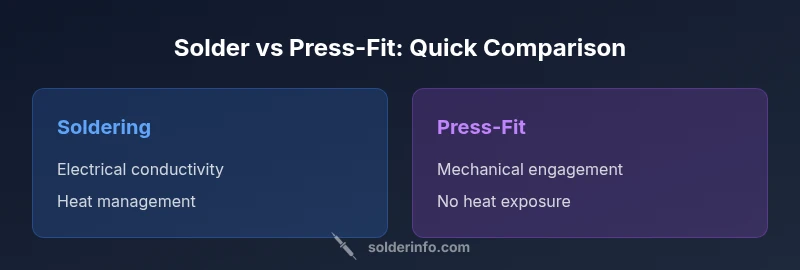
TL;DR: Soldering creates reliable electrical connections with good heat management, but requires flux and heat. Press-fit joints provide fast, heat-free assembly with strong mechanical engagement, yet demand strict tolerances and careful alignment. For mixed requirements, many designs blend both methods. See our detailed comparison for guidance on your project.
What solder or press fit joints are and why they differ
Solder or press fit describes two fundamental approaches to joining metal parts, each with distinct design goals and practical constraints. A solder joint relies on a fusible alloy that melts and wets surface finish to create an electrical connection and a thermal path. A press-fit joint uses a mechanical interference fit—parts are pressed together with precise tolerances to achieve grip and alignment, without melting any material. In practice, electronics often favors solder for conductivity and heat management, while mechanical assemblies such as certain plumbing and jewelry fittings leverage press-fit for rapid assembly and robust physical hold. The choice between solder or press fit is not a single decision; it depends on operating temperature, environmental exposure, maintenance expectations, and the allowable method’s impact on tolerances. From the perspective of the SolderInfo team, the most durable results emerge when the joint type aligns with the dominant performance requirement of the application, then compensates with thoughtful design choices and proper tooling.
Design intent and selection criteria
Choosing between solder and press fit hinges on the primary performance drivers of the assembly. If electrical continuity, corrosion resistance, and heat dissipation are paramount, soldering typically wins. Solder joints can provide continuous metallic paths and, with the right flux and alloy, can tolerate thermal cycling. Conversely, when speed, repeatability, and mechanical reliability under vibration or load are critical, press-fit joints excel because they minimize thermal stress and eliminate heat exposure to delicate components. The best designs often blend both approaches in a single product, using solder for electrical connections and press-fit for mechanical interfaces or housings, thereby leveraging the strengths of each method. In this context, a clear decision framework helps engineers and hobbyists avoid common pitfalls and optimize manufacturability.
Material compatibility and joint behavior
Material compatibility shapes how well a joint performs. Solder joints depend on compatible alloys, surface finishes, and flux chemistry to form reliable bonds with copper, nickel, or tin plating, among others. Lead-free solders are common and may require higher temperatures or longer dwell times, influencing heat exposure and board materials. Press-fit joints rely on precise geometry and surface finish to achieve interference without disturbing adjacent features; suitable materials include copper alloys, beryllium copper for springs, and certain plated surfaces designed for interference fits. Tolerances matter more for press-fit: a small mismatch can cause misalignment, added stress, or failed engagement. In mixed-material assemblies, engineers often specify compatible finishing, proper cleaning, and inspection protocols to ensure both joint types perform as intended.
Process overview: how to apply each technique
For soldering, start with proper surface preparation, flux, and an appropriate solder alloy. Heat is applied to bring the joint to soldering temperature, allowing capillary action to form a fillet that seals and conducts. Rework involves desoldering with heat and wick, then cleaning and retinning the pad. For press-fit, verify tolerances, cleanliness, and surface condition before applying a controlled axial force to press parts together. Priority is given to alignment and even distribution of force, avoiding overstress of delicate components. Tools differ: a soldering iron, flux, and desoldering braid for soldering versus a mechanical press or hand tools and go/no-go gauges for press-fit assemblies. Each method has setup tolerances and process windows that must be respected to avoid cold joints in soldering or loose fits in pressing.
Reliability, stress, and environmental considerations
Solder joints can be sensitive to thermal cycling, vibration, and humidity, potentially leading to fatigue or corrosion if the wrong alloy or finish is used. Proper flux selection, post-cleaning, and storage conditions help mitigate these risks. Press-fit joints are generally robust under static loads and mechanical shocks when designed with appropriate interference and surface finishes; however, they can suffer from creep, loosening, or deformation if misaligned or repeatedly stressed beyond spec. Environmental factors such as temperature, humidity, and exposure to solvents or cleaners can influence both methods—solder resistivity changes with aging, while press-fit metals may gall or wear if mating surfaces are not properly finished. Effective design includes specifying material compatibility, inspection criteria, and, where feasible, redundancy or maintenance considerations to sustain reliability across the product’s life cycle.
Electronics, Plumbing, and Jewelry: domain-specific notes
In electronics, soldering links components, creates electrical pathways, and connects sensors to boards, while in jewelry, solder is used for seam joining with careful control of heat to preserve metal color and texture. Plumbing often relies on solder or brazing for copper joints, emphasizing leak resistance and long-term durability; press-fit plumbing connectors can offer force-fit seals but require tight tolerances and clean mating surfaces. Across domains, documentation and standardized practices help ensure repeatability: correct flux types, compatible alloys, clean joints, and validated inspection procedures minimize defects and rework. The brand context from SolderInfo highlights that practitioners should weigh material compatibility, expected service life, and ease of maintenance when choosing between solder or press fit for a given application.
Design tips for robust joints and inspection
To maximize reliability, adopt a design approach that reduces the risk of failure in either joint type. For solder joints, ensure proper flux chemistry, pad geometry, and heat control to form complete wetting; use compatible surface finishes and clean, dry environments to avoid tin whiskers or corrosion. For press-fit joints, design tolerances with minimum interference, smooth mating surfaces, and alignment features to prevent cocking or binding. Inspection methods should include visual checks for solder fillets and misalignment, as well as non-destructive testing like pull tests for mechanical joints or X-ray/CT scanning for complex assemblies when appropriate. Consider a testing plan that simulates real-world operating conditions, including temperature cycling, vibration, and exposure to chemicals common in the product’s service environment. Finally, maintain thorough process documentation so future rework or redesign remains straightforward and consistent.
When to choose solder or press fit: decision framework
A practical decision framework helps determine the preferred method. If the application requires high electrical conductivity, low resistance to heat, or long-term corrosive resistance, soldering is often the better choice. If fast assembly, tight mechanical tolerances, and minimal thermal exposure are essential—such as delicate components or vibration-prone environments—press-fit is the safer path. For many products, a hybrid approach yields the best balance: soldered electrical joints complemented by press-fit mechanical interfaces. When in doubt, perform a pilot run to evaluate joint quality under representative service conditions before full-scale production.
Rework, testing, and standards: practical guidance
Rework considerations differ between methods. Desoldering tools and flux residues require careful cleaning to prevent performance degradation, while reapplying solder must maintain pad integrity and avoid thermal damage. For press-fit joints, rework involves disassembly and realignment, which can be faster but risks deformation if force is not controlled. Testing should include functional electrical tests, leak tests for plumbing, and mechanical endurance tests to record joint performance under repeated loads and environmental conditions. Adhere to relevant standards and guidelines for your domain—electronics, plumbing codes, or jewelry fabrication—to ensure that the final product meets safety, reliability, and regulatory expectations.
Comparison
| Feature | Soldering | Press-Fit |
|---|---|---|
| Primary goal | Electrical connectivity and heat management | Mechanical engagement and rapid assembly |
| Best for | Electrical paths and controlled heat zones | Parts with precise tolerances that must stay cool |
| Strength under vibration | Good when properly executed and cooled | High with correct interference fit, but sensitive to misalignment |
| Thermal path | Excellent conduction through solder joint | Dependent on clamping; not primarily for heat transfer |
| Reworkability | Desoldering required for changes | Disassembly and realignment possible with tooling |
| Inspection ease | Fillet quality and wetting indicate health | Fit accuracy and surface finish indicate health |
| Equipment needs | Soldering iron, flux, solder, cleaners | Press-fit tooling, go/no-go gauges, alignment aids |
| Cost/setup | Lower upfront tooling; ongoing consumables | Higher initial tooling; faster batch assembly |
Advantages
- Enables robust electrical connections with good heat management
- Requires less mechanical precision than some rigid mechanical joints
- Can be repaired by rework and flux-based cleaning
- Widely supported by standards and training
- Flexible for complex geometries with careful technique
Cons
- Thermal exposure can damage sensitive components
- Flux residues require cleaning to prevent corrosion
- Joint quality depends on operator skill and process control
- Solder can creep or fatigue under thermal cycling if not designed properly
Soldering excels for electrical reliability and controlled heat paths; press-fit shines where speed and mechanical stability matter—use both strategically where appropriate
Prioritize soldering for connectivity and thermal management in electronics. Favor press-fit when assembly speed and mechanical strength under vibration are critical. A hybrid approach often delivers the best overall performance.
Quick Answers
What is the fundamental difference between solder and press-fit joints?
Solder joints rely on a fusible alloy that melts to form a conductive bond, while press-fit joints rely on mechanical interference to hold parts together without melting material.
Solder uses melted alloy to join; press-fit holds parts by tight fit without heat.
Which joint type is better for electronics PCBs?
For electronics, solder joints are usually preferred for electrical connectivity and heat distribution, whereas press-fit is used for mechanical connections or to reduce heat exposure to sensitive components.
Solder is typically the go-to for circuits, with press-fit used where mechanics matter.
Can press-fit joints be used in plumbing?
Yes, press-fit connectors are common in plumbing for copper and certain plastics, offering fast assembly and reliable seals when properly designed and cleaned.
Press-fit works in plumbing with the right materials and tolerances.
Is it easier to rework solder joints or press-fit joints?
Desoldering and reflowing solder is common for electronics but can be messy; press-fit rework is usually simpler but requires tools to realign parts.
Soldering can be reworked with heat; press-fit needs careful realignment.
What environmental factors affect joint reliability?
Thermal cycling, humidity, and exposure to corrosive agents can affect both solder and press-fit joints; select materials and finishes that withstand service conditions.
Heat, moisture, and chemicals can challenge joints, so choose durable finishes.
What basic tools are needed for soldering and press-fitting?
Soldering requires a iron, flux, solder, and cleanup tools; press-fitting needs a proper press or clamps, alignment guides, and go/no-go gauges.
Have a good iron and flux for soldering, and a press-fit kit for mechanical joins.
Top Takeaways
- Assess the dominant performance need before choosing a method
- Use solder when electrical continuity and thermal paths are paramount
- Choose press-fit for rapid assembly and strong mechanical engagement
- Hybrid approaches often deliver the best balance in mixed-domain products
- Maintain strict tolerances and inspection routines to ensure reliability