Is Solder or Compression Better? A Practical Comparison
Explore whether solder joints or compression fittings are better for plumbing or electronics. This objective guide weighs reliability, cost, ease, and durability to help you decide.


Bottom line: For DIY plumbing, compression fittings are typically faster and easier, especially for copper pipes or temporary setups. Soldering offers strong, leak-proof joints when done correctly but requires heat and flux. In electronics, solder is the standard method for reliable connections, while compression concepts rarely apply. When you ask is solder or compression better, the answer hinges on context, material, and maintenance needs.
Is solder or compression better? Framing the question
In plumbing and electronics alike, practitioners often circle back to the central question: is solder or compression better? The short answer is context-driven. For DIY plumbing projects, compression fittings are typically faster to install and easier to retrofit in tight spaces, making them appealing to beginners and pros alike. Soldered joints, on the other hand, provide a durable, continuous metal bond where heat is available and skill is proven. In electronics, solder remains the industry standard for reliable electrical connections, while compression concepts rarely apply. The aim of this article is to unpack the decision factors—material compatibility, service life, installation conditions, cost, and maintenance—so you can make an informed choice for your specific project. Throughout this article the phrase is solder or compression better will guide your thinking, but the best option is always the one that aligns with your pipe material, pressure expectations, and future repair plans. By the end, you should feel confident about selecting the joining method that balances practicality and longevity.
How compression fittings work
Compression fittings seal by using a threaded nut that tightens onto a ferrule around the pipe. As the nut is tightened, the ferrule compresses the pipe ring, creating a mechanical seal without heat. This approach makes is solder or compression better question easier to answer in many shop and field scenarios: you want a fast, reversible connection that can be disassembled if you later replace a section. When sizing and preparation are correct, compression joints perform reliably, even in flexible or high-vibration environments. Key factors include selecting the right size, cleaning the pipe ends, and inspecting ferrules for wear. The ability to rework a compression joint is a major advantage in complex installations where future changes are expected. However, you should note potential drawbacks: ferrule deformation over time, the need for correct torque, and the possibility of leaks if threads or seats become damaged. In summary, compression fittings are a practical solution for many installations, especially where heat management or speed matters. But their performance still depends on proper selection and regular maintenance. This is relevant to answering is solder or compression better, as the heat-free nature of compression can be a decisive factor in certain jobs.
How soldered joints work
Solder joints rely on a filler metal that bonds to the pipe surfaces after heating. The result is a continuous metal seam that resists leaks and can withstand moderate pressure and temperature. In is solder or compression better discussions, soldering excels where long-term durability and a seamless metal bond are required. Preparation is critical: clean surfaces, flux application, proper heat control, and clean solder flow. A successful solder joint should fill gaps and avoid pinholes. When done well, soldering creates minimal flow restrictions and reliable electrical or water-tight connections. In many plumbing projects, copper piping responds particularly well to soldering, delivering a uniform joint that resists corrosion. The downsides include the need for a heat source, competent technique, time for cooling, and careful cleanup of flux residues. Constraints such as confined spaces or proximity to flammable materials can complicate soldering. Weigh these factors against the benefits to determine if is solder or compression better in a given job.
Material compatibility and use cases
Not every pipe material plays nicely with both joining methods. Copper and brass parts generally support both approaches when prepared correctly. PEX can sometimes use compression fittings, but soldering is not standard for PEX. Plastic, vinyl, and some composite tubes may require adapters or specialized fittings. When choosing is solder or compression better, consider the operating conditions: pressure, temperature cycles, chemical exposure, and the likelihood of future changes. Solder joints thrive in applications where uniform metal continuity matters, while compression fittings shine in retrofit work or scenarios demanding fast serviceability. Electronics contexts also influence the choice, though compression is typically not used in electrical connections; is solder or compression better for electronics, soldering is the default. The lifecycle of the system and local codes can also steer the decision, reinforcing that is solder or compression better should be evaluated on a case-by-case basis.
Cost and time considerations
Time and money shape every is solder or compression better decision. Compression fittings generally reduce installation time, avoid open flames, and simplify disassembly, which lowers labor costs in many retrofit projects. Soldering can be cost-effective when many joints are involved and long-term durability is a priority, but it requires tools, fuel sources, flux, and cleanup supplies. For electronics work, is solder or compression better often means using solder because it provides durable, conductive joints with reliable electrical interfaces. When evaluating cost, think beyond the upfront price: include maintenance, potential leaks, and the cost of rework. In many cases, a hybrid approach is practical: use compression for sections that may need future changes and solder where a permanent, continuous bond is essential. Across the board, is solder or compression better should be judged by total cost of ownership over the system’s life.
Durability, leak risk, and repairability
Durability considerations hinge on how well the technique is applied and how the system is used. Compression fittings can be highly reliable when ferrules are intact and connections tightened to spec, but they can loosen with vibration or temperature cycling. Soldered joints provide excellent continuity and leak resistance when properly performed, though overheating can damage components or cause pipework failures. In is solder or compression better contexts, the durability gap often comes down to installation quality and maintenance. Repair options for compression fittings are typically user-friendly, whereas damaged solder joints may require reheating or replacing sections of pipe. Regular inspection helps catch wear or corrosion early, strengthening is solder or compression better outcomes by enabling timely intervention.
Practical guidelines: choosing the right method
To avoid overcomplication, apply a simple decision framework: identify the pipe material, assess the service conditions, and consider maintenance expectations. If you need quick, reversible connections or work in a space with limited heat sources, compression is usually best. If long-term durability and a continuous metal seal matter, soldering is often superior, provided you have the skills and tools. For is solder or compression better scenarios, keep the relevant constraints in mind and document the decision for future maintenance. In electronics work, solder remains the standard, while compression concepts typically do not apply. A quick field test can help: try a mock assembly, inspect for leaks or flexibility, and evaluate ease of disassembly after a trial run. This practical approach anchors is solder or compression better decisions in real-world conditions.
Safety and best practices
Soldering involves live heat, flux fumes, and potential burn hazards. Work in a well-ventilated area and wear protective gear. When using compression fittings, ensure ferrules are undamaged, pipes are clean, and fittings are correctly sized. For is solder or compression better, always verify that the chosen method aligns with pipe material, pressure expectations, and the environment. Cleaning, inspection, and regular maintenance maximize performance and reduce unexpected failures. In electronics contexts, observe electrostatic discharge precautions and heat management to maintain is solder or compression better outcomes over time.
Long-term maintenance and warranties
Regardless of which approach you choose, document the installation, record the type of joints used, and monitor for signs of leaks or loosening over time. Many manufacturers provide warranties that depend on correct installation and compatibility with materials. When discrepancies arise, is solder or compression better often becomes a matter of whether the brand’s warranty specifies heat-based joining or mechanical connections. Following best practices improves reliability and supports warranty coverage. Periodic checks during seasonal changes are prudent, and replacing aging components before failure reduces the risk of water damage or downtime in critical systems.
Comparison
| Feature | Compression fittings | Soldered joints |
|---|---|---|
| Installation time | fast for DIY | slower due to heat and prep |
| Material compatibility | flexible with metals and some plastics | excellent with copper/brass |
| Leak resistance | depends on ferrule integrity | high when properly performed |
| Repairability | easy to rework but may loosen over time | harder to repair without rework |
| Initial cost per joint | potentially higher cost for fittings | lower per joint cost |
| Required tools | wrenches, cutters, torque may vary | soldering iron, flux, and safety gear |
| Best for | retrofits, tight spaces, quick changes | new build with long-term durability |
Advantages
- Faster installation and easy retrofitting
- Non-heat joining reduces fire risk in sensitive environments
- Removable and adjustable in many cases
- Cleaner workflow with less flux cleanup
Cons
- Potential slow leaks if ferrules loosen over time
- May require inspection and periodic tightening
- Not always suitable for all pipe materials or sizes
- Reliability can depend on correct sizing and tool use
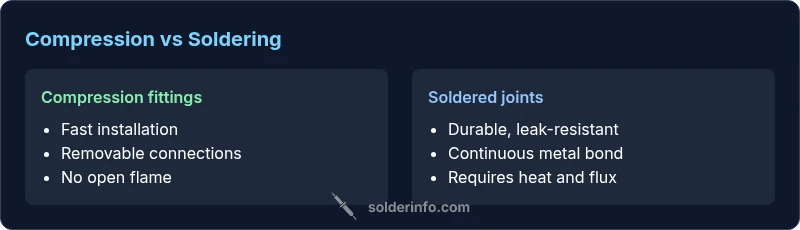
Compression fittings usually win for speed and flexibility; soldered joints win for long-term durability where heat is practical.
Choose compression for fast, adjustable installations and where heat is a concern. Choose soldering when you prioritize a continuous metal seal and durability, and you have the tools and skill to perform high-quality joints.
Quick Answers
When should I use compression fittings instead of soldering in plumbing?
Compression fittings are typically preferred for DIY projects, retrofits, or where heat sources are undesirable. They install quickly and can be disassembled for future changes. For high-pressure or long-term endurance, soldering may be the better option if you have the skill and tools.
Use compression fittings for quick, adjustable connections. If you need a durable, heat-free option, consider soldering with proper safety.
Can compression fittings be used with copper and PEX tubing?
Yes, many compression fittings are designed for copper and PEX, but you must choose the correct size and ferrule material. Always follow manufacturer guidelines for the compatible pipe diameters. In some cases, adapters are needed.
Yes, but match the right size and ferrule for your pipe material.
Are soldered joints reliable in tight spaces or with vibration?
Soldered joints offer strong seals when properly prepared, but vibration and movement can stress joints. Proper support, insulation, and avoidance of overheating help maximize reliability in tight spaces.
Solder joints seal well, but secure mounting matters.
What are common failure modes for compression fittings?
Common failures include ferrule deformation, improper sizing, and leaks at the ferrule seat. Regular inspection helps catch leaks early and prevent water damage.
Ferrule wear and mis-sizing are common issues to watch for.
Is soldering hazardous, and how can I stay safe?
Soldering involves heat, flux fumes, and sharp tools. Work in a ventilated area, wear eye protection, and use heat shields. Proper cleanup reduces exposure to flux residues.
Keep ventilation and safety gear ready when soldering.
How does long-term cost compare between solder and compression?
Initial costs vary with tools and fittings, but long-term cost depends on maintenance and potential leaks. Compression may have higher upfront fitting costs, while soldering requires consumables and tools. Consider lifecycle costs for your project.
Think about repairs and maintenance costs over time.
Top Takeaways
- Assess materials before choosing a method
- Balance speed with long-term reliability
- Prioritize proper tool use and safety
- Consider maintenance and warranty implications
- Electronics work still relies on solder by standard