Compression Valve vs Solder: A Practical Plumbing Comparison
An objective, in-depth comparison of compression valve versus soldered joints for plumbing, covering installation, durability, costs, and best-use scenarios to guide DIYers and professionals.


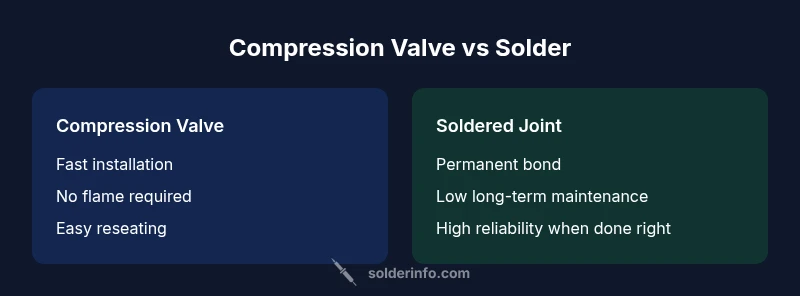
The compression valve vs solder comparison shows that compression fittings offer fast, tool-free installation suitable for temporary or tight spaces, while soldered joints provide permanent, durable connections when performed correctly. The choice hinges on service life, maintenance plans, and code requirements in your locale. For many projects, a hybrid approach—using compression fittings for serviceable sections and soldered joints for permanent connections—often delivers the best balance of speed and longevity.
Mechanical Overview: How Compression Valves and Solder Joints Form the Connection
In plumbing, a compression valve relies on a ferrule and a compression nut to seal around a copper or plastic pipe. When the nut is tightened, an internal ferrule bites into the pipe, creating a pressurized seal without heat. Soldered joints, by contrast, require heat to melt a filler metal (solder) that bonds the pipe to a fitting. This creates a continuous metal-to-metal joint that, when cooled, forms a single, leak-tight connection. The key contrast is that compression fittings depend on mechanical compression, while soldering creates a metallurgical bond. For the involved DIYer, the decision hinges on access, tool availability, and the required service life of the connection.
According to SolderInfo, understanding the material compatibility and the operating environment is essential before choosing between compression valve vs solder methods. The importance of clean, prepared surfaces cannot be overstated; a poor seal in either method will fail over time, but the failure modes differ. Compression joints may loosen or creep under vibration if not seated properly, whereas solder joints may crack or fail at the heat-affected zone if heat is not controlled. In short, both methods can be reliable when executed with proper technique and appropriate materials.
For both approaches, a clear plan for future maintenance helps prevent surprises. If you anticipate frequent pipe movement, a compression connection might be preferable because it can often be rebuilt without heat. If you expect a long service life with minimal access, soldering can provide a more permanent, low-maintenance solution. This nuanced view—compression valve vs solder—highlights that there is no one-size-fits-all answer; the context matters, including pipe material, system pressure, and local building codes.
format
wordCount:170},
Comparison
| Feature | Compression Valve | Soldered Joint |
|---|---|---|
| Installation Time | Fast, tool-free assembly on-site | Longer process requiring heat, flux, and cleanup |
| Skill Required | Low to moderate; good for quick repairs | Moderate to high; requires heat control and soldering technique |
| Repairability | Easily reseated or replaced without heat | Can be more difficult to repair if heat-affected areas are compromised |
| Durability | Strong when seated correctly and in suitable conditions | Highly durable when performed by skilled installers and corrosion-resistant materials |
| Code Considerations | Often allowed; confirm local codes for fittings | Often preferred in new construction where permitted by code |
| Material Compatibility | Works with copper, PEX, CPVC with appropriate adapters | Requires compatible fittings and clean surfaces for best results |
Advantages
- Fast installation with minimal tools
- Easier to replace or reposition in service calls
- No open flame required for many compression fittings
- Less heat exposure to surrounding components
- Good for temporary or modular sections
Cons
- Potential leaks if not properly seated or over-tightened
- Not ideal for high-pressure/high-temperature systems in some codes
- O-ring or ferrule wear over time can lead to failures
- May incur higher per-joint cost due to specialized fittings
Soldered joints generally offer stronger, longer-lasting connections for permanent plumbing, while compression fittings excel in quick, tool-free repairs or spaces where heat is undesirable.
If longevity and minimal maintenance are priorities, soldering often wins when performed by skilled technicians and using proper materials. For quick fixes, serviceable joints, or installations in restricted spaces, compression fittings provide practical advantages and can be used strategically in a hybrid approach.
Quick Answers
What is the fundamental difference between a compression valve and a soldered joint?
A compression valve seals by mechanically tightening a ferrule around the pipe, while a soldered joint relies on heat to melt solder and fuse the pipe to a fitting. Both can be leak-tight when properly executed, but they suit different project needs.
A compression valve seals with tight nuts and ferrules; a soldered joint uses heat to fuse metal. Both work, but they fit different situations.
Is a compression fitting suitable for all pipe materials?
Compression fittings work with several common materials like copper, PEX, and CPVC when paired with the correct adapters. Always verify compatibility with the specific pipe and fitting series you plan to use.
Most compressions work with copper and PEX if you pick the right adapters.
Can I upgrade a soldered joint to a compression fitting without cutting the pipe?
Often yes, but it depends on the pipe end condition and the space available. In many cases, you can cut back to a clean, straight section and install a compression fitting with the appropriate ferrule.
Usually you can cut back to clean pipe and install a compression fitting with the right ferrule.
What are common failure modes for compression versus solder joints?
Compression joints fail mainly from improper seating or overtightening, leading to leaks. Solder joints fail from poor heat control, cold joints, or joint contamination. Both types benefit from proper prep and inspection.
Leaks from bad seating in compression fittings; cold joints or heat issues in soldering.
Are compression fittings allowed for outdoor or exposed installations by code?
Code requirements vary by jurisdiction. Many places allow compression fittings outdoors if materials are rated for exposure, but some forbid certain connections in exterior environments due to temperature cycling and UV exposure.
Check your local codes; outdoor use depends on materials and climate.
What basic tools should a DIYer have to work with compression vs solder?
For compression: adjustable wrench, cutter, deburring tool. For solder: propane torch, flux, solder, heat shield. Always wear safety gear and work in a well-ventilated area.
For compression you need wrenches; for solder, a torch and solder.
Top Takeaways
- Evaluate project life expectancy before choosing
- Assess space constraints and access for installation
- Plan for maintenance and potential reseating
- Consider local codes and material compatibility
- Factor cost over the expected service life