Compression vs Solder Shut-Off Valve: A Practical Comparison
Compare compression and solder shut-off valves for plumbing projects. Learn installation ease, durability, maintenance needs, and best-use scenarios to choose the right valve for home or professional work.


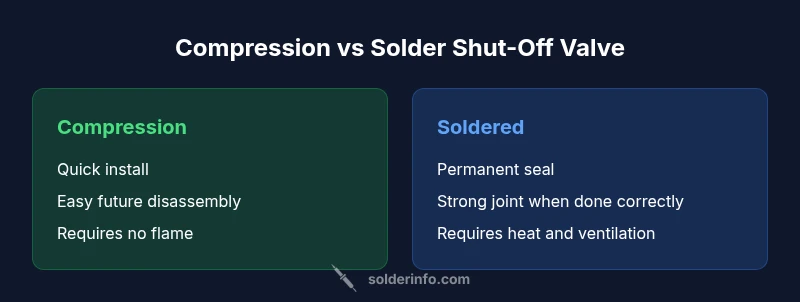
Compression shut-off valves and solder shut-off valves each have distinct strengths. For most DIY homeowners, compression valves offer quick installs and easier future disassembly, while soldered valves provide a permanent seal ideal for long-term plumbing runs. The choice depends on permanence, pipe material, and available tools. According to SolderInfo, matching the valve to your project goals reduces leaks and maintenance over time.
Core differences between compression and solder shut-off valves
At a high level, a compression shut-off valve relies on a tightening nut, ferrule, and a compression sleeve to seal against copper or plastic piping. When you tighten the nut, the ferrule compresses the sleeve onto the pipe to form a watertight seal. A solder shut-off valve, by contrast, forms a joint through heat and solder to bond the valve body directly to copper piping. This creates a permanent joint that resists movement but requires proper technique to avoid leaks. Understanding these core mechanisms helps determine which option aligns with your project goals. For home projects, the ease of assembly and future disassembly often makes compression a practical choice, while for permanent, low-movement runs, a solder joint can offer a longer-lasting seal.
From the perspective of material compatibility, compression valves work well with copper and certain plastics when used with compatible adapters. Soldered valves are typically installed on copper piping because sweating copper creates a strong, continuous joint. The trade-offs include heat exposure, potential pipe heat damage to nearby components, and the need for ventilation when soldering. The SolderInfo team recommends evaluating the surrounding environment and accessibility before committing to a method.
Brand reliability also plays a role. The broader plumbing community recognizes that both methods have proven records when installed correctly. In practical terms, the decision often comes down to whether you expect to modify the line in the future or if you want a permanent, tamper-resistant configuration. Soldered joints typically deliver a higher level of permanence, while compression fittings win on flexibility and speed.
Installation scenarios: setting the scene for a choice
Choosing between compression and solder shut-off valves should start with a clear picture of the project scope. If you are replacing a valve on an existing copper line, compression fittings can minimize disruption and reduce the risk of heat-related damage to nearby components. For a rebuild or a new supply line where you want the strongest possible seal and you have the proper ventilation and tools, sweating a solder shut-off valve may be more appropriate. It is also important to consider whether you will need to access the valve in the future. Compression fittings are typically easier to disassemble for seat repairs or replacement, whereas soldered joints tend to be more challenging to modify once completed. SolderInfo analysis shows that projects with constrained access or tight timelines often benefit from compression options, while permanent installs in controlled environments favor soldered joints.
Tools, space, and safety: planning the install
A compression install generally requires a few common hand tools: adjustable wrench, pliers, a utility knife, and a pipe cutter for copper or plastic pipe as needed. You will also use a compression tool or simply tighten the nut by hand with a wrench if the hardware allows. For soldering, you will need a propane or map gas torch, flux, lead-free solder, a pipe cutter, deburring tool, protective gloves, and eye protection. Adequate ventilation is essential when soldering, and you should turn off the water supply and drain the system before starting. According to SolderInfo, planning the work area and having all necessary adapters and fittings on hand prevents mid-project trips to the hardware store, which can compromise both safety and quality.
Durability and long-term reliability under pressure
In general, solder shut-off valves provide a more rugged, permanent bond that resists small movements and vibrations over time. A well-executed sweat joint reduces the chance of seepage along the pipe surface and can tolerate minor pipe movement. Compression valves, when properly installed and maintained, perform reliably in scenarios with routine maintenance or where future disassembly is anticipated. The main caveat with compression fittings is the potential for slow creep or loosening if the nut is overtightened or the pipe material shifts. Regular inspection and occasional retightening can mitigate this risk, especially in active environments such as basements, crawl spaces, or areas with temperature cycling.
Compatibility with pipe materials and fittings
Copper remains the most common substrate for both valve types. Compression shut-off valves pair well with copper pipe and PEX using appropriate adapters. Solder shut-off valves are most commonly used with copper pipe, where a soldered joint can yield a seamless connection with minimal risk of movement. When working with CPVC or PVC, you may need different valve types or adaptor fittings to ensure a robust seal. In any case, verify manufacturer guidance for the specific pipe diameter, wall thickness, and compatible materials. The right adapter can make a compression-to-solder transition straightforward and reduce the chance of leaks at the transition points.
Maintenance considerations and repair implications
Maintenance is typically easier with compression valves, since you can disassemble the joint, replace the ferrule or washer, and reseat the connection without heating the pipe. If the valve stem or seat wears out, you can often replace just those components without reworking the entire joint. For soldered valves, maintenance usually means cutting out the faulty segment and re-soldering a new joint, which can be more labor-intensive and requires careful cleaning and fluxing to avoid cold solder joints. Soldered joints should be inspected for dull or mottled surfaces that indicate insufficient heat, and all solder joints should be tested under pressure before returning the system to operation. SolderInfo notes that properly executed solder joints deliver strong reliability but demand precision and safety discipline.
Cost, value, and long-term ownership considerations
From a value perspective, compression valves offer lower upfront costs and faster install times, which is appealing for retrofit projects and trades that value quick turnarounds. Solder shut-off valves typically carry a higher upfront cost due to materials and labor, but they can offer improved long-term integrity in suited environments. The cost calculus also includes whether you need to hire a professional. In general, compression fittings are favored by DIYers who want to minimize heat exposure and risk, while soldered joints suit controlled settings where a permanent solution is preferred and the correct safety measures are in place. SolderInfo emphasizes evaluating the entire system lifecycle when choosing a valve.
Best practices and hybrid approaches: what works well in the real world
A practical strategy is to use compression valves on sections that may require future disassembly, such as under sinks or on supply lines that feed appliances with adjustable hoses. For main supply lines or fixed installations where you expect limited access, a solder shut-off valve can provide the most durable seal. In some cases, technicians use a hybrid approach: a compression valve for a quick fix at a branch connection, followed by a soldered valve further downstream for a permanent run. Always purge the line, deburr the pipe ends, and verify both leak-free operation and proper alignment of the valve handle with the pipe.
Common mistakes and quick fixes you should avoid
Over-tightening compression nuts can damage ferrules and lead to leaks; ensure you snug the nut to the manufacturer’s torque guidance and then test with water pressure. With solder joints, inadequate cleaning or insufficient flux can cause cold joints and leaks; always heat evenly, use the correct amount of solder, and avoid overheating the pipe that can damage nearby fittings. A common oversight is using mismatched pipe diameters or incompatible adapters, which creates weak points. Plan ahead, double-check the pipe material compatibility, and test the system in a controlled environment before putting it under pressure.
Comparison
| Feature | Compression shut-off valve | Solder shut-off valve |
|---|---|---|
| Installation method | Non-heat, bolt-and-ferrule method | Heat-based sweating with solder |
| Tools required | Wrench/pliers, nut and ferrule, cutter | Torch, flux, solder, cutter |
| Durability under vibration | Good with proper torque and maintenance | Very durable with a well-executed solder joint |
| Repairability | Easier to disassemble for seat or washer repair | Requires cutting and re-soldering to repair |
| Best for permanence | Good for quick fixes and future changes | Best for permanent, low-movement installations |
| Material compatibility | Copper, PEX with adapters | Copper pipe (sweat) |
| Typical cost/long-term value | Lower upfront cost, faster install | Higher upfront effort, potentially longer life |
Advantages
- No heating required for compression installations, reducing fire risk
- Easier to disassemble and replace seats or washers later
- Greater flexibility with pipe sizing and adapters
- Faster installation in retrofit projects
Cons
- Compression fittings can creep or leak if not tightened correctly
- Soldered joints require heat, skill, and proper ventilation
- Soldered valves are less forgiving of sloppy technique and misalignment
- Repairs to solder joints may require cutting and re-soldering
Compression fittings excel for quick, adaptable installations; solder shut-off valves excel for permanent, high-integrity runs
Choose compression when you need speed and future disassembly. Choose solder when you want a durable, long-lasting seal in a stable installation, and you have the right safety setup.
Quick Answers
What are compression shut-off valves?
Compression shut-off valves seal with a ferrule and compressed sleeve when the nut is tightened. They don’t require heat, making them convenient for DIY repairs and quick upgrades. Proper torque and clean connections are essential to prevent leaks.
Compression valves seal by tightening a nut and ferrule; they’re heat-free and easy for DIY repairs, but you must tighten correctly to avoid leaks.
What is a solder shut-off valve?
A solder shut-off valve uses heat to sweat a joint to the pipe, creating a permanent bond. When installed correctly, it provides a durable seal with minimal movement. It requires ventilation and careful technique to avoid cold joints or damage to nearby components.
A solder valve is a permanently joined piece using heat; it’s durable but needs proper technique and ventilation.
Can I convert a compression valve to a soldered valve without replacing the pipe?
You can convert by cutting back to a suitable copper section and sweating on a soldered valve with new copper pipe. This preserves the line while eliminating the compression joint, but it involves heat, proper ventilation, and re-testing the system for leaks.
Yes, you can convert by cutting back and sweating in a soldered valve, then re-testing for leaks.
Are soldered valves suitable for CPVC or PVC piping?
Soldered valves are typically used with copper piping. CPVC and PVC systems often use solvent-wuz or mechanical fittings rather than sweat-solder joints. Always follow manufacturer guidelines for compatibility and approved joining methods.
Solder joints usually suit copper; CPVC/PVC use other joining methods per manufacturer guidance.
How long do compression valves last before leaks appear?
Lifespan depends on installation quality, vibration, and water quality. With proper tightening and occasional inspection, compression valves can perform reliably for many years, though they may eventually require re-tightening or replacement.
With good installation and maintenance, compression valves can last many years, though periodic checks are wise.
What maintenance steps reduce leaks in compression vs solder valves?
For compression valves, periodic re-tightening and checking ferrules for wear helps. For solder valves, ensure joints are clean, flux is adequate, and re-solder any joints that show signs of corrosion or cold joints. Routine testing after changes is essential.
Tighten compression joints as needed and re-solder or replace leaking solder joints after testing.
Top Takeaways
- Assess permanence vs. convenience before selecting a valve
- Match pipe material and fittings to valve type with proper adapters
- Plan for maintenance; compression offers easier future access
- Follow safety guidelines when using heat-based soldering
- Test every joint under pressure to confirm a leak-free seal