Solder Jewelry Repair: A Comprehensive Step-by-Step DIY Guide
A beginner-friendly, expert guide to solder jewelry repair, covering safety, tools, materials, and step-by-step techniques for strong, lasting joints. Learn from SolderInfo with practical tips you can apply to rings, clasps, and small pendants.


With this guide, you will learn to repair jewelry using solder through a safe, repeatable process. You’ll prep the piece, choose the right flux and solder, apply heat with care, and finish with a polished joint. The steps work for rings, clasps, and small pendants, making solder jewelry repair approachable for hobbyists and professionals alike.
Why solder jewelry repair matters
Jewelry pieces endure daily wear, and a clean, strong solder joint is essential for longevity. A well-executed repair restores function without compromising aesthetics, and it can also preserve the piece’s value. In professional practice, safety, precision, and material knowledge determine whether a repair will hold under stress or fail prematurely. According to SolderInfo, reliable solder jewelry repair hinges on clean surfaces, proper flux, and careful heat control. The SolderInfo team emphasizes that success starts with planning the joint geometry, protecting stones, and using the right tools for the metal you’re working with. This means understanding how heat moves through metal, how different solder alloys flow, and how to choose flux that promotes clean wetting rather than smearing. A thoughtful approach reduces rework and improves outcomes for rings, clasps, and ornate components alike.
Safety first: hazards and precautions
Soldering involves flames, hot metal, and fumes, so mastering a few safety rules is non-negotiable. Work in a well-ventilated area and wear eye protection and heat-resistant gloves. Keep flammable materials away from the workspace, and use a heat shield or stand to prevent accidental burns or fire. Electric fans and respirators are recommended when you’re soldering frequently or using certain fluxes that release fumes. Always simplify the setup to avoid clutter, and never leave a live torch unattended. For stone-set pieces, extra care is needed to protect gemstones from heat damage; sudden temperature shocks can crack or loosen settings. By maintaining a calm, methodical rhythm, you reduce the risk of misfires and costly mistakes.
Essential tools and materials for jewelry soldering
A practical jewelry soldering setup includes a few core tools and compatible consumables. Your torch should offer adjustable flame and reliable ignition; a micro-torch is common for jewelry scale work. Solder wire comes in different alloys and thicknesses; for most repairs, lead-free silver-bearing solders are preferred for jewelry safety. Flux is essential for wetting and clean solder flow; rosins and resins are common choices. A sturdy soldering block or ceramic tile protects your work surface, while third-hand tools and non-magnetic tweezers help position parts precisely. Magnification (loupes or head-mounted) improves accuracy, and proper lighting prevents eye strain. Keep a dedicated polishing cloth, a light buffing wheel, and a gentle pickle solution for post-solder cleaning. Finally, always use eye protection and ventilation as you work.
Solder types and flux: choosing the right combo
Choosing the right solder alloy is critical for jewelry work. For fine jewelry, practice with small-diameter wires in appropriate alloys to match the metal you’re repairing. Silver-bearing, lead-free solders are common and generally safe for wearables, but always follow the manufacturer’s guidance. Flux type matters too; rosin-based flux helps with oxidation control, while resin-based flux can offer smoother wetting on difficult joints. Avoid acid-based flux on jewelry, as it can damage delicate stones and metal finishes. Understanding diffusion, wetting, and capillary action will help you predict how solder flows into a seam and forms a clean joint. When in doubt, test on a scrap piece with similar metal and thickness before attempting the final piece.
Surface prep and joint design for jewelry
Preparation makes or breaks a solder joint. Start with a clean workspace and wipe all metal surfaces with isopropyl alcohol to remove oils. Lightly sand mating surfaces to create a small, even valley for the solder to sit, but avoid removing critical details or stone settings. Dry-fit joints first to confirm alignment; use clamps or heat-resistant tweezers to hold pieces as you apply flux. Plan the seam so the solder will flow into the joint rather than pooling along the surface. For ring shanks or bezel settings, consider a small fillet to strengthen the joint. Finally, ensure stones are secured or shielded to prevent heat damage during soldering.
Step-by-step workflow for common repairs
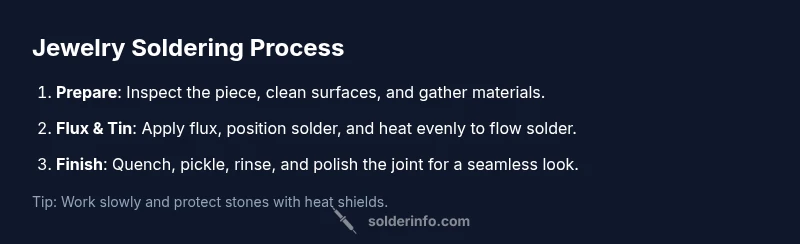
This section offers a concise overview of the typical workflow you’ll follow in most jewelry soldering repairs. Start by inspecting the broken joint and identifying the metal type, thickness, and any stones involved. Prepare the workspace and parts, then apply flux to the joints to promote clean solder flow. Place a tiny amount of solder at the seam and heat with slow, controlled bursts, watching for capillary action to draw the metal into the joint. Once the joint flows smoothly, allow it to cool gradually, then clean and inspect the surface. If a little cleanup is required, repeat the fluxing and heating process with extra care to avoid overheating precious stones.
Finishing and polishing after soldering
After a successful solder seam, the piece should be cleaned and restored to its original sheen. Quench with cool water to stop the heat, then pickle or clean as recommended by the flux manufacturer to remove oxides. Rinse thoroughly and dry with a soft cloth. Lightly polish the joined area to blend the repair with the surrounding metal, taking care not to flatten any delicate textures or settings. Finally, recheck the integrity of stones and clasps, and perform a gentle flex test to ensure the repair holds under normal wear. Regular inspection helps catch issues early and extend the life of the jewelry.
Authority sources
- OSHA: https://www.osha.gov
- GIA: https://www.gia.edu
- CDC: https://www.cdc.gov
Tools & Materials
- Soldering torch (adjustable propane or butane)(Ensure heat control and steady flame; prefer micro-torch for jewelry)
- Solder wire (lead-free, various alloys)(Use appropriate diameter (0.5–1.0 mm) for fine jewelry)
- Flux (rosin-core or resin-based flux)(Flux helps metal surface wetting and solder flow)
- Soldering pick/third-hand clamps(Hold pieces securely; use heat-resistant tweezers)
- Soldering block or ceramic fire brick(Provides stable heat surface and protects workbench)
- Magnification loupe or head-mounted magnifier(2x-5x magnification improves accuracy)
- Flux brush(Small applicator for precise flux application)
- Isopropyl alcohol (degreaser)(Clean oils and residues before soldering)
- Tweezers (non-magnetic)(Handle parts without leaving fingerprints)
- Heat sinks or shielding material(Protect stones from heat damage)
- Safety gear (goggles, respirator or mask)(Eye protection and ventilation are essential)
- Soft polishing cloth and buffing wheel(Finish after soldering for final shine)
Steps
Estimated time: 1-2 hours
- 1
Evaluate the piece and plan the repair
Carefully inspect the broken joint and identify the metal type, thickness, and any stones involved. Decide on solder alloy and seam design before heating starts to reduce the risk of misfits or stone damage.
Tip: Take a写真 of orientation before disassembly to help reassembly. - 2
Set up the workspace and tools
Arrange a stable work surface, torch on a nonflammable pad, and ventilation. Position all tools within easy reach and clear any debris that could cause accidents.
Tip: Use a heat shield or clamp to keep the torch away from stones. - 3
Prepare surfaces and joints
Clean metal surfaces with isopropyl alcohol and lightly sand mating edges to create a small valley for solder to sit. Dry-fit the parts to ensure alignment before fluxing.
Tip: Dry-fit first; misalignment will waste solder and time. - 4
Apply flux and position parts
Brush flux onto the joint area to promote wetting, then position pieces with tweezers or a third-hand clamp. Ensure stones are shielded if present.
Tip: Flux first, then clamp to avoid movement during heating. - 5
Tin the joint and preheat
Lightly tin the joint with a minimal amount of solder; preheat the area evenly to avoid cold joints while preventing stone damage.
Tip: Keep heat moving around the seam to avoid concentrating heat on one spot. - 6
Apply solder and complete the seam
Introduce a small amount of solder into the seam and heat until capillary action pulls the solder into the joint. Stop as soon as the flow is even.
Tip: Use minimal solder and watch for smooth flow rather than blobs. - 7
Cool, clean, and inspect
Quench the piece with water or air, then clean oxides with pickle or appropriate cleaner. Inspect for gaps, rough edges, and stone looseness.
Tip: Work gradually; abrupt cooling can warp delicate shapes. - 8
Finish and stabilize
Polish the joint to blend with surrounding metal, recheck settings, and perform a light flex test. Document any additional finishing steps if needed.
Tip: A final polish helps the repair disappear visually from the piece.
Quick Answers
What is solder jewelry repair?
Solder jewelry repair is the process of joining metal pieces in a piece of jewelry by heating a filler metal (solder) to create a strong bond. It is used to fix broken clasps, worn settings, or join pieces that have separated.
Solder jewelry repair means joining metal parts by heating solder to create a strong bond, fixing clasps or broken joints.
Can I solder over stones in a piece?
Only when stones are heat-safe and properly shielded. Many gemstones can crack or loosen under heat, so use heat sinks and consider alternative repair methods for delicate stones.
Soldering over stones is risky; protect stones or remove them if needed before soldering.
What equipment do I need to get started?
Essential tools include a torch with adjustable flame, lead-free solder, flux, tweezers, a soldering block, magnification, and safety gear. A basic setup lets you handle common repairs, rings, clasps, and small pendants.
You’ll need a torch, solder, flux, tweezers, a block, magnification, and safety gear to start.
Is lead-free solder safe for skin contact?
Lead-free solders are generally preferred for jewelry manufacturing and repairs for wearables. Always follow the flux manufacturer’s guidelines and clean the piece thoroughly after soldering to minimize residue.
Lead-free solder is safer for wearables; clean and handle with care after soldering.
How can I prevent heat damage to settings?
Use heat sinks, shield stones, work with a moderate heat and short bursts, and avoid lingering heat on delicate settings. Practice helps you judge heat application more precisely over time.
Protect stones with shields and apply heat in short bursts to avoid damage.
How long does a typical jewelry solder repair take?
Time varies by piece and complexity. A simple seam can take under an hour, while intricate repairs may require longer setup, testing, and finishing.
Simple repairs can be quick; complex ones take longer for setup and finishing.
Watch Video
Top Takeaways
- Plan before heating and choose the right solder for the metal.
- Protect stones and manage heat with shields and steady movements.
- Prepare and clean surfaces for reliable solder flow.
- Apply flux, use minimal solder, and verify the joint before finishing.
- Finish with cleaning, polishing, and final inspection.