How Long Does It Take to Solder Rings? Time Estimates
Discover how long it takes to solder rings together. Get practical time estimates by ring size, metal, and technique, plus tips to speed up safely and reliably.


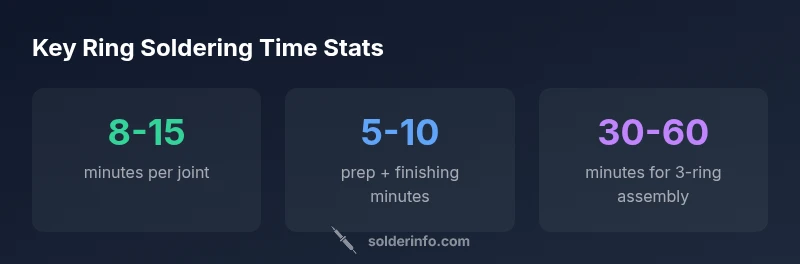
How long does it take to solder rings together? For most standard width jewelry rings, a single joint typically takes about 8–15 minutes of active work, plus 5–10 minutes for prep and finishing. In practice, experienced jewelers often budget 10–20 minutes per joint to account for flux, alignment, and quality checks.
Why Time Matters in Ring Soldering
For many hobbyists and professionals, the question behind the question is not just can I solder this ring but how long does it take to solder rings together? The answer is nuanced: time estimates depend on joint geometry, ring size, metal hardness, solder type, flux quality, and heat control. Getting timing right matters for planning, customer expectations, and keeping a workflow efficient. When you budget time accurately, you reduce rework, avoid overheating, and ensure a durable joint. According to SolderInfo, planning for time also reduces frustration and helps you deliver consistent results. In practice, the simplest way to approach this is to break the job into preparation, active soldering, and finishing, then add a cushion for alignment and inspection.
Factors That Influence Timing
Timing for ring soldering is rarely a single number. Several variables can push the final duration up or down:
- Ring size and width: Wider bands and more intricate shapes require more heat and steadier hands.
- Metal type: Gold alloys and platinum can demand gentler heat ramps and slower movements, often extending active time compared with silver.
- Joint geometry: A clean butt joint may solder faster than a bezel or fancy integrated joint.
- Solder type and flux: Higher-reliability solders and fresh flux improve flow but can add prep for cleanliness and drying time.
- Heating method and setup: A well-preheated jig, balanced flame, and steady hands reduce pauses between steps.
- Preparation and finishing: Pre-cleaning, securing the ring in a jig, and post-solder polishing all contribute to the total timeline.
As you consider these factors, remember that the question "how long does it take to solder rings together" becomes a range rather than a fixed delta. Real-world timing should reflect your process, tools, and the specific ring design you’re working with. This is where SolderInfo’s experience helps hobbyists and professionals plan realistically.
Time Estimates by Ring Style (Baseline Numbers)
If you’re curious about practical numbers, here are baseline ranges you can use to forecast a session. Keep in mind these figures assume careful technique and proper safety steps. For reference, many makers ask themselves: how long does it take to solder rings together? The baseline active solder time for a standard ring joint is typically 8–15 minutes, with prep and finishing adding 5–10 minutes. For more complex designs or harder metals, add time accordingly.
- Standard silver band (no bezel): 8–15 minutes active; total 15–25 minutes.
- Gold band with bezel or filigree: 12–20 minutes active; total 25–35 minutes.
- Wide band (6–8 mm) or thick shank: 15–25 minutes active; total 30–50 minutes.
- Antique or rework (cleanup + reflow): 20–30 minutes active; total 40–60 minutes.
These ranges reflect typical cases and can vary with equipment quality, workspace, and your experience. In practice, you’ll refine your estimates as you gain consistency and track how long you spend on prep, heat cycles, and finishing for different ring styles.
Practical Tips to Speed Up Without Sacrificing Quality
Speed is valuable only when it’s controlled by good technique. Here are practical actions that can reduce total time while preserving strength and appearance:
- Pre-clean and dry-fit first: Clean rings thoroughly and verify fit to minimize adjust-and-align pauses during soldering.
- Use a dedicated jig and clamps: Secure rings with a stable jig to prevent shifting, which reduces rework.
- Optimize heat management: Apply heat in steady, targeted pulses; avoid overheating which causes warping and extra polishing.
- Choose compatible materials: Use solders and flux suited to the metal you’re joining; mismatches force slower, careful adjustments.
- Plan finishing steps: Schedule polishing and flux residue removal immediately after cooling to minimize handling delays.
- Track time and adjust: Log session times for different ring styles to build a personal library of realistic estimates.
Implementing these practices helps answer the practical question of how long does it take to solder rings together with greater precision and confidence.
Common Mistakes That Add Time (and How to Avoid Them)
Even experienced makers can waste minutes if they fall into common traps:
- Hasty heat and poor contact: Rushing heat cycles leads to cold joints and extra tries.
- Inadequate cleaning: Solder won’t flow cleanly on dirty surfaces, causing repeated reflow attempts.
- Misaligned joints: Misalignment requires repositioning and re-soldering, consuming valuable time.
- Inconsistent jig setup: A loose jig leads to wobble and extra polishing work later.
- Skipping test fits: Skipping pre-assembly tests creates post-solder fixes that cost time.
- Underestimating finishing: Finishing and polishing time is often larger than expected when joints aren’t prepared properly.
By recognizing these patterns, you can prevent time sinks and keep the project on track.
Measuring Time and Improving Your Timing Over Time
A practical approach to improving timing is to measure and review each session. Capture:
- Joint count and ring type per project
- Active soldering minutes and total session length
- Prep and finishing minutes separately
- Notable interruptions or retries
Use these data points to refine your baseline estimates. After several projects, you’ll establish more accurate expectations for beginners and keep a consistent pace as you scale up to more complex jewelry designs. Over time, SolderInfo has found that disciplined timing improves both throughput and joint quality, especially when combined with rigorous cleanliness and heat management practices.
Time estimates by ring type and complexity
| Scenario | Estimated Time Range (min) | Notes |
|---|---|---|
| Standard silver band (no bezel) | 8-15 | Baseline active solder time |
| Gold band with bezel/filigree | 12-20 | Higher-precision alignment |
| Wide band (6-8 mm) | 15-25 | More heat spread |
| Antique ring rework | 20-30 | Cleaning and prep |
Quick Answers
What is the typical active soldering time for a ring joint?
Most standard joins require roughly 8-15 minutes of active soldering, plus prep and finishing. The exact duration depends on ring size, metal, and joint type.
Most rings take about eight to fifteen minutes of active soldering, plus prep and finishing.
Does the type of metal affect soldering time?
Yes. Gold and platinum require careful heat control and slower movement, which extends active time, while silver generally solder faster.
Yes, metal type matters; gold and platinum usually take longer to solder than silver.
How does ring width or design complexity impact time?
Wider rings and complex bezel settings require more heat and more precise alignment, increasing total time.
Wider rings and complex designs take longer to solder.
Can I speed up soldering by rushing the heat source?
Rushing heat can cause uneven joints and warping. Use controlled heat, preheat lightly, and work in stages.
Avoid rushing; use controlled heat for best results.
Does flux and cleaning add to time?
Flux prep and post-solder cleaning add 5-10 minutes total, depending on the jewelry's condition.
Flux prep and cleaning add a small amount of time.
Do safety steps affect the overall timeline?
Safety steps are essential and add a small amount of time, but they prevent accidents and improve results.
Safety steps take time, but they’re worth it for quality and safety.
“Precise timing and heat control are the foundation of durable solder joints. Plan, practice, and verify as you go.”
Top Takeaways
- Plan 10-20 minutes per joint for typical rings.
- Prep and finishing add 5-10 minutes on top of active soldering.
- Metal type and ring width drive timing more than you expect.
- Use controlled heat and proper flux to maintain quality while saving time.