No-Clean vs Rosin Activated Solder: Flux Type Comparison
An analytical comparison of no-clean flux versus rosin-activated flux, covering residue behavior, cleaning needs, reliability, and best-use scenarios for electronics, jewelry, and plumbing.


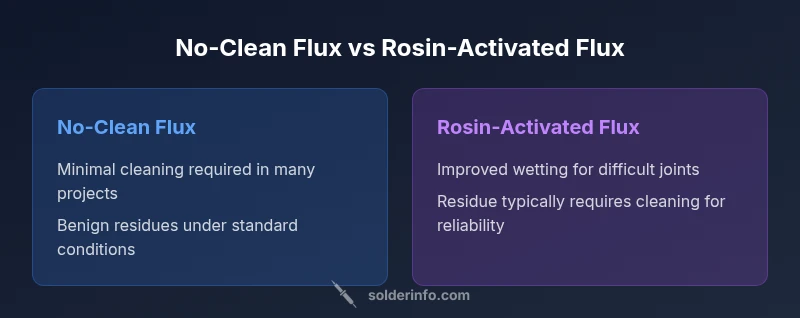
No-clean flux and rosin-activated flux are two common choices for soldering. In practice, no-clean offers convenience with minimal cleaning, while rosin-activated flux can provide strong adhesion but may require cleaning under certain conditions. This comparison analyzes chemistry, residues, cleaning needs, reliability, and best-use scenarios to help you decide which flux type fits your project.
No-Clean vs Rosin Activated: What They Are
In the world of soldering, flux plays a critical role by cleaning metal surfaces, improving wetting, and protecting joints during heating. The phrase no-clean vs rosin activated solder refers to two broad families of flux chemistries. No-clean fluxes are formulated to leave residues that are supposed to be non-corrosive and non-conductive under typical operating conditions, enabling enthusiasts and professionals to solder with little or no cleaning. Rosin-activated fluxes rely on rosin resin combined with activators to enhance solderability, particularly on challenging joints or when surfaces are difficult to prepare. Understanding these differences helps you predict residue behavior, cleaning requirements, and long-term reliability in your designs. The keyword no clean vs rosin activated solder should be understood as a spectrum—flux choice often converges with application constraints, board materials, and environmental challenges. For hobbyists, the no-clean option frequently means faster turnaround; for reliability-focused work, rosin-activated flux can offer performance advantages when paired with the proper cleaning protocol.
Soldering with flux is about balance: you want adequate flux activity to promote good wetting at the joint, while keeping residues from adversely affecting nearby components or long-term durability. No-clean flux formulations aim to seal the surface with benign residues that won’t corrode copper traces or degrade insulation. Rosin-activated fluxes, however, leave rosin-derived residues that can be mildly acidic if left unchecked, especially under humid conditions. The choice between these two families often hinges on the target environment, required cleaning capabilities, and the acceptable level of post-solder processing.
For readers of SolderInfo, the practical takeaway is that no-clean flux is typically the most convenient for routine electronics work, whereas rosin-activated flux is favored when you anticipate aggressive flux activity or need improved wetting for difficult joints. This distinction becomes even more important in high-reliability systems or where boards may operate in moisture-prone environments. In that context, the no clean vs rosin activated solder decision is less about one being universally better and more about which set of trade-offs aligns with your project priorities.
wordCountInBlock1_placeholder_editor_note_that_was_removed_for_valid_json
Comparison
| Feature | No-clean flux soldering | Rosin-activated flux soldering |
|---|---|---|
| Flux type and chemistry | No-clean organic flux designed to leave inert, non-corrosive residues | Rosin resin with activators for enhanced flow and cleaning performance |
| Residue after soldering | Residue is usually mild or invisible; often considered benign | Rosin-based residues are more noticeable and may require cleaning for reliability |
| Cleaning requirement | Often none required for typical electronics assemblies | Cleaning is commonly recommended or required for many assemblies |
| Corrosion risk from residue | Low risk when used per guidelines and within normal humidity ranges | Rosin residues can attract moisture and may cause corrosion if not removed on sensitive parts |
| Best-use scenarios | Non-critical consumer electronics, hobbyist projects, leaded and low-pin-count boards | High-reliability electronics, humid environments, or joints that need aggressive wetting |
| Compatibility with lead-free solders | Generally compatible across common lead-free alloys | Typically compatible but check rosin content and cleaning requirements |
| Handling and storage considerations | Store in a cool, dry place; many formulations have long shelf life without refrigeration | Store tightly sealed; rosin can become tacky or degrade if exposed to moisture |
| Cost and availability | Widely available; price varies by brand and flux type | Widely available; rosin-activated fluxes can be slightly more expensive due to resin content |
Advantages
- No-clean flux offers speed and simplicity for routine work
- No-clean residues are usually non-corrosive and non-conductive
- Rosin-activated flux can provide superior wetting on difficult joints
Cons
- No-clean residues may still cause issues on highly sensitive boards or harsh environments
- Rosin residues typically require cleaning, adding an extra step and cost
- Rosin-activated fluxes can leave tougher residues that demand solvents or dedicated cleaners
No-clean flux is generally better for quick, routine electronics work; rosin-activated flux excels where joints are difficult or require aggressive wetting, provided you can manage cleaning.
Choose no-clean for fast turnarounds and forgiving boards. Opt for rosin-activated when reliability and joint quality in challenging conditions justify post-solder cleaning.
Quick Answers
What exactly is no-clean flux, and how does it differ from rosin-activated flux?
No-clean flux is formulated to leave residues that are non-corrosive and non-conductive under typical conditions, allowing users to solder with minimal cleaning. Rosin-activated flux uses rosin resin with activators to improve solder flow and wetting, often requiring cleaning for long-term reliability.
No-clean flux leaves tiny, typically harmless residues, so you can skip cleaning in many cases. Rosin-activated flux improves flow but usually needs cleaning afterward for best reliability.
Do I always have to clean rosin-activated flux residues?
Not always, but cleaning is commonly recommended for rosin-activated flux, especially on sensitive electronics or where moisture could cause corrosion. In many hobby applications, simple cleaning with isopropyl alcohol is sufficient, but check the flux manufacturer’s guidelines.
Usually yes, especially on sensitive parts. Check the flux label and clean when in doubt.
Can I use no-clean flux for plumbing or jewelry soldering?
No-clean fluxes are primarily designed for electronics. Plumbing and jewelry soldering often use different flux chemistries, including water-soluble or rosin-based fluxes. Always follow the project’s material compatibility and safety guidelines.
No-clean is typically for electronics, not ideal for plumbing or jewelry without confirming material compatibility.
Which flux type is better for lead-free electronics?
Both flux types can be used with lead-free solders, but you should consider cleaning requirements and residue behavior. Lead-free alloys can be more sensitive to certain flux residues, so testing and manufacturer recommendations matter.
Either flux can work with lead-free solders, but cleaning and residue control are key.
Are no-clean flux residues safe for long-term exposure?
No-clean residues are designed to be non-corrosive under standard conditions, and many are considered safe for typical consumer electronics use. If the device operates in harsh humidity or critical environments, consider post-solder cleaning or a flux with proven long-term stability.
Generally safe for normal use, but assess your environment if reliability is critical.
What factors should drive my flux choice besides cleaning?
Consider joint geometry, board material, thermal profile, environmental exposure, and cleaning capability. No-clean is convenient for quick builds, while rosin-activated flux can offer superior wetting on challenging joints when cleaning is feasible.
Think about joint difficulty, environment, and cleaning capacity when choosing.
How should I store flux to maximize shelf life?
Store flux in tightly sealed containers in a cool, dry place. Exposure to moisture can alter rosin-based fluxes, and both flux types should be kept away from heat sources to preserve activity.
Keep flux sealed, in a cool, dry place away from heat.
Top Takeaways
- No-clean flux minimizes post-solder work in standard environments
- Rosin-activated flux improves wetting on difficult joints
- Cleaning requirements differentiate the two options
- Consider environmental humidity and board sensitivity when choosing
- Test compatibility with your solder alloy and components