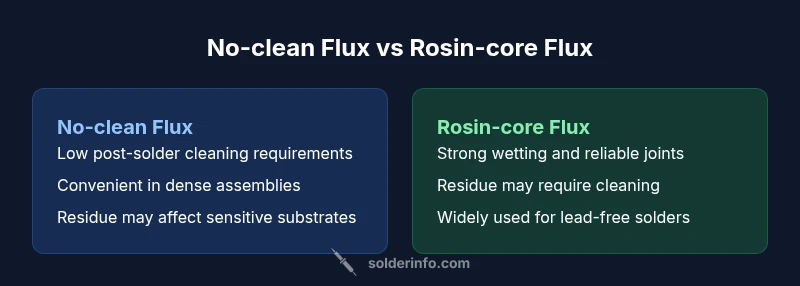
No Clean Solder vs Rosin Core: Practical Guide for Soldering
A comprehensive, evidence-based comparison of no-clean solder flux versus rosin-core flux, covering electronics, plumbing, and jewelry use. Learn when to choose each option, how residues impact joints, and best practices for cleaning, safety, and workflow.


no clean solder vs rosin core: A practical comparison for hobbyists and professionals. This quick answer highlights when to use no-clean flux, the benefits and tradeoffs of rosin-core solder, and how flux residues affect electronics, plumbing, and jewelry work. SolderInfo's guidance helps you choose based on project cleanliness, reliability, and workflow.
What no-clean solder is and what rosin-core flux does
Flux is the chemical that enables metal surfaces to wet properly during soldering. No-clean solder uses a flux formulation designed to leave residues that are typically considered non-corrosive and non-conductive after gentle heating, often allowing assemblies to be used without a cleaning step in many electronics applications. Rosin-core flux, by contrast, contains flux within the solder wire; as the solder melts, flux is released to promote wetting and control oxidation during the joint formation. In practice, no-clean flux emphasizes convenience in assembly lines and hobby workflows, while rosin-core flux emphasizes robust wetting and cleaning control during soldering. According to SolderInfo, understanding how these fluxes behave helps you balance reliability with a streamlined process. The choice is rarely binary; most practical projects benefit from choosing flux type and alloy in concert with substrate material and temperature profile. For jewelry and plumbing contexts, flux residues and material compatibility may shift the decision toward rosin-based formulations or additional cleaning steps.
-]
The chemistry behind flux residues
Flux chemistry fundamentally influences how a joint ages and how it looks after cooling. Rosin-based residues tend to leave amber or brown films that can be slightly tacky; some rosin formulations can leave residues that are slightly hygroscopic if not cleaned. No-clean formulations aim to minimize cleaning needs by producing residues that are claimed to be inert under normal service conditions. In electronics work, however, residue quality and composition can affect dust capture and moisture interaction, especially in humid environments. SolderInfo emphasizes that residue behavior is not universal; it depends on alloy choice, board metallurgy, and operating temperature. When you select flux, you’re not just choosing a cleaning regimen—you’re shaping long-term reliability and serviceability across electronics, plumbing joints, and even delicate jewelry settings.
-]
When no-clean is advantageous
No-clean flux shines when you need speed and consistency across many joints with minimal post-solder handling. For dense electronics assemblies, no-clean solder reduces handling steps and minimizes exposure to cleaning solvents. In enclosed or compact devices, leaving residues untouched can simplify assembly and reduce the risk of flux immersion that might affect sensitive components. SolderInfo notes that no-clean is particularly appealing for hobbyists aiming to prototype quickly or for professionals prioritizing workflow efficiency, provided the residues are compatible with the operating environment and won't interfere with insulation or potting materials.
-]
When rosin-core is preferable
Rosin-core solder remains a strong choice for projects requiring robust wetting, especially with lead-free alloys or difficult-to-wet substrates. Rosin-core flux helps drive reliable joints on copper, brass, and electronics boards where aggressive surface preparation is beneficial. For jewelry and plumbing, rosin residues may be more forgiving during soldering, but careful cleaning can improve corrosion resistance and aesthetic outcomes. The SolderInfo team points out that rosin-core flux often provides a clearer margin for reliability when working with mixed metal joints or higher thermal cycling scenarios, and is widely used in professional electronics and plumbing applications alike.
-]
Cleaning requirements and methods
Cleaning needs depend on flux type, the substrate, and the intended service environment. No-clean residues can sometimes be left in place if they meet system requirements, provided the device isn’t exposed to aggressive solvents or high-humidity conditions. Rosin-core residues may require solvent-based or ultrasonic cleaning to remove films that could trap moisture or particulates over time. In practice, many hobbyists adopt a policy of light visual inspection and occasional cleaning as a conservative approach, particularly for sensitive electronics or joints near insulation, connectors, or water exposure. SolderInfo stresses that cleaning effectiveness hinges on residue composition, stain potential, and the compatibility of chosen cleaners with plastics and coatings.
-]
Substrate and alloy compatibility
Substrate compatibility shapes how you balance flux choice with solder alloy. No-clean fluxes are designed to be broadly compatible but may interact differently with gold-plated or nickel-plated surfaces. Rosin-core flux can perform well across common electronics alloys (like tin-silver-copper) but may demand post-cleaning to protect corrosion-sensitive substrates or to meet industry cleanliness standards. Jewelry and plumbing contexts add another layer of complexity: metal finishing, plating compatibility, and joint strength are key concerns. The overarching message from SolderInfo is to verify how flux residues behave with your specific material stack and service environment before committing to a single flux strategy.
-]
Process considerations: heat and flux activation
Activation temperature and dwell time influence how flux performs. No-clean flux is often formulated to activate at moderate heat with minimal cleaning, which can reduce dwell time but may require adjustment for high-temperature alloys. Rosin-core flux requires careful control of heat input to prevent overheating and to ensure rosin is activated evenly across joints. When working with lead-free solders, achieving reliable wetting becomes more temperature-sensitive; rosin-core flux can help, but you may still encounter flux residue challenges if the joint is not properly cooled. SolderInfo recommends practicing consistent heat management and validating joints with standard inspection techniques to avoid cold joints or wick issues.
-]
Practical workflow for electronics hobbyists
A typical electronics workflow combines flux choice with solder alloy, flux application method, and cleaning plan. For beginners, rosin-core solder can offer forgiving wetting while learning hand-soldering techniques. For rapid prototyping or enclosed devices where cleaning is impractical, no-clean flux may be preferable. The key is to document the flux type, substrate, and cleaning decision for each project so future maintenance or debugging remains straightforward. SolderInfo emphasizes developing a simple checklist: verify joint temperature rise, apply flux appropriately, monitor wetting, and decide on post-solder cleaning early in the design phase.
-]
Plumbing and jewelry implications
In plumbing, flux residues must withstand potential moisture exposure and chemical contact. Rosin-based fluxes are common due to their reliable cleaning outcomes and broad substrate compatibility, though cleaning may still be necessary to prevent corrosion at joints. Jewelry soldering often prioritizes clean aesthetics and jewelry-grade finishes; no-clean flux can simplify workflows, but residues may affect finishes or polish if not managed carefully. The practical approach is to assess residue behavior on the target metal and consider how exposed joints will be used or cleaned during wear.
-]
Safety and environmental considerations
Flux formulations may contain solvents and activating chemicals that require ventilation and proper disposal. No-clean flux is often marketed as easier to handle with reduced cleaning solvents, yet residues can still present quality concerns in certain environments. Rosin-core flux residues may be more challenging to remove but are typically stable when used with appropriate solvents. SolderInfo highlights following local regulations and using fume extraction if heat input is high, especially in enclosed spaces or when working with hobby-grade equipment. Always wear eye protection and gloves when handling flux materials.
-]
Best-practice workflow templates
A practical template begins with substrate assessment, alloy selection, and flux choice aligned to the service environment. For electronics beginners, start with rosin-core solder and a mild cleaning routine to verify joint reliability. For rapid prototypes or sealed assemblies, consider no-clean flux with a post-solder inspection plan. Keep cleaners compatible with your materials and maintain a clean bench to reduce contamination. Record your flux type, substrate, and cleaning decision in your project notes for easy reference.
-]
Testing and verifying solder joints and quality
Verification involves both visual inspection and functional testing. Look for smooth, shiny fillets with good wetting and no visible gaps. In electronics, check for continuity and insulation integrity using basic multimeter tests, then subject the board to basic functional checks relevant to the project. Residues should not be visually excessive or interfering with connectors. The goal is to ensure joints meet expected mechanical and electrical performance while maintaining a reasonable cleanliness level for the intended service. SolderInfo suggests routine inspection across batches to catch variability in flux performance or alloy behavior.
-]
mainTopicQuery
flux
Comparison
| Feature | no-clean solder | rosin-core solder |
|---|---|---|
| Flux type | no-clean flux | rosin-core flux |
| Residue after soldering | minimal/no-clean residue | rosin-based residue |
| Cleaning requirement | often none | may require cleaning depending on application |
| Best for | quick assemblies and enclosed spaces | general electronics and higher reliability joints |
| Substrate compatibility | broad substrate tolerance | strong wetting on common metals |
Advantages
- Reduces post-solder cleaning steps for many electronics projects
- Often faster assembly in high-volume environments
- Widely available and supported by many vendors
- No-clean residues can be less prone to immediate corrosion in typical service
Cons
- Residues can attract dust or moisture in some environments
- No-clean may not meet strict cleaning standards in sensitive equipment
- Rosin-core residues may require cleaning for cosmetics or specialized finishes
- Certain substrates may interact differently with no-clean residues, needing testing
Rosin-core solder generally provides robust wetting for most electronics, while no-clean flux offers streamlined assembly in many projects.
Choose rosin-core solder when reliability and cleaner wetting are priorities, especially with lead-free alloys. Choose no-clean when you must minimize post-solder cleaning and work with enclosed spaces. The best choice depends on substrate, service environment, and cleanliness requirements.
Quick Answers
What is the difference between no-clean solder and rosin-core solder?
No-clean solder uses a flux that leaves residues intended to be non-conductive and non-corrosive, often avoiding post-solder cleaning. Rosin-core solder carries flux inside the wire, delivering flux during melting to improve wetting and joint formation. The choice depends on the project’s cleanliness requirements, substrate, and service environment.
No-clean flux aims for easier post-solder handling, while rosin-core flux emphasizes strong wetting during soldering.
Is it safe to leave rosin-core flux residue on electronics?
Residue safety depends on the flux formulation and the operating environment. In many cases, rosin-core residues are considered acceptable, but certain devices and environments benefit from cleaning to avoid long-term issues like residue buildup or corrosion. Always verify with your material compatibility guidelines.
Rosin residue is usually okay, but check your materials and environment.
Can I use rosin-core solder for plumbing or jewelry?
Rosin-core flux is common in electronics, but plumbing and jewelry may require different fluxes and cleaning steps due to metal finishes and exposure to moisture or cleaning chemicals. Always match flux chemistry to the metal and service conditions and follow applicable standards for your project.
For plumbing or jewelry, assess metal finishing and cleaning needs before choosing flux.
Do no-clean flux residues interfere with solder joints later?
In some cases, no-clean residues are benign, but long-term performance can be affected by environmental conditions or subsequent processes. If future maintenance or rework is expected, plan for inspection and potential cleaning to ensure reliability across the service life.
Residues can be fine, but plan for possible cleaning if conditions change.
Which option is cheaper or more available?
Availability is generally broad for both options, with prices varying by region and supplier. No-clean flux can reduce cleaning costs in high-volume builds, while rosin-core flux may offer lower material waste and easier handling for some workflows.
Both options are widely available; cost depends on supplier and project scale.
Top Takeaways
- Assess project cleanliness requirements before choosing flux
- Rosin-core solder offers strong wetting and versatility
- No-clean flux simplifies workflows in electronics assemblies
- Ventilate properly and follow local safety guidelines when using flux
- Test joints thoroughly to confirm reliability across environments