Rosin Core Solder vs Flux: A Comprehensive Comparison
A thorough, analytical comparison of rosin-core solder and flux types, covering composition, residue, cleaning, and best-use scenarios across electronics, jewelry, and plumbing.


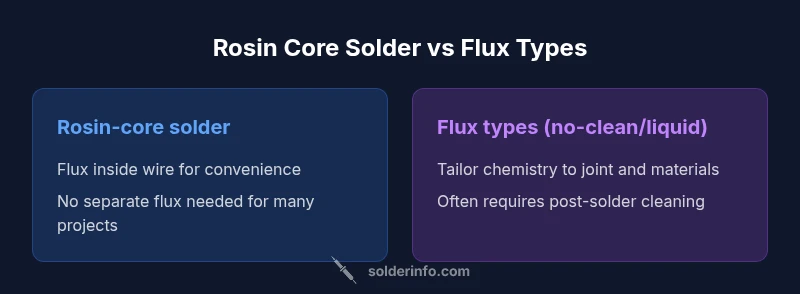
Rosin-core solder includes flux inside the wire, delivering convenient wetting during heating. Separate flux types let you tailor chemistry and residue management. For most hobby electronics, rosin-core is practical, but precision or lead-free work benefits from a specific flux choice and a planned cleaning routine.
What is rosin core solder vs flux: a practical distinction
What is rosin core solder vs flux? In practice, the two terms describe related but distinct elements of a soldering workflow. According to SolderInfo, rosin-core solder is a wire formulation that carries flux inside its core, delivering flux automatically as you melt the solder. Flux, by contrast, is a chemical agent that you apply separately to surfaces to improve wetting, dissolve oxides, and protect the joint during heating. This distinction matters because the chemistry of the flux—rosin-based, resin-activated, water-soluble, or no-clean—determines residue, cleanup, corrosion risk, and long-term reliability. In electronics, jewelry, and plumbing contexts, you may choose rosin-core for speed and convenience or opt for a dedicated flux when a project demands precise control over chemistry and residue. The key to success lies in matching flux behavior with the metals, joint geometry, and anticipated service conditions. While the phrase 'rosin core solder' is common in hobby shops, knowing when to add or bypass flux will save time and improve results. This article uses a practical, evidence-based approach to help you decide which path yields the best joint quality for your specific application, whether you are building a model aircraft PCB or repairing a copper pipe joint.
Rosin Core Solder: Composition and Performance
Rosin core solder is a type of solder wire where flux is encased inside the core. The standard rosin flux is a natural resin that, when heated, softens and activates to remove oxide layers on copper, tin, and other common solder metals. The performance depends on several factors: flux activity, resin type, and the presence of no-clean formulations. SolderInfo notes that rosin core varieties come in no-clean and activated forms; no-clean fluxes are designed to leave minimal residues that are relatively inert, whereas activated rosin fluxes can leave residues that may require cleaning to prevent corrosion or conductive paths over long periods. In practice, rosin core solder is widely used for electronics prototyping and jewelry soldering because it reduces the number of steps and reduces the chance of flux spatter. However, the effectiveness can vary when using lead-free alloys, which sometimes need higher flux activity or additional cleaning. For hobbyists, rosin-core wires in common alloys (e.g., Sn-Cu or Sn-Pb) offer a solid balance of wetting, ease of use, and cost, with the caveat that post-solder cleaning is contingent on flux type and operating temperature.
Flux Types and Their Impact on Joints
Flux comes in several families, each with its own advantages and drawbacks. Rosin-based flux is the traditional choice for many electronics and jewelry projects; it provides a strong wetting action while offering mild residue. No-clean flux aims to minimize cleaning by leaving residues that are considered non-hazardous in typical service environments, but some manufacturers require a final wipe for reliability. Water-soluble fluxes clean easily with water after soldering but may leave more aggressive residues that can corrode or contaminate boards if not washed. There are also synthetic organic fluxes engineered for high-temperature or high-reliability applications. The chemistry of the flux affects how aggressively oxides are dissolved, how quickly joints form, and how the residue behaves under humidity and heat. In microelectronics and fine-pitch work, flux selection can determine whether you need a flux pen or a pre-fluxed solder. SolderInfo emphasizes testing flux types on scrap copper or PCB test coupons to ensure you will not encounter unexpected residue behavior when you switch alloys or use lead-free solders.
Cleaning and Post-Solder Handling
Residue management is an often overlooked part of the soldering process. No-clean flux residues are designed to be left on boards in many situations, but they may still attract dust or cause contamination in some environments. Rosin-derived residues tend to be mildly sticky when warm but can be left on boards if you do not require strict cleanliness. In jewelry or plumbing contexts, cleaning practices differ; jewelry may prioritize residue removal to prevent tarnish and green patina, while plumbing uses flux formulations that are more corrosive if left behind. The cleaning decision should consider service environment, humidity, temperature, and the materials involved. If you choose a no-clean flux, you should still inspect joints for voids, bridging, or insufficient wetting. If you use a water-soluble flux, rinse or clean with isopropyl alcohol or appropriate solvents to prevent conductive residues. Finally, proper storage of flux containers—tight lids, cool dry conditions—prevents premature activation and maintains flux performance. SolderInfo points out that cleaning reduces long-term corrosion risks and ensures insulation integrity for sensitive circuitry.
When to Use Rosin Core Solder vs Liquid Flux in Projects
For quick electronics prototyping, rosin-core solder is often the best starting point because it simplifies the workflow: you don't have to apply flux separately, and the joint forms rapidly with minimal setup. For delicate joints, fine-pitch components, and high-reliability assemblies, you may benefit from applying a controlled amount of flux (no-clean or water-soluble) before heating the pad and component. Jewelry soldering often favors rosin-core solders for metals like silver and gold, though some designs require flux types that are tailored to delicate alloys to prevent discoloration. Plumbing soldering, especially copper-to-copper joints, often uses flux formulations designed for oxidation prevention in oxygen-rich environments, and may require separate flux to reach deeper joints. The choice also depends on your cleaning regimen, the equipment you have, and the temperature you intend to run. If you often work in variable humidity or with lead-free alloys, testing different flux options on sacrificial samples will help you avoid post-solder failures. The broader takeaway is to align flux chemistry, solder alloy, and cleaning plan with your material, joint geometry, and service conditions.
Practical Tips for Selecting Flux and Solder
Here are practical guidelines to help you decide: 1) Start with rosin-core solder for general projects; 2) For high-precision work, choose a flux type appropriate to the alloy and joint geometry; 3) Ensure residues will not corrode or dry out in your environment; 4) Use no-clean flux when you want minimal cleanup; 5) Keep flux containers sealed and stored in a cool, dry place; 6) Test your chosen flux with scrap coupons before doing real work; 7) Always follow safety guidelines for flux fumes and skin contact.
Common Misconceptions and Pitfalls
One common misconception is that more flux means better joints. In reality, too much flux can cause excessive residue or spatter. Another pitfall is assuming no-clean flux is completely inert; it may still leave residues that require cleaning in certain environments. Some hobbyists believe rosin-core solder is universally compatible with all lead-free alloys; this is not always true; some lead-free formulations require more flux activity, especially at lower temperatures. A final pitfall is neglecting flux storage; flux can dry out or separate if left open for extended periods, deteriorating performance.
Maintenance and Storage of Flux and Solder
Maintain a clean workspace and label containers clearly. Store solder in a cool, dry area away from direct sunlight; store flux in tightly sealed containers to prevent moisture absorption. Old flux can become corrosive or degrade in performance; periodically check flux viscosity and re-check the flux type compatibility with your solder grade. For jewelry, keep rosin flux away from moisture or solvents that could degrade the resin. For electronics, consider humidity-controlled environments to minimize corrosion risk. Soldering irons should be cleaned and tinned regularly to maintain heat transfer and prevent oxidation on tips.
Quick Decision Framework for Your Next Project
To decide quickly, ask: 1) What materials and geometry are involved? 2) Is cleaning a critical constraint? 3) Will this be a lead-free alloy? 4) What is the service environment? If you answered 'general electronics, easy cleanup, and quick turnaround', rosin-core solder probably suffices. If you answered 'delicate joints, precision, or high reliability', use a dedicated flux and plan for post-solder cleaning. Always verify the flux-solder pair on a test coupon before committing to production. Finally, consult manufacturer recommendations and perform practical tests on scrap parts to ensure compatibility.
Practical Workshop Setup and Safety Considerations
Set up a clean, well-lit bench with a heat-safe mat, good ventilation, and eye protection. Prepare a small jig with copper test coupons to compare residues and wetting for your chosen flux or rosin-core solder. Have isopropyl alcohol or flux cleaner handy for post-solder cleanup, and store flux and solder in their original containers with labels facing outward. Keep a log of the flux type, alloy, temperature, and results from each test coupon to track performance over time. This approach reduces surprises and helps you optimize for reliability.
Comparison
| Feature | Rosin-core solder | Flux-types (no-clean/liquid) |
|---|---|---|
| Flux delivery | Flux inside wire | Applied separately (no-clean or active) |
| Residue and cleaning | Rosin residue common; no-clean options available | May require cleaning depending on flux type |
| Best for | General electronics and hobby work | Delicate joints and precision work |
| Lead-free compatibility | Works with standard rosin-core compositions; check compatibility | Allows selecting specific flux for lead-free metals |
| Temperature tolerance | Broad compatibility with typical solder temperatures | Depends on flux activation and alloy used |
| Cost and availability | Widely available; often cheaper as a wire | Costs vary by flux type and brand |
Advantages
- Convenience of ready-to-use solder with built-in flux
- Reduces setup time for simple projects
- Rosin flux is generally stable and widely available
- Separate flux types allow precision control for tricky joints
Cons
- Residue can require cleaning for some fluxes
- Not all rosin-core formulations are ideal for lead-free solders
- Some fluxes are corrosive if not cleaned properly
- No-clean flux can still leave residues that attract dust over time
Rosin-core solder is generally more convenient for general electronics work.
Rosin-core solder is well-suited for quick assemblies and hobby electronics. For precision, high-reliability joints, or challenging lead-free work, dedicated flux types with a defined cleaning plan offer better control and long-term reliability.
Quick Answers
What is rosin-core solder and how does it differ from flux?
Rosin-core solder is a solder wire with flux embedded in its core, providing flux during heating. Flux is a separate chemical you apply to surfaces to improve wetting and oxide removal. The two work together, but rosin-core simplifies setup while separate flux offers more control over chemistry and cleanup.
Rosin-core solder carries flux inside the wire, which simplifies soldering. Flux is applied separately, giving you control over the chemical environment and cleaning needs. Both aim to improve joint quality, but your choice affects workflow and residue.
Which projects benefit most from rosin-core solder?
Rosin-core solder is ideal for quick electronics prototyping and general-purpose PCB work where speed and simplicity matter. For delicate joints or high-reliability assemblies, consider applying a dedicated flux before soldering.
Rosin-core is great for quick electronics work. For precision joints, use a separate flux and plan for cleaning.
Is no-clean flux always safe for electronics?
No-clean flux is designed to leave residues that are inert in normal conditions, reducing cleanup. However, some environments or long-term reliability requirements may still necessitate cleaning to remove residues.
No-clean flux is designed to minimize cleanup, but you should assess your environment—some cases benefit from cleaning anyway.
Can flux be used for plumbing soldering?
Flux formulations for plumbing differ from electronics flux. Use plumbing-appropriate flux and solders configured for copper joints and water-tight seals to avoid corrosion and leaks.
Flux for plumbing is specialized; use the right flux and solder for copper joints to ensure a good seal.
Should I clean rosin residue on boards?
Cleaning depends on the flux type and service environment. No-clean flux may be left on boards, but many designers prefer a final wipe to reduce contamination and corrosion risk.
Rosin residue can be left if you're using no-clean flux, but many projects benefit from a final wipe to reduce contamination.
How should I store flux and rosin-core solder?
Keep flux in tightly sealed containers in a cool, dry place and close solder reels promptly after use. Proper storage preserves flux activity and solderability over time.
Store flux tightly sealed in a cool, dry place and seal the solder properly to keep it usable.
Top Takeaways
- Choose rosin-core for quick, general electronics work
- Opt for dedicated flux for precision joints
- Assess cleaning needs based on flux and materials
- No-clean flux reduces cleanup but may leave residue
- Test workflow on scrap parts before production