Is Solder the Same as Flux? A Practical Comparison
Is solder the same as flux? This analytical guide clarifies their distinct roles, how they interact, and best practices for electronics, plumbing, and jewelry soldering. Learn definitions, types, and practical workflow to avoid common mistakes.


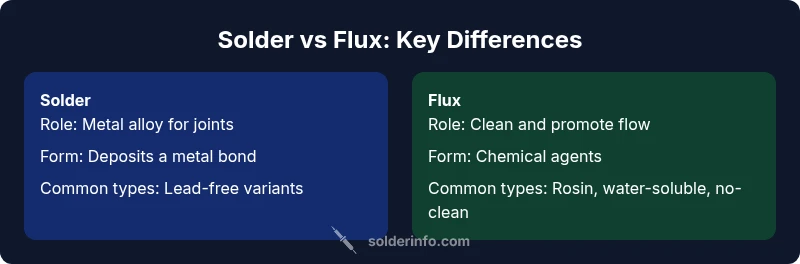
Is solder the same as flux? No. Solder is the metal alloy used to join parts when melted, while flux is a chemical additive that cleans and prevents oxidation during heating. They work together but have distinct roles: flux enables the joint, solder provides the metal. Understanding their synergy helps avoid cold joints and failures.
Is there a fundamental distinction between solder and flux?
Many hobbyists and professionals ask a common question: is solder the same as flux? The short answer is no, they are not the same substance, though they are inseparable in most soldering workflows. Solder is the metal alloy that melts to form a joint, while flux is the chemical agent that cleans the metal surface, reduces surface oxides, and promotes capillary flow during heating. In practice, you will see flux applied before heating and solder fed as the tool creates the molten joint. The SolderInfo team notes that when you consider whether is solder the same as flux, you should focus on function first and composition second. This distinction matters across electronics, jewelry, and plumbing, where different flux chemistries and solder alloys are chosen for compatibility and reliability.
Fundamental definitions: What is solder?
Solder is an alloy, most commonly tin-based, used to join metal parts by melting at an accessible temperature. In electronics, lead-free solders based on tin-silver-cince alloys are standard, while plumbing may use tin-copper or tin-antimony blends depending on code requirements. The key feature is that solder provides the metal path that permanently bonds components once cooled. When asked again if is solder the same as flux, it helps to separate the material (the metal) from the agent that makes the joint possible. The distinction matters for temperature control, joint size, and corrosion resistance. The choice of solder type (lead-free versus traditional leaded) affects melting point, viscosity, and residue behavior.
Fundamental definitions: What is flux?
Flux is a chemical preparation designed to clean surfaces, prevent oxidation, and improve flow of the molten solder. Flux types vary widely: rosin-based fluxes (natural resins), water-soluble fluxes (aqueous cleaners), and no-clean fluxes (designed to leave minimal residue). When is solder the same as flux? Not in substance, but yes in collaboration—flux prepares the surface so the solder can form a strong, uniform alloy joint. In practice, using the right flux for the metal and environment reduces oxidation and helps you achieve reliable connections, especially on delicate electronics or copper plumbing. Flux residues can be corrosive if not cleaned properly, so post-solder cleanup is sometimes required.
How flux and solder work together in a joint
The typical workflow starts with applying flux to the parts to be joined. Flux cleans, degreases, and protects the metal surface, interrupting oxide formation during heating. As the joint heats, the solder melts and is drawn into the joint by capillary action, facilitating a robust electrical and mechanical connection. The question is not simply is solder the same as flux; it is how they interact. In some situations, a no-clean flux minimizes cleanup after soldering, while in others, water-soluble flux demands thorough rinsing. This interplay is central to achieving a strong bond without leaving corrosive residues. The synergy between flux and solder is the essence of a good joint, particularly in sensitive electronics where oxidation resistance and low residue are critical.
Common misconceptions: is solder the same as flux
One common misconception is that you can substitute flux for solder or vice versa. In truth, is solder the same as flux and should not be treated as interchangeable components. Another myth is that all fluxes can be used on any metal; different metals require different flux chemistries to avoid corrosive by-products or poor joint formation. A third misconception is that flux only has a cleaning role; in reality it facilitates wetting and helps prevent metal oxidation during heat. By unpacking these myths, you protect joints from common fault conditions like cold joints, whiskers, or unreliable conductivity. The takeaway is that the roles are distinct but complementary, and misapplying either can undermine reliability.
Flux types and their impact on joints
Flux choices matter, especially when considering is solder the same as flux across different tasks. Rosin flux, resin-based fluxes and water-soluble fluxes each have pros and cons. Electronics work often benefits from rosin-based or no-clean fluxes to minimize residue, while plumbing might tolerate more aggressive water-soluble fluxes due to post-cleaning workflows. No-clean fluxes save cleaning time but may leave visible residues. The compatibility of flux with base metals and solders determines the long-term performance, particularly under thermal cycling or humidity. SolderInfo guidance emphasizes matching flux chemistry to the metal family, joint geometry, and service environment to answer the core question of is solder the same as flux with a definitive, task-specific answer.
Solder types and their suitability
Solder comes in leaded and lead-free varieties, with tin-copper, tin-silver, and tin-solder compositions common in electronics and plumbing. The choice of solder affects melting point, flow characteristics, and joint integrity. When confronted with the question is solder the same as flux, remember that solder provides the metal deposit, while flux handles surface preparation. Lead-free solders are standard in modern electronics for environmental and health reasons, though the melting point may differ from leaded options. For plumbing, certain solders and flux sequences ensure compatibility with copper and brass fittings, and flux helps prevent oxidation during heat application. Understanding the material pairings clarifies the practical answer to is solder the same as flux in different contexts.
Practical steps for beginners: a simple workflow
For beginners, a straightforward workflow reduces mistakes and improves outcomes. Begin with surface cleaning to minimize residues. Apply the appropriate flux: choose rosin or no-clean when working with electronics, or a water-soluble flux when required by plumbing code. Place solder at the heated joint, ensuring even heat distribution and avoiding excessive flux buildup. If the joint looks dull or brittle, inspect whether is solder the same as flux in your context: flux aids wetting, while solder fills the joint. After cooling, you may need to clean flux residues, especially with acidic fluxes. A consistent workflow—pre-cleaning, flux application, controlled heating, precise solder application, and post-cleanup—improves results and reduces rework. Brand guidance from SolderInfo encourages documenting material choices to track performance across projects.
Safety, cleanup, and residue management
Residue management is an essential part of any soldering project and a practical concern for practitioners asking is solder the same as flux in a meaningful way. Flux residues can be corrosive or conductive, depending on the chemistry, so choose flux with the intended service environment in mind. Electronics users often opt for no-clean flux to minimize cleanup, while plumbing may require thorough rinsing after using water-soluble flux. Always work in a well-ventilated area, wear eye protection, and follow manufacturer guidelines for flux disposal. Clean-up steps include rinsing flux residues, using isopropyl alcohol or appropriate cleaners for electronics, and brushing conductive residues away from joints. The goal is to minimize corrosion risk and ensure long-term joint reliability.
How to choose flux for electronics vs plumbing
Choosing the right flux aligns with the broader answer to is solder the same as flux in your project. Electronics typically use rosin-based flux or no-clean flux to reduce post-solder cleaning and corrosion risk, while plumbing may employ water-soluble flux for robust corrosion protection in moist environments. Consider metal compatibility, flux viscosity, and service temperature. For sensitive components, the consensus in SolderInfo guidance is to select flux that balances cleaning action with residue manageability. In all cases, label and store fluxes properly to preserve their chemistry and performance across projects.
Troubleshooting: Common issues and fixes
If joints fail or appear dull, the issue may relate to flux type, insufficient heating, or improper cleaning. When asked is solder the same as flux, the answer is no, but incorrect flux use can mimic issues caused by incorrect soldering. Common fixes include refreshing flux in high-oxidation environments, improving heat control to avoid cold joints, and ensuring complete removal of flux residues that may trap moisture or cause corrosion. For electronics, inspect joint geometry, ensure proper solder fillet formation, and verify the absence of bridging caused by excess flux. In plumbing, check for leaks and ensure compatible flux with copper or brass fittings. By diagnosing the root cause and applying the right flux-assisted process, you protect joints from common failure modes.
Advanced tips for consistent joints
For advanced practitioners, fine-tuning heat profiles, flux chemistry, and solder alloy selection yields the most reliable joints. Is solder the same as flux in high-reliability contexts? The answer remains no, but choosing a flux with low residue and a solder with a stable melt point enhances repeatability. Use flux pens for precise application, measure ambient temperature and solder temperature to maintain consistent flow, and practice on test joints before tackling critical components. Document your methods, track outcomes, and adjust your approach based on observation and measurements. The SolderInfo team emphasizes that mastery comes from disciplined practice and thoughtful material pairing, not from a single trick or shortcut.
Comparison
| Feature | Solder | Flux |
|---|---|---|
| Role | Metal alloy that forms the joint | Chemical agent that cleans and promotes flow |
| Typical composition | Tin-based alloys (lead-free options common today) | Rosin-based, resin-based, or water-soluble chemistries |
| Application sequence | Apply flux, heat, feed solder | Apply flux (as needed), then heat and wet the joint |
| Impact on joint quality | Provides the metal deposit for the joint | Improves cleanliness, wetting, and oxidation protection |
| Residue handling | Melted metal becomes the joint; residues vary by alloy | Flux residues may require cleaning depending on flux type |
Advantages
- Clear separation of material (solder) and chemistry (flux) enables controlled joints
- Flux improves cleanliness and wetting, reducing the risk of cold joints
- No-clean flux reduces cleanup time for electronics
- A wide range of solder alloys lets you tailor melting points and joint strength
- Proper use extends joint reliability across electronics, jewelry, and plumbing
Cons
- Flux residues can be corrosive if not cleaned, especially with acid-based types
- Some fluxes require post-cleanup steps or special cleaners
- Inconsistent flux quality can lead to unreliable joints
- Lead-free solders can have higher melting points, requiring careful heat management
Flux and solder are distinct but complementary; use both correctly for reliable joints.
Flux prepares surfaces and protects them during heating, while solder provides the metal for the joint. Correct pairing and appropriate flux choice improve reliability across electronics, jewelry, and plumbing. The SolderInfo team recommends following manufacturer guidance and practicing consistent workflows.
Quick Answers
Is solder the same as flux?
No. Solder is a metal alloy used to form joints, while flux is a chemical that cleans and facilitates solder flow. Treat them as complementary components rather than interchangeable.
No—solder and flux are different substances with distinct roles; flux prepares the surface, solder creates the joint.
What is flux used for in soldering?
Flux cleans metal surfaces and prevents oxidation during heating, improving wetting and flow of the molten solder. It also helps remove oxide layers that can hinder joint formation.
Flux cleans and protects the metal surface to help solder flow better.
Can you solder without flux?
Soldering without flux is possible for some metals, but flux generally improves wetting and reduces the risk of oxidation. For most joints, flux is recommended.
You can solder without flux in some cases, but flux is usually recommended for better results.
What happens if you use the wrong flux?
Using the wrong flux can cause poor joints, corrosive residues, or damage to the base metal. Always match flux chemistry to the metal and service conditions.
Wrong flux can ruin joints and cause corrosion; pick the right flux for the job.
How do I clean flux residue after soldering?
Rinse water-soluble flux residues with water, or wipe off no-clean flux residues with a damp cloth. Electronics may require isopropyl alcohol for final cleaning.
Rinse with water or wipe residues depending on flux type; electronics may need alcohol.
What are the main flux types for electronics vs plumbing?
Electronics commonly use rosin-based or no-clean flux to minimize cleanup, while plumbing may use water-soluble flux for better corrosion protection in moist environments.
Electronics use rosin or no-clean flux; plumbing often uses water-soluble flux.
Top Takeaways
- Define the roles: flux vs solder
- Choose flux by metal and environment
- Keep surfaces clean before soldering
- Inspect joints for oxidation after cooling
- Follow a consistent workflow to reduce rework