Solder Flux vs Paste: Differences, Uses, and Best Practices
A detailed, analytical comparison of solder flux vs paste, explaining how each works, when to use them, and best practices for electronics, jewelry, and plumbing soldering.


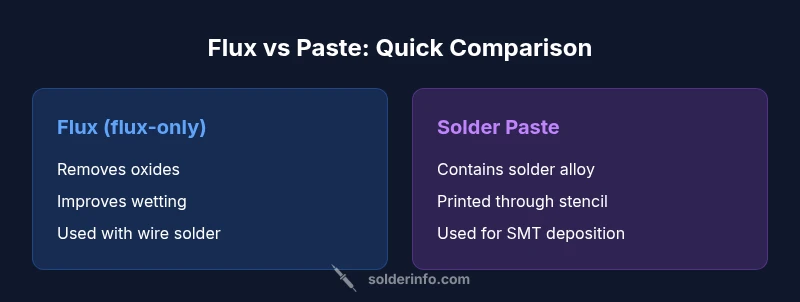
Solder flux vs paste describes two related, yet distinct, tools for joining metals. Flux is a chemical that cleans metal surfaces, removes oxides, and promotes wetting, while solder paste blends flux with solder alloy to allow precise deposition, especially in surface-mount technology. According to SolderInfo, understanding this distinction helps DIY hobbyists and professionals choose the right approach for electronics, jewelry, or plumbing soldering. The key takeaway is that flux prepares surfaces, while paste provides the solder deposit in a single step for SMT workflows.
Defining Solder Flux and Solder Paste
Solder flux vs paste describes two related tools used to join metals. Flux is a chemical that cleans metal surfaces, removes oxides, and promotes wetting, while solder paste blends flux with solder alloy to allow precise deposition, especially in surface-mount technology. According to SolderInfo, understanding this distinction helps DIY hobbyists and professionals choose the right approach for electronics, jewelry, or plumbing soldering. The flux acts as a surface treatment, reducing oxidation and improving solder flow, whereas the paste bundles the active flux with a solder alloy into a single deposit that can be printed or applied with a syringe. This distinction matters across projects—from quick repairs to high-precision assemblies—and sets the stage for choosing the correct workflow.
The Chemistry Behind Flux and Why it Matters
Flux chemistry is the backbone of successful soldering. Flux removes oxide layers and suppresses corrosion to enable metal surfaces to wet and bond with molten solder. Different flux chemistries exist: rosin-based fluxes (natural resins), water-soluble fluxes (activators that dissolve oxides readily), and no-clean fluxes (designed to leave residues that are relatively benign). Each type changes cleaning requirements, corrosion risk, and joint reliability. For hobbyists and professionals, selecting a flux that matches the base metal and operating environment is crucial. The SolderInfo team emphasizes that chemistry should align with workflow, not just product availability, to prevent surprises during rework or maintenance.
What Solder Paste Brings to SMT Processes
Solder paste provides both flux and solder alloy in a single delivery, enabling automated or manual stencil printing for surface-mount technology (SMT). Paste comes in a syringe or is dispensed through a stencil to create precise, repeatable deposits. The flux within paste prepares the pads and dissolves oxides enough to wick solder into joints during reflow. The performance depends on paste viscosity, particle size, and flux content. No-clean pastes aim to minimize cleanup after reflow, while water-soluble pastes may require rinsing. For high-volume electronics production, paste consistency and reflow profile control are critical for reliability and yield. No-clean formulations reduce post-solder cleaning, which can be advantageous in constrained manufacturing lines.
When to Use Flux-Only vs Flux-Containing Paste
Flux-only methods are common in through-hole wiring, repair work, or when you need to re-tin a surface before applying solder. They are also useful in rework where you want to observe the cleaning action before adding solder. Flux-containing pastes are designed for SMT assembly, where rapid deposition and consistent joint geometry are critical. The decision often hinges on process capability, the equipment you have, and the cleanliness requirements of the finished product. Many hobby projects benefit from flux with traditional wire solder, while professional electronics manufacturing relies on paste and precise reflow profiles to meet tight tolerances and throughput goals.
Types of Flux: Rosin, Water-Soluble, and No-Clean
Rosin-based flux is friendly for many electronics tasks and jewelry but requires careful storage to avoid aging. Water-soluble flux offers strong oxide removal but demands thorough cleaning to prevent corrosion. No-clean flux leaves residues designed to be non-corrosive, enabling minimal post-solder cleanup. Each type has advantages and caveats for different materials, board assemblies, or metalwork. When selecting, assess exposure to moisture, cleaning standards, and residue tolerance. The SolderInfo guidance suggests matching flux type to the joint material and expected maintenance routine to optimize reliability across domains.
Types of Solder Paste and Application Considerations
Paste comes in various alloy families, including lead-free and traditional tin-lead formulations. Lead-free pastes are common for modern electronics due to regulations, but they have different melting behavior and reliability characteristics. Printing pastes through stencils requires proper alignment, paste viscosity, and nozzle calibration. Temperature profiles and reflow environments strongly influence results. Paste can be stored cold in a fridge or dry place, but it has a finite shelf life and must be used within the recommended timeframe. For jewelry and small assemblies, paste may be less practical than flux and wire solder, but it remains indispensable for certain micro-SMT tasks.
Cleaning, Storage, and Safety Best Practices
Residues from flux can vary in corrosiveness and ease of removal, depending on the flux type. No-clean flux often requires little cleanup, but sensitive assemblies may benefit from gentle cleaning. Store flux and paste away from heat and humidity, and observe expiry dates. Reflow safety and ventilation are important, particularly when using activator-rich fluxes. PPE, such as eye protection and gloves, helps. SolderInfo notes that following manufacturer guidelines reduces the risk of toxic exposure and ensures stable joints over time. Proper disposal of waste residues and careful labeling of flux types further improve workplace safety and compliance.
Practical Scenarios: Electronics, Jewelry, and Plumbing Examples
Electronic assemblies rely on SMT deposition; flux-based wetting ensures reliable joints, while paste provides precise solder deposition. Jewelry soldering often uses flux to clean metal surfaces and join small components in jewelry settings. Paste is less common in jewelry but can be used for micro-SMT-like tasks on small filigree pieces when precision is critical. Plumbing joints mainly use flux (either rosin or paste) with copper pipes; the choice depends on pipe diameter, solder alloy, and joint geometry. Across domains, lengthier assemblies benefit from paste for controlled, repeatable deposition, while flux-only workflows offer flexibility for repairs and surface preparation. The overarching lesson is to align flux and paste choices with material compatibility, joint design, and post-solder cleaning requirements.
Common Mistakes and Troubleshooting Tips
Common mistakes include choosing the wrong flux type for the base metal, applying too much or too little flux, and failing to reflow under appropriate temperature profiles. For SMT, misaligned apertures or insufficient paste can cause bridges or insufficient joints. In through-hole work, using flux that requires heavy cleaning on sensitive substrates can lead to corrosion if residues are not removed. Troubleshooting involves reviewing flux chemistry, rework steps, and cleaning procedures, then validating with test joints and X-ray or cross-section checks as needed. Following a reproducible workflow reduces defects and improves yield across electronics, jewelry, and plumbing projects.
Comparison
| Feature | Flux (flux-only) | Solder Paste |
|---|---|---|
| Primary role | Chemical cleaning and oxide removal to promote wetting | Combined flux and solder alloy for deposition |
| Best use case | Surface prep, through-hole work, rework | SMT deposition with stencil printing |
| Application method | Brush, pen, or applicator; manual or automated | Printed through stencil or dispensed by syringe |
| Post-process cleanup | Cleanup depends on flux type; some residues are easy to remove | No-clean pastes minimize cleanup; some residues may be left |
| Shelf life / storage | Flux types often have long shelf life if stored properly | Paste shelf life shorter; often refrigeration required |
| Reliability considerations | Depends on flux chemistry and substrate compatibility | Reliability tied to paste formulation and reflow control |
| Ideal for | Repair, rework, and surface prep across metals | High-volume SMT production and precise deposits |
Advantages
- Flux-only workflows provide surface prep and oxide removal for a wide range of joints
- Solder paste enables precise, repeatable deposition for SMT and high-volume work
- No-clean flux reduces post-solder cleanup in electronics-friendly workflows
- Paste streamlines the workflow by combining flux and solder in one step
Cons
- Flux-only methods may require post-solder cleaning depending on flux type and material
- Paste demands accurate printing, viscosity control, and proper reflow profiles
- Paste has a finite shelf life and often needs refrigeration in some formulations
- Flux residues can complicate cleaning for sensitive assemblies if inappropriate flux is chosen
Paste-based SMT deposition is typically best for electronics manufacturing, while flux-only workflows remain essential for surface prep and repairs.
Paste excels in SMT for precise, repeatable deposits; flux-only methods excel in surface prep and through-hole work. The SolderInfo team recommends matching the method to the project requirements, process capabilities, and cleanup tolerance, then validating results with test joints.
Quick Answers
What is solder flux vs paste, and how do they differ?
Solder flux is a chemical that cleans oxide layers and promotes wetting. Solder paste contains flux plus solder alloy for deposition, enabling printed deposits in SMT. Understanding this difference helps you pick the right tool for electronics, jewelry, or plumbing soldering.
Flux cleans surfaces; paste adds solder for deposition. Choose based on the task and assembly type.
Can I use flux alone for SMT work?
Flux alone cannot deposit solder in SMT tasks. SMT relies on solder paste, which provides both flux and solder in a printable form. For repairs or through-hole work, flux with wire solder is common.
Flux alone won’t deposit solder for SMT; paste is usually required.
Is flux necessary when using solder paste?
Most solder pastes include flux, so additional flux is often unnecessary for SMT. However, if you’re combining paste with a separate flux workflow, ensure residues won’t interfere with reflow or cleaning steps.
Paste usually includes flux; separate flux is rarely needed for SMT.
How should I store solder flux and paste?
Store flux in a cool, dry place away from direct sunlight. Solder paste often requires refrigeration or a cool, dry environment and should be used before the stated shelf life. Always follow label instructions for best results.
Keep flux and paste cool and out of sunlight; respect expiry dates.
Do I need to clean flux residues after soldering?
Cleaning needs depend on the flux type and the final assembly requirements. No-clean flux residues are usually tolerated, while rosin- or water-soluble flux may require cleaning to prevent long-term corrosion or surface staining.
Some flux residues are fine to leave; others should be cleaned based on type.
Which is cheaper, flux or paste, for hobby projects?
Costs vary by type and volume. Flux alone is generally inexpensive per use, while paste is priced by syringe or cartridge and depends on alloy choice and required reflow. For small hobby projects, flux with wire solder can be economical; for SMT practice, paste costs scale with production needs.
Flux can be cheaper per use, but paste costs depend on volume and alloy.
Can flux and paste be used together in a workflow?
Yes, in some workflows you may apply flux first for surface preparation and then use paste for deposition, especially when combining restoration or rework with SMT-like deposition. Ensure compatibility and cleaning steps are integrated.
You can combine flux and paste in some workflows if the process is well controlled.
Top Takeaways
- Choose flux vs paste based on joint design and manufacturing approach
- Paste offers precision and streamlined workflow for SMT
- Flux-only remains versatile for cleaning and surface prep
- No-clean flux reduces cleanup in electronics, but verify residue tolerance
- Always validate a new workflow with test joints before full-scale production