Soldering vs Crimp: What’s Best for Wiring Projects
A practical, objective comparison of soldering and crimping wires across electronics, plumbing, and jewelry. Learn when to choose each method, with guidelines, pros and cons, and a decision framework to improve reliability and efficiency.


When deciding between soldering and crimping wires, the answer depends on context. For most repairs and hobby projects, soldering provides a durable, low-resistance joint when done well, while crimping offers fast, repeatable connections ideal for fieldwork and mass production. The best choice hinges on reliability requirements, vibration, accessibility, and repairability.
Is it better to solder or crimp wires?
Is it better to solder or crimp wires? The question 'is it better to solder or crimp wires' often arises in DIY projects and electronics work where reliability, vibration, and repairability matter. In practice, soldering can produce a durable, low-resistance joint when performed with proper flux, clean surfaces, and careful heat control. Crimping, by contrast, offers a fast, repeatable path to reliable connections when the right connector, tool, and inspection steps are used. The correct choice is rarely absolute; it depends on context, accessibility for inspection, exposure to vibration, and whether the joint must be reworkable. For hobbyists, soldering provides flexibility and repairability; for field technicians and production lines, crimping delivers speed and consistency with trained tooling.
Key factors influencing the decision
The choice between soldering and crimping is driven by several factors. Environment and exposure (indoor vs outdoor, moisture, temperature cycling) affect joint longevity. Mechanical stress and vibration demand robust strain relief. Accessibility and space dictate whether heat-intensive soldering is feasible. Repairability matters for hobbyists who may need to modify or redo joints. Production context favors repeatability and tooling for crimping. Finally, safety and regulatory concerns can shape acceptable methods in automotive, aerospace, or plumbing applications.
Soldering fundamentals: technique, flux, heat control
Effective soldering relies on proper flux, surface prep, and heat management. Use flux to remove oxides and improve wetting, maintain a clean, tinned surface, and apply heat evenly. Aim for a shiny, smooth fillet with proper wetting to the conductor and pad. Avoid overheating sensitive components, which can degrade insulation or insulation resistance. For wire joints, pre-tin wires, flux the joint, then apply just enough heat to melt the solder and form a mechanical and electrical bond. Cooling should be gradual to prevent cold joints; reflow if necessary.
Crimping fundamentals: connectors, tools, dies, inspection
Crimping relies on compatible connectors, the right tool, and correct die sets. The crimp must produce a solid mechanical bond and a good electrical connection with proper compression. Use calibrated crimp tools and inspect crimps for uniform deformation, absence of gaps, and proper insulation. Avoid salvaged or mismatched connectors, as they compromise reliability. Documentation and standards (IPC guidelines) provide baseline expectations for crimp quality and repeatability.
Electrical performance and reliability: resistance, corrosion, temperature cycles
Electrical performance depends on joint quality and environmental conditions. Solder joints can offer low and stable resistance when flux is used properly and oxidation is minimized. Crimped joints depend on the connector design and the integrity of the crimp; resistance should stay within spec as long as the joint is mechanically sound and shielded from corrosion. Temperature cycling accelerates aging, particularly at joints exposed to moisture or salt. Choose the method that minimizes long-term resistance drift under anticipated operating conditions.
Mechanical strength and strain relief: joint durability and testing
Mechanical durability hinges on how well a joint resists pulling and bending forces. Solder joints benefit from a well-designed strain relief and proper solder fillet, but heat can weaken nearby insulation if applied too aggressively. Crimped joints rely on barrel geometry and proper insulation; strain relief is often built into the connector design. In testing, pull tests and flex tests help verify that joints can withstand expected mechanical loads without failure.
Real-world scenarios: electronics, plumbing, jewelry, automotive
In electronics, a repaired power line may favor soldering for a robust electrical bond, provided heat exposure is controlled. For automotive harnesses and heavy power connections, high-quality crimped joints with strain relief often outperform solder joints under vibration. Plumbing uses solder in some soldered copper joints, while crimp rings and tube fittings are common for quick, leak-free connections. Jewelry soldering requires precise, low-temperature control to avoid damage to stones and settings.
Cost, time, and skill considerations
Soldering demands time for proper prep, fluxing, heating, and cooling, but tools are relatively affordable. Crimping requires purchase of correct connectors and a quality crimp tool; initial setup may be more expensive, but throughput improves with practice. For hobbyists, the learning curve and tolerance for rework matter; for production, the tooling and process control determine overall efficiency.
Hybrid approaches and best practices
Many real-world applications use a hybrid approach: a crimped connector in the harness for quick assembly, with a solder fillet at a critical junction to reduce resistance and improve reliability. In high-vibration environments, combine robust strain relief with chemical protection (sealant, heat-shrink) to extend joint life. Always inspect joints with visual checks and functional tests, and document the method for future maintenance.
Comparison
| Feature | Soldering | Crimping |
|---|---|---|
| Ease of inspection | Moderate with good technique and magnification | High when using proper connectors and dies |
| Electrical resistance | Low when joints are clean and fluxed | Consistent when using quality connectors and proper crimping technique |
| Required tools | Soldering iron, flux, solder | Crimping tool with correct dies, connectors |
| Maintenance/repairability | Relatively easy to rework with flux and heat | Often easier to replace entire connector; reworkable but demands careful inspection |
| Suitability for vibration | Good with proper strain relief and technique | Excellent when using high-quality crimps and secure housing |
| Speed and throughput | Slower per joint; slower setup but flexible | Faster for mass production and consistent results |
| Cost of setup | Moderate tool costs; ongoing flux/solder supply | Higher upfront cost for specialized crimp tools and dies |
Advantages
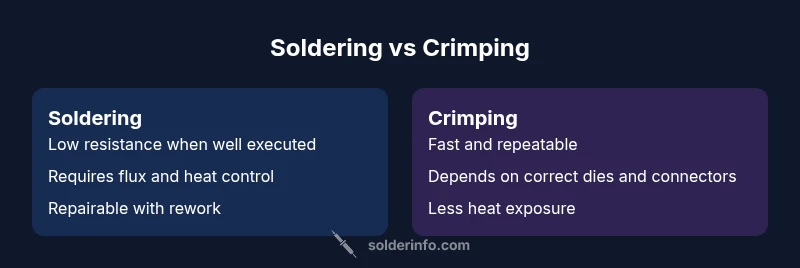
- Soldering can produce very low resistance joints when done with proper flux and technique
- Crimping offers fast, repeatable connections suitable for production lines
- Solder joints are repairable with rework steps if needed
- Crimping minimizes heat exposure to sensitive components when done correctly
Cons
- Poor solder joints can fail due to cold joints or overheating nearby insulation
- Crimps can loosen if connectors are mismatched or under- or over-crimped
- Soldering requires heat input that may damage temperature-sensitive parts
- Crimping depends on correct tooling and connector compatibility; wrong combination reduces reliability
Soldering offers reliability for critical joints; crimping provides speed and repeatability for production and field work.
Choose soldering for critical or repairable joints. Choose crimping for fast assembly and consistent performance in production or field environments.
Quick Answers
Is soldering stronger than crimping for wire joints?
Both methods can be strong when executed correctly. Soldering tends to yield low-resistance joints but requires good heat control; crimping offers mechanical reliability when using the proper connectors and tooling. Always inspect joints for fatigue and corrosion.
Both methods work well if done right; check for heat damage and proper crimp quality.
Can crimped wires fail under vibration?
Yes, poorly prepared crimps can loosen under vibration. Use the correct tool and dies, and verify crimps with pull tests to ensure reliability.
Vibration can loosen weak crimps; ensure proper tooling and testing.
When is soldering not recommended?
In environments with repeated high heat or where heat could damage substrates, soldering may be less ideal. Consider heat management or alternative joining methods.
Heat-sensitive contexts may favor non-solder methods.
What tools do I need for proper crimping?
A quality crimp tool matched to the connector series, appropriate dies, and inspection aids are essential. Poor tooling leads to unreliable connections.
Get the right crimp tool and dies for your connectors.
How do you test a soldered joint for reliability?
Perform visual inspection, continuity checks, and mechanical tests (pull/flex) to verify reliability. Clean flux residue and rework as needed.
Inspect visually, test continuity, and stress the joint.
Is there a risk of cold solder joints?
Yes. Cold joints occur when heat or flux usage is insufficient. Rework with proper heat, flux, and cleaning to ensure a solid joint.
Cold joints happen when heat is wrong; rework properly.
Top Takeaways
- Assess environment and vibration before choosing a method
- Invest in proper tools and training for your chosen method
- Prioritize joint inspection and testing after installation