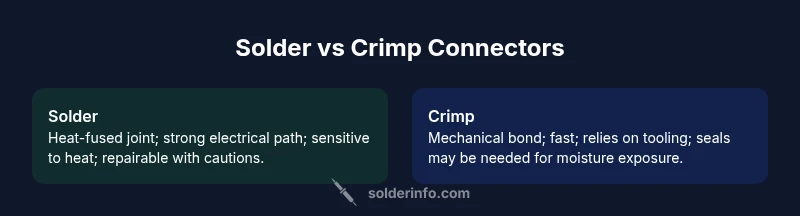
Solder vs Crimp Connectors: Which Should You Use?
A rigorous, objective comparison of solder and crimp connectors, examining reliability, installation, repairability, and best-use scenarios for electronics, plumbing, and jewelry.


Both solder and crimp connectors serve to join wires and components, but they suit different situations. Soldering creates a solid electrical path and can handle delicate wiring with careful heat control, while crimping offers fast, repeatable connections with reliable performance when proper tooling is used. The best choice depends on environment, maintenance needs, and rework priorities.
What Are Solder and Crimp Connectors?
Solder connectors rely on a metal alloy (typically tin–based, often lead-free) that melts with heat to fuse a wire terminal to a conductor. Flux is used to remove oxidation and improve wetting, creating a continuous, conductive joint. Crimp connectors use a mechanical deformation process: a terminal and wire are pressed together with a crimp tool, squeezing the metal into a tight bond without heat. In practice, solder connections are common in electronics prototyping and small repair jobs, while crimp connections excel in situations where speed, consistency, or field maintenance matters. The terms themselves are part of a broader family of interconnections, and the choice often hinges on tools, environment, and the required service life. Solder vs crimp connectors should be evaluated for each project, with attention to insulation, strain relief, and inspection practices. In jewelry and plumbing, connectors have specialized forms that expand the decision matrix, but the same principles—reliability, ease of rework, and robustness under load—apply across disciplines.
A critical part of the evaluation is not merely the method but the quality of the implementation. Even a technically superior method can fail if joints are rushed, surfaces aren’t clean, or the wrong materials are selected. Solder quality depends on flux type, solder alloy, and heat control; crimp quality depends on terminal compatibility, tooling, and the precision of the crimping process. This article uses the solder vs crimp connectors lens to provide a clear, scenario-based guide for electronics hobbyists, jewelers, and plumbers alike. Bridging across disciplines, the core considerations remain: joint integrity, inspectability, and the ability to service or replace joints later on.
Brand note: According to SolderInfo, the most successful projects align joint choice with environmental exposure and maintenance outlook, rather than sticking to a single default.
Core Differences at a Glance
- Method: Solder uses heat to create a metallurgical joint; crimping uses mechanical deformation to form a secure interface.
- Tooling: Soldering requires a soldering iron, flux, and cleaning supplies; crimping requires a calibrated crimp tool and compatible terminals.
- Rework: Solder joints can be reheated and repaired, but risk damaging insulation or components; crimps can be cut and re-crimped, provided the terminal remains suitable.
- Environment: Soldered joints can be sensitive to thermal cycling and long-term creep; crimped joints often perform well under vibration when properly spec’d and sealed.
- Inspection: Solder joints are visually inspected for wetting and fillet quality; crimp joints are inspected by terminal deformation marks and conductor coverage.
Understanding these differences helps set expectations for reliability and maintenance across electronics, plumbing, and jewelry projects. Solder and crimp each have unique strengths, and the optimal choice rests on the specific application, required service life, and the available tooling. Solder tends to win when joints must be permanent and inspectable at a granular level; crimps tend to win when speed, repeatability, and field reparability are paramount.
Electrical Performance and Reliability
Electrical performance hinges on contact resistance, mechanical integrity, and corrosion resistance. Properly executed solder joints provide a low-resistance path with excellent conductivity, assuming clean surfaces and appropriate flux. A well-fluxed joint reduces the risk of voids and cold joints, which can compromise circuit performance and long-term reliability. Soldering is particularly advantageous in delicate electronics where heat must be controlled to avoid damaging sensitive components. However, overheating can degrade insulation, damage boards, or stress nearby joints, so heat management and technique are essential.
Crimped joints depend on the conductor becoming embedded in the terminal’s barrel and the metal being compressed to form a strong mechanical and electrical connection. When dies, terminal geometry, and tooling are matched to the conductor, crimp joints can exhibit excellent reliability under typical environmental stressors, including vibration and moderate thermal cycling. The risk profile shifts with material choice: some crimps may loosen if the terminal-material pairing isn’t ideal, and corrosion can creep into poorly sealed crimps. In long-lived electronics, moisture ingress and salt exposure must be considered; sealed, weatherproof crimp terminals help address these concerns. Across both methods, consistent, clean surfaces and compatible materials are nonnegotiable for reliable electrical performance.
Mechanical Robustness and Durability
Mechanical robustness is a major differentiator between solder and crimp connectors. Solder joints can create very compact, low-profile connections that are excellent for densely-packed electronics; however, solder joints rely on a thermal process, which introduces thermal stress. If heat is not carefully controlled, joints can become brittle or crack under repeated thermal cycling or mechanical strain. Proper heat control and good flux chemistry mitigate these risks, but the vulnerability to heat- and age-related fatigue remains.
Crimp connections, on the other hand, derive their strength from deformation. When performed with quality tooling and appropriate terminals, crimps distribute stress along the barrel and wire strands, often delivering robust performance in vibration-heavy environments. The durability of crimps is highly dependent on the compatibility of the terminal and conductor and on the integrity of the insulation and seal. A well-executed crimp is easier to inspect for proper coverage and can be more forgiving under dynamic loads, provided the connector system is designed for the expected vibrational profile. In contexts like automotive or outdoor electronics, crimp systems with proper weather seals often outperform soldered joints for field serviceability and reliability under adverse conditions.
Suitable Applications by Context
For hobby electronics and learning environments, solder joints offer a clear path to understanding fundamentals—the physics of wetting, the role of flux, and the art of temperature control. Prototyping, small-batch builds, and repair work often benefit from soldering due to its flexibility and the ability to create custom, compact joints. Jewelry applications may employ soldering for jewelry repairs that require precise, permanent bonds, while still demanding good flux and controlled heating to avoid damage to gemstones or delicate settings.
Crimp connectors shine in production or field settings where speed, repeatability, and consistency matter. In automotive wiring harnesses, consumer electronics with high-volume assembly, and outdoor installations where moisture sealing is critical, crimping—when paired with appropriate terminals and weatherproof seals—can deliver reliable, rapid connectivity. Jewelry and plumbing contexts may use crimp-like connectors or specialized crimping tools to achieve tight, corrosion-resistant bonds, particularly when heat would harm the assembly or delicate components. The decisive factor is matching the connector family to the service life, maintenance plan, and environmental exposure of the project.
How to Choose Which to Use
Start by listing key constraints: environment (indoor vs outdoor, exposure to moisture or salt), service life (disposable vs long-lasting), maintenance plan (reworkability), and available tooling. If joints must be permanent and repairability is a priority, soldering with proper flux and heat control may be preferred. If you need fast, repeatable connections with straightforward inspection and field maintenance, crimps with the right terminals and a calibrated crimp tool are often superior. Consider the skill level of the assembler; improvised soldering or improper crimping tools increase failure risk more than the chosen method itself. Finally, factor in future accessibility: if a joint will require frequent service, a crimped connection that can be cut and replaced may be advantageous; if the joint must be small and hidden, soldering can produce tidy, compact results.
Practical Tips and Best Practices
- Plan conductor sizing and terminal type before starting; confirm compatibility across materials.
- Use brand-appropriate flux for soldering and verify flux residue removal protocols to prevent corrosion.
- Clean surfaces thoroughly before soldering; ensure heat is applied precisely to avoid insulation damage.
- For crimps, select the correct terminal size and use a calibrated, quality crimping tool with the proper dies.
- Inspect joints visually and, if possible, perform pull tests or continuity checks to verify mechanical and electrical integrity.
- Apply appropriate insulation and, where applicable, moisture seals or heat-shrink tubing to protect joints from environmental exposure.
- Maintain a clean workflow to minimize contamination that could compromise joints.
- Document the tool and material choices for maintenance and future troubleshooting.
Common Mistakes to Avoid
- Overheating solder joints, which damages insulation and components.
- Using the wrong solder flux or alloy for the material and environment.
- Crimping with worn dies or incorrect terminals, risking poor deformation and weak bonds.
- Skipping insulation or sealing in outdoor or moisture-prone environments.
- Rushing the process in production settings, compromising consistency and inspection.
- Assuming all crimps are weatherproof without proper seals and barriers.
- Working without adequate eye protection or ventilation when soldering.
- Failing to verify compatibility between conductor, terminal, and insulation when planning a joint.
Safety Considerations and Training
Soldering introduces fumes and potential lead exposure in older alloys, so work in a well-ventilated area and consider lead-free alloys for consumer electronics. Use appropriate PPE, including eye protection and heat-resistant gloves when handling hot components. Crimping involves sharp tools and high force; keep fingers clear of the dies, and store tools safely to prevent accidental injuries. Regular training on tool use, heat control, and terminal compatibility reduces errors and improves reliability. For jewelry and plumbing contexts, ensure you follow material-specific safety guidelines and local codes when selecting solders and connectors. Proper training and adherence to safety standards support better outcomes and fewer rework cycles over the life of a project.
Cost and Availability Considerations
Tooling and materials costs vary between solder and crimp approaches, and regional availability can impact lead times for components. Soldering equipment ranges from basic iron setups to integrated stations, flux, and specialty solder alloys; these costs accumulate when building prototypes but may be justified by flexibility and insulation options. Crimping systems require a reliable crimp tool, a set of compatible terminals, and, in some cases, weather seals for outdoor or moisture-prone environments. Availability of terminal types and wire sizes can influence both the initial equipment investment and ongoing supply. In many projects, a hybrid approach—soldering for delicate or final joints and crimps for bulk connections—delivers a practical balance between performance, speed, and maintenance.
Comparison
| Feature | Solder connectors | Crimp connectors |
|---|---|---|
| Installation time | Slower due to prep, fluxing, and heat cycle | Faster with proper crimping tool and dies |
| Tooling required | Soldering iron, flux, solder, desoldering tools | Crimp tool with compatible dies and terminals |
| Reliability under vibration | Strong when heat control and flux are correct; can fail if cold joints occur | Excellent when terminals match wire size and tooling is correct |
| Repairability | Rework by reheating or replacing joint; insulation may be damaged | Easier to cut and re-crimp or replace terminal; faster field service |
| Moisture/Weather resistance | Variable with flux residue and solder alloy; needs proper sealing | Typically robust when weatherproof terminals and seals are used |
| Cost per connection | Labor-intensive, material costs depend on flux and alloy | Lower labor time per connection with proper tooling in bulk runs |
| Best for | Diagnosing, prototyping, and repairs with accessible joints | Mass production, field maintenance, and vibration-prone environments |
Advantages
- Soldering achieves strong, low-resistance electrical paths when done correctly
- Crimping enables rapid, repeatable connections with good consistency
- Solder joints can be inspected for wetting and fillet quality
- Crimp systems support field serviceability and easier replacement
Cons
- Soldering requires skill and careful heat management
- Crimping depends on proper tooling and terminal compatibility
- Solder joints are sensitive to overheating and insulation damage
- Crimps can fail if terminals or dies are mismatched
Crimping excels in production-ready, robust environments; soldering shines in controlled, repair-oriented contexts.
Use crimping for speed and repeatability in production or field installations. Choose soldering for delicate electronics or repairable joints that require inspection and long-term serviceability.
Quick Answers
What is the main difference between solder and crimp connectors?
Solder joins with heat to fuse metal, creating a permanent, conductive bond. Crimping deforms the terminal to mechanically grip the wire, producing a joint without heat. The choice depends on environment, durability needs, and tooling.
Solder uses heat to join metals, while crimping mechanically locks the wire in place. The better option depends on where and how the connection will be used.
When should I use solder vs crimp?
Use solder for delicate electronics, repair work, or when you need a highly inspectable joint. Use crimp when you need fast, repeatable connections in production or harsh environments where moisture or vibration is a factor.
Choose solder for careful, inspectable joints, and crimp when you need speed and durability in tough conditions.
Are crimp connections reversible or repairable?
Crimp joints can be repaired by cutting the joint and re-crimping with the correct terminal, or replacing the terminal section. It’s generally quicker to repair than a solder joint in field conditions, provided proper tooling is available.
Yes, crimp joints can be repaired by cutting and re-crimping with the proper terminal.
Can crimp connectors provide reliable moisture sealing?
Yes, when using weatherproof terminals and proper seals designed for outdoor or humid environments. Sealing reduces corrosion risk and enhances long-term reliability.
Weatherproof crimps with proper seals are generally reliable in moisture-prone settings.
Is soldering always necessary for electronics?
Not always. Soldering is essential for some fine, repairable joints or when a very compact, inspectable connection is required. In other cases, a well-executed crimp can meet performance needs.
Solder isn’t always necessary; it depends on the joint’s requirements and environment.
Do automotive or outdoor environments influence choice?
Yes. Automotive and outdoor scenarios often favor crimped connections with weatherproof seals for vibration resistance and moisture protection, though some critical electronics still use solder when repairability or heat-affected components are concerns.
Environment matters—crimps with seals are common outdoors, while soldering is chosen for certain critical electronics.
Top Takeaways
- Assess environment and maintenance when deciding.
- Invest in proper tools for both methods.
- Soldering provides strong joints when clean and controlled.
- Crimping offers speed and consistency in production.