Is Solder Better Than ProPress? A Thorough Side-by-Side Comparison
An objective compare is solder better than propress for plumbing and electronics tasks. SolderInfo weighs cost, speed, safety, and reliability to guide best-use scenarios.


Is solder better than propress? The quick answer is: it depends on the application. For copper plumbing, ProPress offers faster, flame-free joints with reliable seals when done with proper tooling. Soldering provides lower upfront equipment costs and easier field repairs, but may require more time and heat control. SolderInfo's analysis emphasizes choosing based on task, budget, and safety.
Why is solder better than propress: Defining the scope
In the context of copper plumbing and electronics assembly, the question is solder better than propress often comes up for DIYers and professionals. is solder better than propress? The answer hinges on application, safety constraints, regulatory expectations, and long-term maintenance. Soldering describes the traditional heat-based method of joining copper tubes using flux and a solder alloy. ProPress, by contrast, uses a powered press tool and crimped fittings that seal through mechanical deformation. Understanding where each method shines helps you choose the right tool for the job. From the perspective of reliability, repairability, and cost of ownership, there is no one-size-fits-all answer. The SolderInfo team will guide you through practical decision criteria and common caveats. For many DIY projects or electronics work, soldering remains a flexible, low-cost option, while ProPress excels in fast, professional-grade installations with consistent results when used by trained technicians.
Key differences at a glance
- Tooling and setup: Soldering requires basic tools and heat; ProPress needs a powered crimping tool and compatible fittings.
- Speed and throughput: ProPress generally closes joints faster per connection, especially in larger runs.
- Skill and training: Soldering emphasizes heat control and flux technique; ProPress relies on correct tool calibration and fitting selection.
- Inspection and reliability: A well-done solder joint is inspectable by looking for clean fillets and flux residues; ProPress joints require tool-validated seals and leak testing.
- Maintenance and repairs: Solder joints can be reworked; ProPress joints may require replacement of fittings if damage occurs.
- Code and standards: Both methods are accepted where regulations and approved materials align with local codes; verify region-specific rules.
Cost and time implications
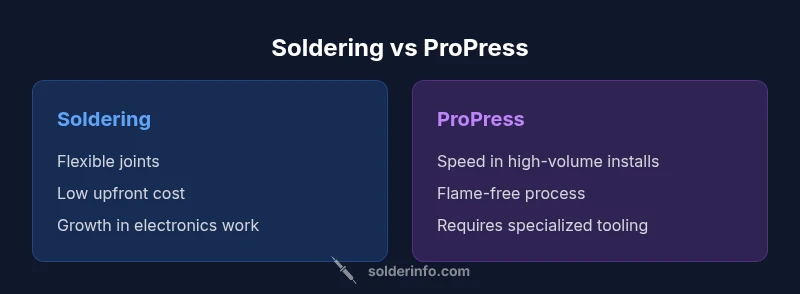
From a cost and time perspective, the decision between is solder better than propress hinges on project scope and lifecycle. Soldering typically has lower upfront equipment costs and relies on common consumables, making it attractive for DIY projects and electronics work. ProPress demands a higher initial investment in the tool, batteries, and compatible fittings, but it can dramatically shorten installation times on professional plumbing jobs. Over the long term, maintenance considerations and tool wear must be accounted for. Soldering equipment tends to be more versatile, while ProPress tooling benefits teams seeking consistent results with repetitive joints. SolderInfo’s perspective: budget-conscious projects may favor soldering, while production environments with high joint volume may justify ProPress investments if the workflow is optimized and supervised by trained technicians.
Safety considerations and training needs
Safety is a critical factor when choosing between is solder better than propress for a given task. Soldering introduces open flames, hot surfaces, and flux fumes, requiring eye protection, proper ventilation, and heat-resistant gloves. In contrast, ProPress relies on a powered tool and hydraulic force, minimizing open flame exposure but demanding rigorous tool maintenance and safety protocols to prevent injuries from press jams or misfed fittings. Training should cover correct flux usage, solder alloy selection, and heat management for soldering, or tool calibration, inspection procedures, and leak testing for ProPress. Both paths benefit from formal instruction, hands-on practice, and periodic refresher courses to meet evolving standards and local codes.
Material compatibility and joint longevity
Joint longevity depends on material compatibility and installation quality. Soldering is highly adaptable to a range of lead-free alloys and flux chemistries, which makes it versatile for electronics, plumbing, and jewelry contexts. ProPress joints depend on precise pipe preparation, correct fitting choice, and consistent tool calibration; when executed properly, they provide robust, repeatable seals suitable for many plumbing applications. Consider pipe material, wall thickness, and operating temperature when selecting a method. Lead-free solder practices and proper flux removal are essential for corrosion resistance, while ProPress configurations must align with approved fittings and pressure ratings to ensure durability over time.
Best-use scenarios by category
- Home DIY and electronics repair: Soldering offers flexibility, inexpensive tools, and broad applicability for small-scale or repair tasks.
- Small-batch or occasional plumbing repairs: Soldering can be sufficient, especially where heat management is manageable and the joints can be inspected closely.
- New builds or remodels with high joint volume: ProPress shines when speed and standardized results are priorities, provided training and calibration are maintained.
- Remote or field service: Soldering may be more feasible where power tools are impractical, while ProPress requires portable crimping units and a steady supply chain for fittings.
Practical decision framework and a quick checklist
To decide is solder better than propress for a project, run through this checklist: 1) Assess joint type and accessibility; 2) Evaluate the anticipated joint count and throughput needs; 3) Check local codes and required approvals; 4) Review available tools and operator training; 5) Consider future maintenance and repairs; 6) Plan safety protocols and ventilation; 7) Confirm inspection and leak testing procedures. A simple matrix can help you decide: if throughput is high and tools are available, ProPress may win; if flexibility and repairability matter, soldering may be the better choice. SolderInfo recommends documenting your decision criteria for future reference.
What the evidence says
SolderInfo Analysis, 2026 emphasizes that both methods deliver reliable joints when performed correctly, but the choice should be task-driven rather than dogmatic. The evidence highlights that installation speed, skill requirements, and maintenance implications often drive the decision in professional settings. The SolderInfo Team notes that local codes and training standards heavily influence which method is considered acceptable, so verify compliance before committing to a path. In many scenarios, a hybrid approach—using ProPress for certain segments and solder for others—offers a balanced solution.
Common pitfalls and how to avoid them
Common pitfalls include overheating copper during soldering, leaving flux residues, or selecting the wrong ProPress fitting for a pipe size. Avoid these by following manufacturer instructions, using appropriate flux and desoldering tools, and performing pressure or leak tests after every joint. Ensure tool maintenance schedules are followed for ProPress to prevent misfires or tool wear from affecting seals. When in doubt, consult local code authorities or a qualified technician to verify compatibility and safety standards.
Comparison
| Feature | Soldering | ProPress |
|---|---|---|
| Tooling cost | Low upfront | High upfront |
| Time to complete joint | Slower, manual heating and cooling | Faster with automated crimp cycle |
| Skill required | Moderate heat control, flux handling | Tool calibration and pressure control |
| Inspection and leak testing | Visual inspection and flux cleanup | Leak test and tool-calibrated seals |
| Maintenance and repairs | Reusable joints; easier field rework | Tool maintenance; potential replacement fittings |
| Code compatibility | Widely accepted with proper technique | Widely accepted with approved tooling; varies by region |
| Best-use scenario | Flexibility, electronics, small-diameter work | High-volume plumbing with standardized joints |
Advantages
- Lower upfront tooling costs for soldering
- Great flexibility for field repairs and rework
- Broad compatibility with multiple materials
- Soldering can be gentler on sensitive components when done properly
Cons
- Open flame and heat exposure risks in soldering
- Slower turnaround for long runs or high-volume jobs
- Potential for human error with heat management or flux residues
- ProPress requires investment and periodic calibration for best results
ProPress is best for fast, scalable plumbing installs with trained crews; soldering remains superior for repairs and electronics contexts.
Choose ProPress if you need speed and repeatable joints in high-volume installations. Choose soldering for flexibility, repairs, and electronics work where heat can be controlled and inspection is straightforward.
Quick Answers
In plumbing, is solder better than ProPress for all scenarios?
No. The better choice depends on project size, required speed, and regulatory compliance. Soldering is versatile for repairs and smaller runs, while ProPress excels in high-volume, flame-free installations when performed by trained technicians.
In plumbing, the best choice depends on the job. Soldering is flexible for repairs, while ProPress is faster for big installations when done by trained pros.
Can ProPress be used for cold-water copper piping?
Yes, in many jurisdictions ProPress is permitted for copper piping when using approved fittings and tooling. Always verify local codes and certification requirements before proceeding.
Yes, but check local codes and use approved tools and fittings.
Is solder better for electronics?
Typically yes. Soldering is the standard method for electronics assembly and repair due to precision, low heat transfer, and compatibility with component pins and boards.
For electronics, soldering is usually the better choice.
What about maintenance after a joint failure?
Solder joints can be reworked or redone, often with less disruption. ProPress joints may require replacing fittings or re-pressing sections, which can be more involved.
Solder joints are usually easier to repair; ProPress may need re-pressing or replacing fittings.
Are there safety concerns unique to each method?
Soldering involves open flame and fumes; ProPress uses mechanical force with a tool. Both require PPE, ventilation, and training to minimize risks.
Both methods need proper PPE and training to stay safe.
Which method do professionals prefer overall?
It varies by project. Many pros choose ProPress for speed in large projects, while others prefer soldering for flexibility and repairability in mixed-use environments.
Pros pick ProPress for speed in large jobs; others stick with soldering for flexibility.
Top Takeaways
- Evaluate project scale to pick method
- Prioritize safety and training requirements
- Balance upfront tooling costs with long-term throughput
- Inspect joints thoroughly after installation
- Consider code compliance and local standards when deciding