Lead vs No-Lead Solder: A Practical Comparison
A detailed, objective comparison of lead-based and lead-free solders across electronics, plumbing, and jewelry contexts. Learn about health, safety, regulatory impact, processing differences, reliability, and best-use scenarios with practical guidance from SolderInfo.


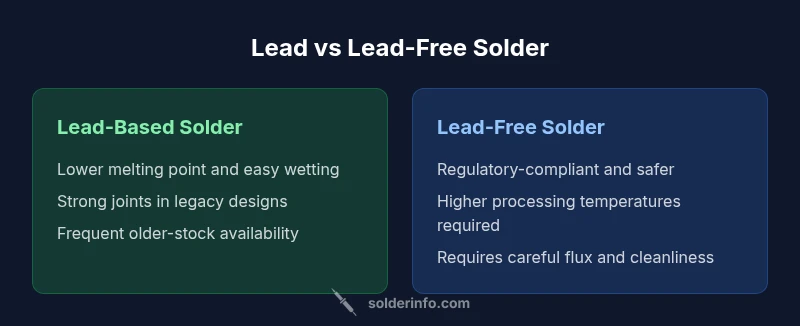
Lead-based solder generally offers easier wetting, lower processing temperatures, and strong joint reliability when used within spec. Lead-free solder reduces health and environmental risks but can require higher temperatures and careful flux choices to achieve reliable joints. This comparison highlights the trade-offs to guide your decisions in electronics, plumbing, and jewelry projects.
Lead vs No Lead Solder: Definitions and History
Lead-based solder refers to tin–lead alloys that have been used for decades due to their forgiving wetting behavior and low melting temperatures. Lead-free solders are tin-based alloys designed to reduce lead exposure and environmental impact. In this section, you’ll see how the historical adoption of leaded solders shaped manufacturing practices and how regulatory changes—especially in electronics and consumer goods—pushed many industries toward lead-free formulations. According to SolderInfo, the shift toward lead-free solders accelerated as RoHS and related regulations limited lead use in electronics and other consumer products, prompting suppliers and users to adapt alloy systems, flux chemistries, and processing windows. Understanding these fundamentals helps set expectations for performance differences in real-world applications.
Health, Safety, and Environmental Considerations
Lead exposure is a risk during handling, soldering, and waste management. Lead-based solders can release lead particulates or fumes if heated or scraped, posing potential health hazards to workers and environments. Lead-free options minimize direct lead exposure, though they bring their own considerations, such as stricter handling of flux residues and more careful disposal practices. For hobbyists and professionals, adhering to local regulations and using proper ventilation, PPE, and waste management practices is essential. The SolderInfo team emphasizes adopting safer practices and pursuing lead-free configurations where regulatory and practical constraints permit, while still respecting legacy workflows where required by equipment or compatibility.
Regulatory Landscape and Industry Trends
Regulatory bodies around the world increasingly restrict lead usage in consumer electronics, medical devices, and jewelry settings. Lead-free solder is often mandated in electronics manufacturing, with exemptions for certain high-reliability applications. The regulatory push has shaped supply chains, flux formulations, and rework strategies, driving a global move toward lead-free options. SolderInfo analysis shows a clear trend toward standardized lead-free alloys and flux systems, aimed at reducing health risks and improving environmental outcomes while maintaining reliability across common soldering tasks.
Alloy Systems: What’s in Each Solder
Leaded solders are typically tin–lead alloys that offer predictable melting behavior and excellent wettability on many metals. Lead-free solders, by contrast, rely on tin-based alloys with other elements such as silver, copper, and sometimes bismuth or antimony to tune melting behavior and mechanical properties. The absence of lead often results in higher melting temperatures and more pronounced sensitivity to flux chemistry and surface contamination. Understanding the fundamental differences in alloy chemistry helps you predict wetting, grain structure, and joint reliability across different substrates (copper, nickel, or plated surfaces).
Processing Windows: Temperature, Flux, and Wetting
Lead-based solders typically require lower peak temperatures and yield reliable joints with a wider wetting window on standard copper surfaces. Lead-free solders demand higher peak temperatures and sometimes longer dwell times or optimized flux chemistries to achieve equivalent wetting and spreading. Variations in solder composition and flux systems can also influence surface cleanliness, oxide break-up, and tin-rich joint formation. For technicians, adopting controlled reflow profiles and properly cleaning flux residues remains critical when working with lead-free systems to avoid weak joints or whisker concerns in some environments.
Joint Reliability and Long-Term Performance
Joint reliability depends on many factors beyond alloy choice, including substrate preparation, cleanliness, thermal cycling, and mechanical stresses. Lead-based joints can be extremely durable under moderate thermal cycling, but they may be vulnerable to creep and fatigue if components are stressed over time. Lead-free joints can perform very well when designed for thermal budgets and with appropriate flux and pad design, yet they sometimes require careful handling to mitigate issues like tin whiskers or brittle intermetallics. The reliability puzzle is ultimately solved by appropriate process control rather than alloy choice alone.
Rework, Repair, and Compatibility
Repairing leaded joints is typically easier due to more forgiving wetting and lower temperatures, which reduces the risk of damaging nearby components. Lead-free joints require higher heat input and careful heat management to avoid overheating adjacent parts or boards. Compatibility with existing components and legacy hardware is another practical concern: older boards or plumbing fixtures may have parts rated for leaded solders, while newer equipment often assumes lead-free flux and alloy systems. Planning for rework and inventory compatibility is essential in mixed environments.
Cost, Availability, and Supply Chain Considerations
In broad terms, leaded solders have historically been cheaper and more abundant, though regulatory changes have altered the supply landscape. Lead-free solders may incur higher material costs or require different flux formulations, but the long-term regulatory and environmental benefits often justify the shift for many production environments. Availability can vary by region and application, so buyers should assess local supplier performance, material compatibility, and lead-free certification requirements when budgeting projects.
Design and Board-Level Implications
From a design perspective, the choice between leaded and lead-free solders influences trace clearance, pad geometry, and thermal management. Lead-free soldering often requires larger land patterns or altered pad shapes to compensate for different wetting and intermetallic growth rates. Designers should incorporate these considerations early, especially for high-reliability electronics or dense boards. Tools such as X-ray inspection can help verify intermetallic formation and solder fillet consistency across assemblies.
Special Cases: Plumbing and Jewelry Contexts
In plumbing, solder joints often rely on different alloy formulations and standard fluxes than electronics, with leaded solders sometimes used in non-potable applications where regulations permit. However, modern plumbing practice increasingly favors lead-free alloys to avoid trace lead in drinking water pathways. In jewelry, material purity, color, and melting behavior guide solder choice; lead-free options are standard for consumer safety, but some traditional workflows may still employ leaded solders for specific settings or aesthetics under controlled conditions. Always verify local codes and material compatibility for your craft.
Decision Framework: When to Choose Lead vs Lead-Free
A practical decision framework starts with regulatory requirements and safety goals, then weighs processing temperatures, board or joint sensitivity, and long-term maintenance plans. For legacy equipment with compatible tolerances and non-regulated contexts, leaded solder can offer predictable behavior. In modern electronics, plumbing, and jewelry projects governed by safety standards, lead-free solder is generally the preferred baseline. Build your plan around regulatory compliance, heat sensitivity of components, repairability, and waste handling to make the most informed choice.
The Future: Trends, Standards, and Best Practices
The solder industry continues to evolve with ongoing improvements in lead-free alloy systems, flux chemistry, and inspection methods. Best practices emphasize clean surfaces, proper flux selection, and thorough post-solder cleaning to maximize reliability across environments. Ongoing standards development aims to harmonize lead-free processing across markets, which reduces complexity for engineers and hobbyists alike. The SolderInfo team anticipates continuing movement toward safer, more reliable lead-free solutions while preserving a pathway for legacy work under controlled conditions.
Comparison
| Feature | Lead-based solder | Lead-free solder |
|---|---|---|
| Alloy basis | Tin–lead alloy with proven wetting | Tin-based alloys (e.g., Sn-Ag-Cu) with no lead |
| Processing temperature | Lower melting temperature and forgiving wetting | Higher temperatures required for reliable joints |
| Joint reliability (typical conditions) | Excellent when used within legacy tolerances | Excellent with proper process control; sensitive to flux and cleanliness |
| Health and safety | Contains lead; handling and disposal require care | Lead-free reduces lead exposure risk; flux residues still require proper handling |
| Regulatory status | Not always restricted by regulation in older contexts | Widely restricted in electronics and many consumer sectors |
| Cost and supply | Historically cheaper and abundant | Often higher material cost; supply and standardization improving |
Advantages
- Lower processing temperatures and easier wetting with leaded solder
- Potentially stronger, more forgiving joints in legacy systems
- Simpler rework due to stable melting behavior
- Broad availability of compatible tools and materials
Cons
- Health risks and environmental hazards from lead exposure
- Regulatory restrictions limit use in electronics and consumer products
- Disposal and recycling complexity due to lead content
- Future supply uncertainty as markets phase out lead solder
Lead-free solder is the practical default for modern projects; leaded solder remains relevant only for controlled, legacy workflows.
Choose lead-free by default to meet safety and regulatory expectations. Reserve leaded solder only for sanctioned legacy equipment or environments where you can control exposure and ensure compliance.
Quick Answers
What is the difference between lead-based and lead-free solder?
Lead-based solder uses tin–lead alloys, offering easy wetting and low processing temperatures. Lead-free solder relies on tin-based alloys with other elements to replace lead, reducing health and environmental risks but often requiring higher temperatures and more careful flux selection.
Lead-based solder wets easily and heats at lower temperatures, while lead-free solders remove lead but may need higher heat and careful flux choices.
Why are governments pushing lead-free solders?
Regulations like RoHS limit lead use in electronics and consumer products to reduce health and environmental hazards. This pushes manufacturers to adopt lead-free alloys, standardized fluxes, and safer disposal practices.
Regulations are phasing out lead to protect health and the environment, speeding the move to lead-free solders.
Can lead-free solder cause tin whiskers?
Tin whiskers can occur with certain lead-free tin-based solders, especially under specific thermal and environmental conditions. Proper alloy selection, surface finish, and storage practices help mitigate the risk.
Yes, tin whiskers can be a concern with some lead-free solders, but good practices lessen the risk.
Is lead-based solder legal for plumbing today?
Lead-based solders are generally restricted in drinking-water systems and many jurisdictions. Lead-free plumbing solders are preferred today, with regulations encouraging safe, lead-free joints.
Lead is restricted in plumbing for drinking water, so lead-free solders are the standard.
What should I consider when choosing solder for repairs?
Consider regulatory requirements, safety, heat sensitivity of components, and the availability of compatible flux. For repairs on modern electronics, lead-free is usually safer and compliant; legacy projects may tolerate leaded solder where permitted.
Look at safety, heat needs, and compatibility with your components when choosing solder for repairs.
Top Takeaways
- Prioritize lead-free solder for new designs to meet safety standards
- Assess heat sensitivity and repair needs before choosing alloy
- Plan for waste handling and regulatory compliance from the start
- Keep a small, controlled inventory of leaded solder only for legacy workflows