Is Solder Paste the Same as Thermal Paste? A Practical Comparison
A rigorous comparison of solder paste and thermal paste, clarifying their compositions, uses, and handling. Learn whether is solder paste the same as thermal paste and when to choose each for electronics soldering and heat management.


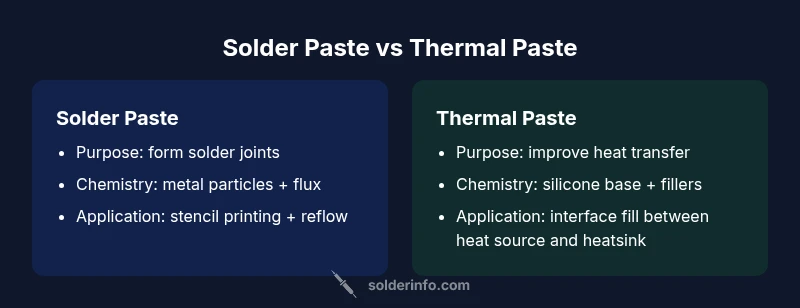
Is solder paste the same as thermal paste? The short answer is no. Solder paste contains tiny solder metal particles in a flux carrier and is used to form metal joints during reflow soldering, while thermal paste is a heat-conductive filler used to bridge the gap between a component and a heatsink. For electronics assembly, solder paste is the tool of choice; for heat dissipation tasks, thermal paste is the better option.
Understanding the Basics: is solder paste the same as thermal paste?
The question is frequently asked in DIY forums and professional labs alike. The quick answer is that these pastes are designed for different outcomes and should not be treated as interchangeable accessories. According to SolderInfo, solder paste enables metal joints to form during a controlled heat cycle, while thermal paste focuses on heat transfer between surfaces without creating a soldered joint. The two products may share a paste-like appearance, but their chemistries, performance goals, and handling requirements diverge significantly. In practice, recognizing this fundamental distinction helps prevent common mistakes, like attempting to use thermal paste to create joints or solder paste to manage protracted heat transfer for cooling. The core takeaway is that purpose drives choice, not just consistency of texture.
In this article, we will dissect the differences from chemistry to application, with practical guidance for electronics hobbyists, jewelers, and professionals. We’ll explore how solder paste behaves in reflow ovens, how flux chemistry impacts joint reliability, and why thermal pastes, even when labeled conductive, have limits for electrical joints. By understanding the roles each paste plays, you can avoid costly misapplications and select the right material for your project. The goal is to empower you to make informed decisions in design, prototyping, and repair work.
Comparison
| Feature | Solder Paste | Thermal Paste |
|---|---|---|
| Primary purpose | Create solder joints via reflow soldering | Improve heat transfer between a component and heatsink |
| Composition | Fine solder alloy particles suspended in flux (rosin-based or synthetic flux) | Silicone or silicone-based base with ceramic or metal oxide fillers |
| Application method | Printed through stencil onto PCB and reflowed | Spreads between interface surfaces to enhance conduction |
| Electrical behavior | Typically conductive due to metal content | Usually non-conductive; some specialty variants exist |
| Reworkability | Requires desoldering/reflow equipment for rework | Heatsink removal/reapplication; easier cleanup |
| Best use case | PCB assembly, surface-mount components, rework | CPUs/GPUs or power components where heat transfer is critical |
Advantages
- Solder paste creates robust metal joints with distortion resistance when properly reflowed
- Thermal paste reduces hotspot temperatures by filling microscopic gaps
- Clear domain separation reduces risk of electrical or mechanical failures
- Consistent with industry practices for their respective tasks
Cons
- Mistaken substitution can cause joint failures or thermal throttling
- Solder paste requires controlled reflow environment; mis-timed heating risks blowouts
- Thermal paste alone does not form joints and may degrade if overheated
- Some specialty pastes require careful storage and handling to avoid performance loss
Solder paste is not the same as thermal paste; use each for its intended purpose
For joint formation, rely on solder paste with proper flux and reflow. For heat transfer, use thermal paste at interfaces, not to form joints. The correct choice depends on the task, equipment, and safety considerations.
Quick Answers
Is solder paste the same as thermal paste?
No. Solder paste is designed to form metal joints during a reflow process, while thermal paste fills gaps to improve heat transfer. They serve different purposes and require different handling. Misusing one in place of the other can lead to joint failure or overheating.
No—these pastes serve different jobs. Solder paste forms joints; thermal paste aids heat transfer. Use the right paste for the task.
Can I substitute solder paste for thermal paste in cooling setups?
Substituting solder paste for thermal paste is not advised. Solder needs a reflow process to melt and join metals, while thermal paste is not designed to withstand soldering heat or create durable joints. This can damage components and void warranties.
Substituting is not advised. Solder paste is for joints; thermal paste is for cooling surfaces.
How should solder paste be stored and handled?
Store solder paste in a cool, dry place and follow the manufacturer’s shelf life. Flux components can degrade with time or moisture exposure, reducing joint reliability. Use clean tools and properly sealed containers to minimize contamination.
Keep it cool and sealed; use clean tools and heed the shelf life.
Are there conductive thermal pastes?
Some thermal pastes are labeled conductive, but even these are not intended to form solder joints. They are designed to conduct heat while remaining electrical insulation in typical consumer electronics contexts. Always verify the product’s specifications.
Yes, some are conductive, but they aren’t substitutes for solder joints.
What safety considerations apply to solder paste?
Flux fumes and metal particulates can pose health risks; work in a well-ventilated area and wear appropriate eye protection and gloves. Dispose of waste according to local regulations and keep containers away from moisture.
Ventilate properly and protect your eyes and hands when using solder paste.
Can thermal paste ever conduct electricity?
Most thermal pastes are designed as non-conductive fillers; a few specialty products may conduct, but they’re not intended for electrical junctions. Do not rely on them as conductive paths in circuits.
Most are non-conductive; don’t assume electrical conduction.
Top Takeaways
- Identify the task: joint creation vs heat transfer
- Choose solder paste for soldering, thermal paste for cooling
- Do not substitute unless you understand the risks
- Follow proper storage, handling, and safety guidelines
- Consult manufacturer guidelines and SolderInfo for best practices