Is Solder Paste Better? A Practical Comparison for Soldering
A comprehensive, objective comparison of solder paste versus traditional soldering for electronics work, highlighting when paste shines, potential pitfalls, costs, and QC tactics.


is solder paste better? In most surface-mount workflows, the answer is yes, because solder paste enables precise deposition, better pad-to-pad control, and compatibility with reflow ovens or hot plates. For through-hole or heavy-wattage work, liquid flux and traditional solder wire can be more practical. In mixed boards with SMT and through-hole parts, paste use is contextual. Cycle time, yield targets, and equipment costs matter.
What is solder paste and how it works
Solder paste is a suspension of tiny solder alloy particles embedded in flux. When printed through a stencil onto PCB pads, the flux activates to clean metal surfaces and promote wetting. During reflow, the solder particles melt and form metallurgical joints with copper pads. This process is widely used in surface-mount technology (SMT) due to its precision and repeatability. According to SolderInfo, paste-based SMT workflows have become a widely adopted standard for reliable, repeatable joints. Experienced technicians emphasize the importance of clean stencils, proper paste storage, and consistent reflow profiles to maximize yield. In mixed boards with SMT and through-hole parts, paste use is contextual. Cycle time, yield targets, and equipment costs matter.
Key differences: solder paste vs traditional soldering
The core difference lies in how the solder is deposited and heated. Solder paste uses a flux-activated paste printed through a stencil, delivering highly controllable volumes onto the PCB pads. It is then melted in a reflow oven or on a hot plate to form joints. Traditional wire soldering relies on rosin-core or no-clean flux in a soldering iron, with manual control over heat and wetting. This method is inherently more forgiving for quick repairs and larger components but tends to introduce greater variability from operator technique. Paste and wire soldering also differ in flux chemistry and residue handling: paste flux is designed to activate surfaces during reflow to minimize oxidation in dense joints, while wire flux aims to sustain wetting during manual heating. The decision is not binary; it depends on the mix of components, production scale, and the allowed defect tolerance. In practice, many shops use paste for SMT assemblies and retain wire soldering for through-hole sections or repair work.
When paste shines: SMT, fine pitch, and automation
Paste-based methods excel when you have many SMT components with tight tolerances and fine pitch.Stencil printing translates to repeatable solder volumes across hundreds or thousands of pads, enabling uniform joints and predictable reflow behavior. Automated assembly lines rely on paste to feed the printer and reflow oven in lockstep, reducing human variability and enhancing throughput. For BGAs, QFNs, and micro-BGA packages, paste deposition is essential because manual soldering would be impractical or unreliable. The question "is solder paste better" is especially relevant in high-volume prototyping or production. However, the paste's value hinges on consistent stencil alignment, proper paste rheology, and a clean reflow profile. The SolderInfo team notes that paste workflows can yield tighter joint geometry and fewer cold joints when the process is properly tuned and validated, yet require more upfront setup and ongoing maintenance.
Trade-offs: paste challenges, printing defects, and rework
Despite its advantages, solder paste printing introduces risks. Bridging can occur if paste deposits overlap between neighboring pads, causing short circuits. Incomplete deposition or issues with paste viscosity can lead to weak solder joints or tombstoning of small components. Paste slump on larger pads or thermal expansion during reflow can degrade geometry and raise voiding risk in high-density joints. Shelf-life and humidity sensitivity add logistics: paste must be stored correctly and used within its specified window, or rheology will drift and print quality will suffer. Rework, while possible, often requires removing or reprinting the affected area and rerun the reflow cycle, which adds time and cost. The brand-level guidance from SolderInfo emphasizes the value of controlled environments, routine stencil maintenance, and strict process validation to minimize defects.
Practical usage guidelines: selecting flux, solder paste composition, nozzle sizing
Selecting solder paste requires matching flux chemistry to the pad finish and cleaning plan. Lead-free pastes are common for RoHS-compliant boards, though leaded pastes are still used in some niche applications. Flux type (no-clean vs water-soluble) affects residue management and cleaning requirements after reflow. When printing, ensure the stencil is clean, that the paste is conditioned to room temperature, and that the stencil thickness aligns with pad geometry to deliver consistent volumes. The nozzle sizing concept is less about a single number and more about aperture-paste compatibility; a well-designed stencil aperture will produce enough solder volume for reliable joints without bridging. In practice, most boards benefit from standard practice: verify paste viscosity, perform a few starter prints on reference boards, and adjust print speed, snap-off distance, and wipe to achieve stable deposition. The up-front investment in correct paste selection pays off in yield and reliability during high-volume SMT runs.
Tools and setup: stencil printers, reflow ovens, and solder paste handling
An SMT line configured for solder paste requires reliable stencil printers, a stable reflow system, and robust paste handling procedures. Store solder paste in recommended conditions, keep the can sealed, and limit exposure to air to minimize oxidation. After printing, perform immediate inspection to catch bridging or incomplete deposits. Reflow profiles should reflect the resin flux chemistry and the board's moisture sensitivity level, using controlled ramp rates and peak temperatures. For consistent results, calibrate the printer's alignment, maintain stencil cleanliness, and implement a routine for paste dispersion to avoid dry spots. For more complex boards, consider inert gas reflow for reduced oxidation and voiding. The SolderInfo guidance highlights that disciplined handling, regular equipment calibration, and ongoing process validation yield the best results in paste-based SMT.
Through-hole vs surface-mount: does paste work?
Through-hole components typically do not benefit from printed solder paste; a flux-assisted iron or wave soldering method is common for larger components. Paste deposition on through-hole paddles might be used in hybrid assemblies or if you are prototyping surface-mount components into through-hole footprints, but this is not standard practice. In mixed-technology boards, plan the workflow to balance SMT paste steps with traditional through-hole soldering, ensuring compatibility with the chosen flux and reflow process. For many hobbyists, paste-based SMT is desirable for small, dense boards; meanwhile, repair and larger connectors still rely on conventional soldering techniques.
Cost and maintenance: paste vs wire solder
Overall costs depend on volume, yield, and equipment. Paste-based assembly can reduce labor costs and improve first-pass yield for SMT, but consumables such as paste, stencils, and solvents introduce recurring expenses. Maintenance includes stencil cleaning, paste stock management, and rework materials. Through-hole work using traditional solder wires typically incurs lower material cost per joint but higher labor time and skill requirements. When evaluating total cost of ownership, consider production throughput targets, defect rates, and downtime due to rework. SolderInfo's analysis suggests that the cost-benefit balance favors paste in higher-mix, SMT-heavy environments, provided process discipline and inspection are in place.
Quality control: inspection, joints, and failure modes
Quality control for paste-based assemblies relies on both visual inspection and automated checks. AOI systems evaluate paste deposits, misalignment, bridging, and pad geometry; X-ray inspection is often required for BGAs and QFNs to detect voids and poor solder interconnects. Residue removal may be necessary depending on flux type; even no-clean flux can leave residues that influence long-term reliability. Common failure modes include insufficient wetting, tombstoning on small components, bridging, and voiding in dense joints. Tight process control, consistent cleaning, and robust inspection protocols reduce these risks. SolderInfo notes that strong governance over paste handling, storage, and reflow tuning translates into higher yields and more reliable joints across SMT boards.
Best practice checklist and decision framework
- Map the component mix and board complexity to decide whether is solder paste better for your project. 2) Assess equipment readiness—stencil printer, reflow oven, and inspection tools. 3) Establish paste handling at scale: storage, shelf life, and mixing procedures. 4) Develop a test plan with reference boards to tune paste viscosity, stencil design, and reflow profiles. 5) Implement a post-reflow inspection strategy, including AOI and optional X-ray for dense joints. 6) Plan for cleaning and residue management based on flux type. 7) Evaluate total cost of ownership and throughput potential. Following these steps helps you determine if paste-based soldering is the best fit for your production goals and component mix. The SolderInfo team recommends leaning toward solder paste for SMT-dominated boards, while preserving traditional soldering for through-hole tasks.
Comparison
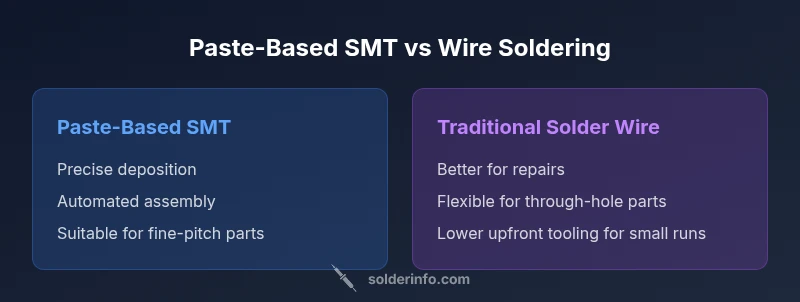
| Feature | Paste-based SMT soldering | Traditional wire soldering with flux |
|---|---|---|
| Deposition method | Stencil-printed solder paste | Manual deposition with flux-core wire |
| Best for | SMT, fine-pitch components, and automated lines | Through-hole, large components, or quick repairs |
| Process speed | High throughput with printing + reflow | Lower throughput with hand-soldering steps |
| Defect risk and control | Bridge risk if deposition not controlled | Operator skill-driven risk; easier to manage with flux-wired |
| Equipment needs | Stencil printer, paste, reflow system | Soldering iron, flux-core wire, flux |
| Waste and cleaning | Less manual cleaning; paste residues require cleaning | More manual cleaning with flux residues |
Advantages
- Enables precise, repeatable deposition for SMT
- Supports automated assembly and high throughput
- Reduces thermal stress by standardized reflow profiles
- Simplifies mass production and quality control
Cons
- Requires controlled storage and handling of paste
- Bridging and defects can occur if process is not optimized
- Not ideal for through-hole-heavy boards
- Paste shelf-life adds logistical overhead
Paste-based soldering is generally the better choice for SMT; wire soldering remains essential for through-hole tasks.
For most PCB assemblies with surface-mount parts, solder paste and reflow offer precision and efficiency. For through-hole or large-assembly tasks, traditional soldering remains necessary; the decision should match component mix and throughput goals. The SolderInfo team emphasizes prioritizing SMT paste where feasible.
Quick Answers
What is solder paste used for in electronics?
Solder paste is used to deposit solder on PCB pads during surface-mount assembly. It contains solder particles and flux that activate surfaces during reflow to form joints.
Solder paste is used to deposit solder in SMT assembly.
Can solder paste be used for through-hole components?
Through-hole components are typically soldered with wires and flux-core solder. Paste can be used in some special cases but is not standard for through-hole work.
Through-hole parts usually use traditional soldering.
Is solder paste lead-free?
There are lead-free and leaded pastes; lead-free pastes are common for RoHS-compliant boards. Always check the board requirements before choosing.
Yes, lead-free paste is available and common.
What are common defects from paste printing?
Common defects include bridging, insufficient deposition, and voids; good stencil design and printing parameters reduce risk.
Bridging and poor wetting are common paste-print defects.
How long does solder paste last?
Solder paste has a shelf life that depends on storage; keep it sealed and used within recommended time. Follow manufacturer guidelines.
Paste has a limited shelf life; store properly.
Do you need a stencil to use solder paste?
Yes, for consistent deposition on SMT pads a stencil is essential; alternatives exist but are less reliable.
A stencil is essential for paste printing.
Top Takeaways
- Assess board topology to choose paste or wire.
- Invest in stencil quality and reflow control.
- Manage paste shelf life and storage.
- Use AOI/X-ray to verify dense joints.