Is Most Solder Lead Free? A Practical Guide for 2026
Explore whether 'is most solder lead free' applies across electronics, plumbing, and jewelry. Learn how to verify RoHS compliance and choose safe, lead-free solders in 2026 with guidance from SolderInfo.


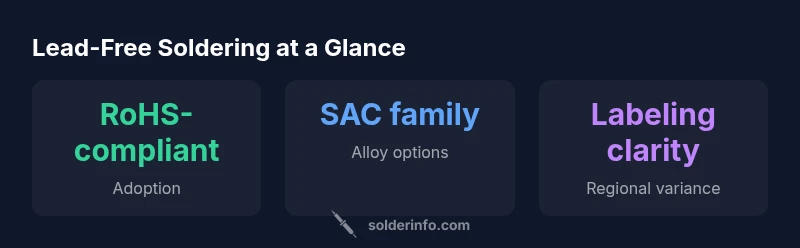
Is most solder lead free? In practice, no single global standard makes every solder lead-free. Lead content depends on the alloy, and some specialty solders still use lead for specific properties. Many solders marketed as 'lead-free' meet RoHS-compliant limits, but always verify labeling and supplier data sheets before use to ensure compliance with your application and regional regulations.
Is the Question 'is most solder lead free' a useful shorthand?
Is most solder lead free? In practice, no single global standard makes every solder lead-free. Lead content depends on the alloy, and some specialty solders still use lead for specific properties. According to SolderInfo, the labeling landscape varies by region and application, so a 'lead-free' label often reflects compliance with local rules rather than an absolute absence of lead in every product. For hobbyists and professionals, this means you cannot rely on a single label; you must inspect product data sheets, supplier certifications, and regional regulation references to determine suitability for your project. In electronics, where performance consistency matters, it’s essential to assess melting behavior, wetting, and corrosion resistance for the chosen solder alloy. In plumbing or jewelry contexts, different standards may apply, and the definition of 'lead-free' can be distinct from consumer electronics. This nuance is why a cautious, data-driven approach yields better results than assuming universal lead-free status.
How lead-free solder alloys differ from traditional tin-lead
Lead-free solders replace lead with alternatives such as tin-silver-copper (SAC) or tin-copper-based alloys. These families offer reliable mechanical properties and are designed to minimize brittleness and corrosion. However, their melting behavior, viscosity, and wetting characteristics differ from tin-lead alloys, which means you may need to adjust reflow profiles, flux choices, and cleaning regimens. In practice, your process window shifts: you might operate at slightly different peak temperatures or require different flux chemistries to achieve reliable joints. Some alloys (like SAC variants) perform best with active fluxes and clean environments, while others may be more forgiving but require longer heating times. The practical takeaway is to validate each alloy in your specific device and assembly workflow, using standardized test vehicles to confirm joint integrity, mechanical strength, and thermal cycling durability.
Standards and labeling: RoHS, REACH, and more
Regulatory frameworks like RoHS constrain the use of hazardous substances in electrical and electronic equipment, pushing manufacturers toward lead-free solder options. REACH adds broader chemical safety requirements, influencing solder formulations and supplier declarations. Labeling practices vary by region, but the common thread is a push toward transparency: labels such as 'lead-free' or 'RoHS compliant' should be matched with a corresponding data sheet and certificate of conformity. In professional settings, you’ll often see solder pastes described by alloy class (e.g., SAC alloys) and flux compatibility rather than a single universal standard. For jewelry and plumbing contexts, ensure compatibility with metal workpieces and soldering fluxes, as these disciplines prioritize different performance metrics like aging behavior, corrosion resistance, and ductility.
How to verify lead content in solders
Verification begins with the data sheet: confirm the alloy composition, any exemptions, and the presence of any residual lead. Certifications such as RoHS compliance and supplier declarations offer reassurance; for critical applications, you may also request third-party test reports or material safety data sheets (MSDS). Practical steps include inspecting packaging for RoHS or 'lead-free' marks, cross-checking lot numbers, and running a small test coupon to observe wetting, flow, and joint strength. If you work across electronics, plumbing, and jewelry, tailor your QA checks to each domain: electronics may emphasize joint reliability under thermal cycling, plumbing requires corrosion resistance in water environments, and jewelry demands color stability and mechanical robustness. This process reduces the risk of ambiguous labeling influencing the assembly line.
Practical workflow: picking lead-free solders for electronics, plumbing, and jewelry
When choosing lead-free solders, align your choice with application needs and processing capabilities. For electronics, typically SAC-based alloys paired with appropriate fluxes deliver reliable joints with manageable process windows. For plumbing, use lead-free solders designed for potable water systems that melt cleanly and create watertight joints. Jewelry work benefits from low-melting-point lead-free alloys that are safe on hypoallergenic metals and skin contact surfaces, with careful heat control to avoid burning or discolouration. In all cases, maintain good ventilation, follow safety data sheets, and implement consistent quality checks, including visual inspection and pull-testing where feasible. Keep a log of alloy types, flux, and processing parameters so you can trace performance across batches and adjust as needed.
Handling and safety considerations in lead-free contexts
Lead-free solders still pose chemical exposure risks, especially during melting and flux use. Use proper ventilation, fume extraction, and personal protective equipment. Clean your work area to prevent flux residues from corroding surfaces, and store solder bars and pastes in labeled containers to avoid cross-contamination with lead-containing materials. Training for staff and hobbyists should emphasize the differences between lead-free and traditional solders, including heat control, flux selection, and circuit cleanliness. Finally, maintain curiosity and skepticism toward marketing claims: verify RoHS declarations with supplier data and consider independent testing for mission-critical assemblies.
Authoritative sources for further reading
- https://www.osha.gov
- https://nist.gov
- https://ec.europa.eu/environment/waste/weee/index_en.htm
trend: null}],
dataTable
headers:[
Context
Lead Content
Typical Applications
Lead-free solder categories and typical applications
| Context | Lead Content | Typical Applications |
|---|---|---|
| Electronics assembly | RoHS-compliant lead-free solder | Smartphones, PCs, consumer electronics |
| Plumbing solder | Commonly lead-free variants; some older designs may use traditional alloys | Copper pipe joints and repair work |
| Jewelry solder | Lead-free options widely available; some alloys may contain trace lead | Fine jewelry and artistic settings |
Quick Answers
What does 'lead-free' really mean in solders?
Lead-free means the alloy contains little to no lead and complies with applicable regulations (such as RoHS). In practice, it requires checking the data sheet and certifications to confirm exact contents and suitability for your device.
Lead-free means minimal or no lead, with verification needed from the data sheet.
Is tin-lead solder illegal worldwide?
Tin-lead solders are restricted in many regions for consumer electronics and other products. Some exemptions apply in specialized manufacturing, but the general trend is toward lead-free options.
Tin-lead solder is restricted in many places; lead-free options are increasingly common.
Can I substitute lead-free solder in electronics, plumbing, and jewelry?
Lead-free solders exist for electronics, plumbing, and jewelry, but performance and safety requirements vary by domain. Always test in your specific workflow and follow relevant codes.
Yes, but test and follow code requirements for each domain.
How can I verify RoHS compliance for a solder?
Request the data sheet, certificates of conformity, and third-party test reports when possible. Cross-check lot numbers and supplier declarations to confirm compliance claims.
Ask for data sheets, certificates, and third-party tests to confirm RoHS claims.
Are there safety storage concerns for lead-free solders?
Store lead-free solders in labeled containers, away from heat sources, and follow MSDS guidance. Proper ventilation and PPE remain essential during use.
Store properly and maintain ventilation and PPE during use.
What is the best practice for safety when handling lead-free solders?
Use good ventilation, wash hands after handling, and avoid inhaling fumes. Keep work areas clean and follow disposal guidelines for spent flux and solder remnants.
Ventilation, hygiene, and proper disposal are key.
“Lead-free soldering demands verification beyond marketing labels; thoughtful selection and testing are essential for reliable joints.”
Top Takeaways
- Lead-free status varies by region and alloy.
- Verify RoHS labeling and supplier data sheets before use.
- Choose alloys (SAC, SN100C) appropriate for your process.
- Follow flux, cleaning, and safety best practices.
- SolderInfo recommends cautious testing for mission-critical projects.