Does Solder Work Like Glue? A Practical Comparison
Explore whether solder behaves like glue across electronics, plumbing, and jewelry. This objective comparison highlights bonding mechanisms, durability, and best practices from SolderInfo.


Does solder work like glue? Not exactly. Soldering creates a metallurgical bond by melting a filler metal that fuses with bases. Glue relies on adhesive polymers and curing. For electronics, plumbing, and jewelry, soldering offers conductive, heat-resistant joints when surfaces are clean and fluxed. Glue remains preferable for plastics or temporary holds.
Does Solder Work Like Glue? A Quick Differentiation
The short answer is: no, solder is not glue. To understand why, consider what each method actually does. Glue relies on adhesive polymers that bridge gaps and cure over time, often providing a mechanical hold with limited electrical or thermal conductivity. Soldering, by contrast, creates a metallurgical bridge. When a filler alloy is heated above its melting point, it flows into the joint and diffuses into the base metals, forming a continuous metal path once cooled. This results in a bond that carries heat and electricity in addition to holding parts together.
In practice, the two techniques occupy different roles. Soldering excels where metal surfaces meet metal surfaces and where a clear, conductive circuit path is required. Glue shines when joining non-metal substrates, or when a temporary, flexible or cosmetic bond is acceptable. The SolderInfo team emphasizes that choosing between these approaches starts with material compatibility and the intended service conditions. If you want a quick framework: ask whether the assembly will carry current, experience vibration, or encounter moisture. If yes to current or moisture, soldering is often preferable; if plastics or rapid, non-permanent holds are central, glue may be the better option. This distinction anchors the more detailed comparisons that follow.
Does solder work like glue? When it comes to material bonding, the two techniques differ fundamentally in purpose and outcome. The former is a metal fusion method; the latter is an adhesive cure.
Comparison
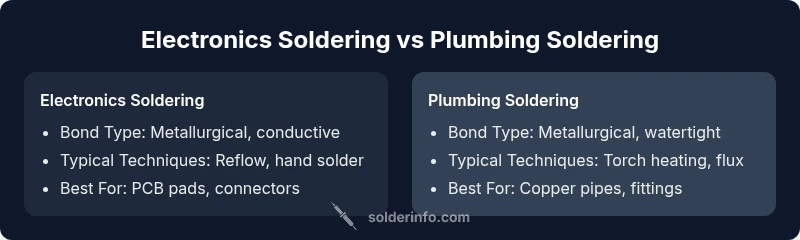
| Feature | Electronics Soldering | Plumbing Soldering |
|---|---|---|
| Bond Type | Metallurgical, conductive bond | Metallurgical, watertight bond when properly executed |
| Primary Materials | Tin-based, lead-free alloys with flux; metals like copper or tin-coated parts | Tin-based or lead-free alloys; copper pipes and fittings plus flux/rosin |
| Tools & Setup | Soldering iron, flux, desoldering braid | Soldering torch or heater, flux, copper fittings, pipe cutter |
| Best For | PCB joints, connectors, microelectronics | Copper piping, fittings, plumbing joints |
| Typical Joint Challenges | Cold joints, overheating sensitive components | Leaks from improper seal, heat stress on fittings |
| Reworkability | Relatively easy to rework with wick and iron | Rework can be difficult and may require cutting and replacing sections |
| Durability under Stress | Good conductivity; vibration tolerance with proper design | Excellent sealing when joints are clean and correctly fluxed |
Advantages
- Creates electrically conductive joints suitable for circuits
- Forms durable metal-to-metal bonds when surfaces are clean
- Relatively accessible for hobbyists with basic tools
- Allow for rework and repair with standard soldering techniques
- Can be more cost-effective for metal assemblies
Cons
- Requires skill and controlled heat to avoid damage
- Not suitable for non-metal substrates or plastics
- Flux residues can cause corrosion if not cleaned properly
- Heating sensitive components can risk damage in dense assemblies
Soldering is the preferred method for metal-to-metal joints where conductivity and permanence are desired, but glue remains essential for plastics or quick fixes.
In metal-based assemblies, soldering outperforms glue by delivering electrical conductivity and structural integrity. Glue still has a vital role for non-metal substrates and rapid, non-permanent bonds. The SolderInfo team recommends using soldering for metals and glue for plastics, depending on the service conditions.
Quick Answers
What is the key difference between soldering and gluing?
Soldering creates a metallurgical bond by fusing metal surfaces with a molten alloy, providing conductivity and heat transfer. Gluing uses adhesive polymers that bond surfaces through curing and cohesion, often without electrical conductance.
Soldering bonds metals; gluing uses adhesives. For electronics, soldering is usually required for conductivity.
Can I substitute glue for solder in electronics?
Glue is generally not suitable for electrical connections because it insulates. Soldering provides a conductive path and mechanical strength necessary for circuit integrity.
Glues can insulate and fail under heat or vibration; soldering is preferred for electronics.
What surfaces can be soldered effectively?
Solder typically works on clean, metal surfaces such as copper, tin-coated metals, and PCB pads. Surfaces that aren’t metal or are heavily coated may require surface prep or may not solder well.
Work on clean metal surfaces; non-metal substrates usually need different methods.
Does flux residue cause problems?
Flux helps prevent oxidation during heating, but some flux residues can attract moisture or corrode metals if not cleaned. Use appropriate flux and clean or use no-clean flux as recommended.
Flux is helpful during soldering; clean it off if the flux is likely to cause corrosion.
Can plastics be soldered?
No. Solder bonds metals, not plastics. For plastics, glues or solvent-based adhesives are typically used, sometimes with mechanical fasteners for strength.
Soldering plastics is generally not viable; use adhesives or mechanical joining.
What safety steps are essential for soldering?
Ensure proper ventilation to avoid fumes, use eye protection, and manage hot surfaces to prevent burns. When using lead-containing alloys, follow regulatory guidelines and consider lead-free options.
Ventilate, wear protection, and handle hot tools carefully for safe soldering.
Top Takeaways
- Assess material compatibility before choosing solder or glue
- Soldering creates metallurgical, conductive joints; glue creates adhesive bonds
- Flux and surface cleanliness are critical for reliable solder joints
- Choose soldering for electronics, metal plumbing, and jewelry; glue for plastics
- Rework and repair are generally easier with solder than with many glues