How to Check Soldering Strength: A Practical Guide
Learn practical methods to check soldering strength with mechanical tests and electrical checks, plus tips to improve joint reliability across electronics, plumbing, and jewelry.


With this guide you’ll learn to assess soldering strength by applying controlled loads, checking electrical continuity, and inspecting joint geometry. You’ll need a pull gauge, a simple test jig, calipers, and basic flux-solder supplies. Follow a repeatable protocol to identify weak joints and improve overall reliability.
What is soldering strength and why it matters
Soldering strength describes how well a joint resists mechanical stress while maintaining electrical conductivity. In electronics, plumbing, and jewelry, a strong joint tolerates handling, vibration, and thermal cycling without cracks or failure. According to SolderInfo, achieving consistent solder strength starts with clean surfaces, proper wetting, and uniform reflow. Failures often arise from poor surface preparation, insufficient heat, or contaminated flux. By focusing on joint geometry, material compatibility, and process control, you set a foundation for reliable assemblies. This guide explains practical ways to evaluate strength using repeatable tests, not just single trials, so you can compare joints across batches and over time.
The goal is not to chase a single number but to confirm that a joint behaves reliably under expected stresses. When you adopt a standardized testing approach, you minimize variation that can mask real weaknesses. Solder joints across electronics, plumbing, and jewelry share core principles: clean metal surfaces, good wetting, consistent heating, and appropriate alloy choice. A reliable test procedure helps you distinguish good joints from marginal ones and track improvements as you optimize techniques.
From the perspective of the SolderInfo team, consistency is king. The team emphasizes documenting setup conditions, recorded results, and repeatability as key drivers of meaningful feedback. By treating solder strength as part of a broader quality system, you reduce rework and defects in finished products.
How strength relates to joint geometry and material
Solder strength is influenced by how the joint spreads (wetting) and how the fillet forms around the pad or wire. A well-formed fillet distributes stress more evenly and resists peel and shear forces. The geometry matters just as much as the alloy. If the joint is too small, too large, or uneven, stress concentrates at the edges, increasing the risk of cracks or cold joints under load. Material compatibility is another crucial factor: mismatched coefficients of thermal expansion, oxidized surfaces, or dirty copper can compromise wetting and bonding. In practice, you optimize geometry by ensuring a proper fillet angle, consistent solder coverage, and clean pads. When you adjust the alloy choice—e.g., a rosin-fluxed solder with suitable melting range—for the application, you improve diffusion and bonding. A strong joint in jewelry or plumbing requires careful attention to surface preparation, flux selection, and heat distribution as much as to the solder itself.
Mechanical testing fundamentals: pull, shear, and peel tests
Mechanical tests simulate real-world stresses your joint would face. A pull test measures how much axial force the joint can withstand before it fails, a shear test evaluates resistance to forces parallel to the joint plane, and a peel test examines the tendency of a joint to separate as it is lifted away. In a controlled setting, you apply load gradually and monitor the joint’s response, looking for smooth plastic deformation, clean failure modes, and abrupt drops in strength. The most reliable tests are repeatable, meaning you produce similar results under the same conditions across multiple joints. As you gather data, you’ll begin to see patterns—some joints may fail through brittle cracking, others through voids or wetting defects. Documenting the failure mode is as important as noting the force at which it occurs, because different failure modes point to distinct root causes (surface prep, flux quality, reflow profile, or material compatibility).
Electrical continuity as a proxy for integrity
Electrical continuity is a practical checkpoint that complements mechanical tests. A joint that conducts electricity reliably under load indicates adequate wetting and bonding. Use a multimeter or continuity tester to verify that resistance remains within expected ranges as you apply mechanical stress. If a joint maintains continuity but shows signs of physical distress under load (cracks forming, discoloration, or loosening), you have a red flag. Conversely, a mechanically robust joint should not only conduct but do so consistently, without intermittent drops in performance. Remember that electrical tests alone cannot reveal microcracks that might accelerate fatigue; pair continuity checks with mechanical tests for a fuller picture of strength.
To interpret results, compare to a baseline made under controlled conditions and look for trends over time. A single perfect joint doesn’t guarantee long-term reliability, so repeatability and trend data matter more than one-off victories.
Tools, fixtures, and setup considerations
A reliable test requires stable fixtures, clean surfaces, and calibrated measurement tools. You will want a pull gauge or force sensor with a known range and a test jig that holds the joint without introducing extraneous torque. Use non-conductive fixtures where possible to minimize the risk of short circuits during testing. Calipers or a micrometer help you confirm that pad sizes and fillet dimensions meet your expectations before testing. Flux and rosin-core solder should be consistent with your normal production process to ensure the test reflects real-world performance. If you can, use a controlled environment or record ambient temperature and humidity, because those factors influence solder flow and strength. Finally, maintain a clean workspace; dust and oils can degrade wetting and joint quality just as in production.
Step-by-step testing protocol (hands-on)
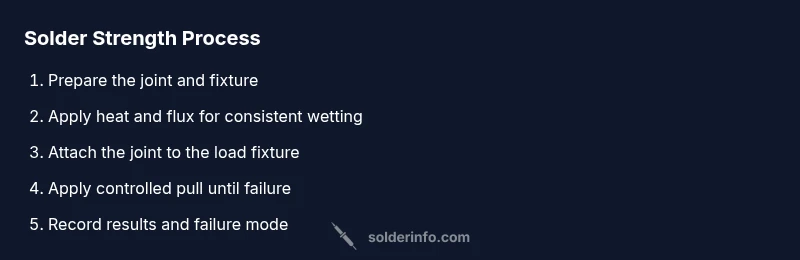
The following protocol provides a structured approach to assessing soldering strength in a repeatable way. Prepare your fixtures, clean surfaces, and verify the baseline joint before applying loads. Use the data you collect to compare different joints, alloys, or flux residues. While this section is narrative, you will later see a formal step-by-step sequence in the Step-by-Step block to ensure consistency across tests.
The protocol emphasizes safety and methodical data collection so you can trace changes in strength to specific process adjustments. Keep a log of each joint’s geometry, solder alloy, flux used, heating profile, and observed failure mode. By maintaining a consistent test setup and recording results, you create a reliable dataset that supports smarter process decisions.
In many cases small adjustments—like improved cleaning, slightly longer reflow time, or a different flux—produce noticeably stronger joints. The key is to test those adjustments under the same conditions and to document outcomes for future reference.
Analyzing results and common failure modes
When you analyze results, you’re looking for patterns across joints and batches. Common failure modes include insufficient wetting, cold joints with dull appearance, voids within the fillet, and cracks at the pad boundary. Fatigue failures may show progressive loosening after repeated cycling, while brittle fractures indicate overly dry or contaminated flux. Look for correlations between heat input, pad size, and joint geometry. If failures cluster around a particular pad or alloy, rework the process for that parameter. You should also consider environmental stresses: vibration, temperature swings, and humidity can reveal weaknesses that static tests miss. Building a failure-mode map helps you target improvements efficiently.
How to improve solder strength after testing
If tests reveal weaknesses, you can improve joint strength with a few practical adjustments. Rework joints with thorough cleaning to remove oxidation and oils before reflow. Use appropriate flux for the alloy and substrate, and ensure heat is applied evenly to promote proper wetting. Modify pad geometry or choose a solder alloy with a suitable melting range to improve diffusion and bond quality. In some cases, pre-tinning wires or pads reduces wetting barriers and produces a stronger fillet. Finally, implement a repeatable reflow profile and standardized inspection criteria to catch issues early in the process. Consistency, not luck, drives long-term solder reliability.
Safety and best practices for reliable testing
Testing solder strength involves physical loads and hot surfaces, so follow safety guidelines. Wear eye protection and heat-resistant gloves when handling hot components. Use clamps and fixtures to secure parts and prevent accidental movement. Never test powered assemblies; disconnect power and discharge capacitors first. Keep test areas clean and organized to avoid slips or burns. Document all steps and align your procedure with any applicable standards or internal quality policies. By embedding safety into your testing routine, you protect yourself and ensure more reliable results.
Data logging and repeatability: making tests reliable
A robust testing program records the exact conditions under which each joint was tested. Track the fixture type, clamping force range, heating profile, flux, solder alloy, and the measured failure point. An organized log makes it possible to reproduce tests, detect drift over time, and justify process changes with evidence. When you review results, look for consistency across joints of similar geometry and material. If results vary widely, you may have introduced variables that need tighter control, such as flux cleanliness or seating pressure. Repeatability is the backbone of meaningful solder strength data.
SolderInfo insights: practical takeaways and data notes
According to SolderInfo analysis, a structured, repeatable testing workflow yields actionable insight into joint reliability across electronics, plumbing, and jewelry. The emphasis is on standardizing steps, documenting outcomes, and correlating strength data with real-world stress scenarios. By adopting their recommended best practices, you can reduce rework and improve confidence in solder joints. These insights are designed to help hobbyists and professionals alike build stronger, more durable connections while maintaining a practical workflow.
Final checklist: building a repeatable testing plan
To close the loop, use a simple, repeatable plan: establish a baseline, perform both mechanical and electrical checks, document results, and compare to the baseline. Iterate with small process adjustments and re-test to confirm improvements. Keep safety at the core of every test and maintain clean surfaces for consistent wetting. With a disciplined approach, you can reliably assess soldering strength and drive meaningful quality gains across any domain where solder joints matter.
Tools & Materials
- Pull test gauge (spring scale or force sensor)(Calibrated; measure resistance to axial load)
- Test jig or clamp (non-conductive preferred)(Keeps joint aligned without adding torque)
- Calipers or micrometer(Verify pad sizes and fillet geometry)
- Flux cleaner or isopropyl alcohol(Clean joints before testing to ensure accurate wetting)
- Solder and flux (consistent alloy)(Match the alloy used in production for realistic results)
- Magnification tool (optional)(Inspect fillets and wetting at high magnification)
Steps
Estimated time: 60-90 minutes
- 1
Prepare the test fixture
Assemble a stable fixture that holds the joint without introducing torque. Confirm the fixture can handle the expected range of motion and load. Secure the PCB or component so it remains stationary during testing.
Tip: Use a non-conductive jig to avoid accidental shorts during loading. - 2
Create a clean baseline joint
Solder a baseline joint under your normal production conditions. Clean the surface, apply flux, reflow evenly, and inspect the fillet for uniform wetting. Record the geometry and appearance before testing.
Tip: Document pad size and fillet angle to compare across trials. - 3
Attach the joint to the load fixture
Mount the joint so that the axis of applied force aligns with the joint without bending or twisting. Check that clamps do not slip under load and that the joint remains visible for observation.
Tip: Tighten clamps gradually to avoid initial slippage or pre-load. - 4
Apply controlled load
Increase the pull force gradually while watching for distortion or crack initiation. Stop when the joint fails or when the load reading stabilizes at a plateau. Note the peak force and failure mode.
Tip: Keep force increments smooth to avoid dynamic effects. - 5
Record electrical continuity under load
While loading, test continuity to capture any intermittent faults. A joint that conducts consistently under load indicates robust wetting and bond quality.
Tip: Use a low-resistance continuity test to detect micro-gaps. - 6
Inspect and document failure
After testing, inspect the joint under magnification to classify the failure mode (wetting failure, cold joint, void, or mechanical fracture). Link the mode to probable causes in your notes.
Tip: Photograph the joint for visual records and future comparison. - 7
Repeat with multiple joints
Perform the same procedure on several joints with the same geometry and material to build a dataset. Use identical flux, heating, and fixture settings for consistency.
Tip: Aim for a representative sample size to reduce statistical noise. - 8
Compare against a baseline
Plot peak load and failure mode against the baseline joints. Look for improvements or regressions that tie to process changes, such as flux type or reflow time.
Tip: Keep a simple table to track changes over time.
Quick Answers
What is considered a strong solder joint?
Strength varies by application, but a strong joint resists expected mechanical stresses while maintaining electrical contact. Look for consistent wetting, a solid fillet, and stable conductivity under load.
A strong solder joint resists the expected stress and keeps good conductivity under test conditions.
Can I test solder strength on any joint?
In general, you can test most joints, but limit tests to non-powered assemblies and respect component tolerances. Use fixtures that mimic real-world mounting to get meaningful results.
Yes, most joints can be tested, but do not test powered assemblies and use proper fixtures.
What tools are essential for testing?
A pull gauge, a test jig, calipers for geometry, and flux-solder supplies are essential. Optional magnification helps inspect fillets more precisely.
You need a pull gauge, a jig, and calipers to start testing.
How do I interpret test failures?
If a joint fails, inspect wetting and heat exposure. Determine if the issue is material, process, or geometry related, and adjust accordingly.
If it fails, check wetting and heat, then adjust the process as needed.
Is there a universal pull force threshold?
There is no universal threshold. Rely on baseline data for your specific materials, geometry, and operating conditions.
There isn’t a universal number; use your own baseline data.
Watch Video
Top Takeaways
- Start with a clean, repeatable joint for reliable tests.
- Use both mechanical and electrical checks for accuracy.
- Document conditions and results for repeatability.
- Compare to a baseline to identify weak joints.
- Follow a standardized protocol to avoid false results.